
As we approach the end of the winter season, what are the chances of finding two identical snowflakes? According to physicist Jon Nelson (via Popular Mechanics), the chances are “essentially zero.” Or, to be more mathematically precise, the chances are one divided by 1,000,000,000,000,000,000,000,000,000,000,000,000,000,000,000,000,000,000,000,000,000, 000,000,000,000,000,000,000,000,000,000,000,000,000,000,000,000,000,000,000,000,000,000, 000,000,000,000,000,000,000,000,000,000,000,000,000,000,000,000,000,000,000,000,000, 000,000,000,000,000,000,000,000,000,000,000,000,000,000,000,000,000,000,000,000,000, 000,000,000,000,000,000,000,000,000,000,000,000,000,000,000,000,000,000,000,000,000, 000,000,000,000,000,000,000,000,000,000,000,000,000,000,000,000,000,000,000,000,000, 000,000,000,000,000,000,000,000,000,000,000,000,000,000,000,000,000,000,000,000,000, 000,000,000,000,000,000,000,000,000,000,000,000,000,000,000,000,000,000,000,000,000, 000,000,000,000,000,000,000,000,000,000,000,000,000,000,000,000,000,000,000,000,000, 000,000,000,000,000,000,000,000,000,000,000,000,000,000,000,000,000,000,000,000,000, 000,000,000,000,000,000,000,000,000,000,000,000,000,000,000,000,000,000,000,000,000, 000,000,000,000,000,000,000,000,000,000,000,000,000,000,000,000,000,000,000,000,000, 000,000,000. (The enormous denominator in this fraction is the number of possible snowflake shapes there are: one followed by 768 zeros.) By the way, the image below, via Rian Dundon, is a reproduction of one of the first photographs of a snowflake:
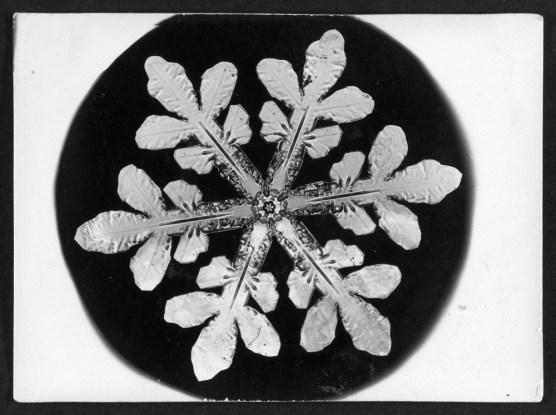
Credit: Wilson Bentley







 prior probability
Ah, but there’s more. You expressed the problem as “finding” two identical snowflakes. If the odds that there *exists* two identical snowflakes is something like 1 in 10^768, wouldn’t the *finding* of this fact take something like 10^768 factorial?
10^768 factorial, by the way, would be something like 10^(10^1885).
That is a great point. It’s like finding that one special book in Borges’s Library of Babel!
Good analogy!