
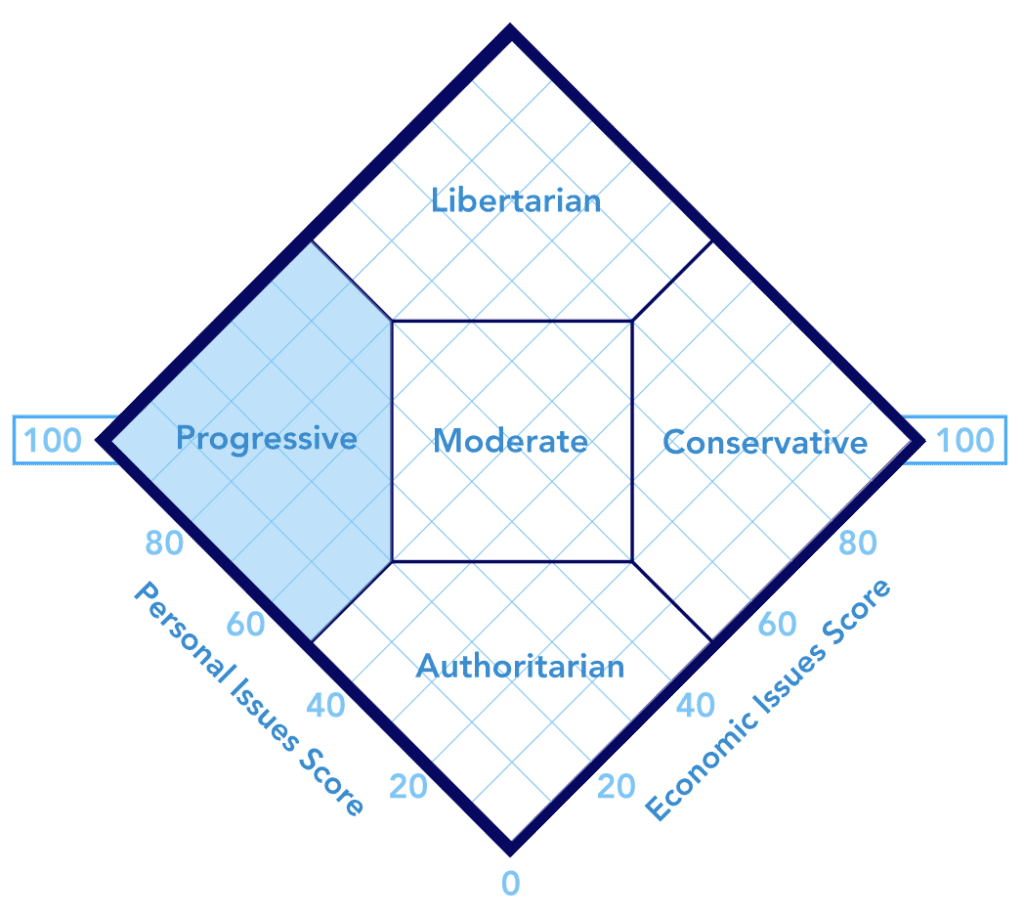
I revised my draft of “Die Adam Smith Probleme” during my train ride from Edinburgh to London, and I have just posted my revised work on SSRN (see here). Among other things, I added two new and related open problems to my growing list of unsolved Adam Smith mysteries. One has to do with Smith’s politics: is Smith really a hardcore libertarian or is he a closet progressive? (Into which quadrant in the diagram below, for example, does Smith best fit?) The other refers to Smith’s concern for the plight of the poor and his views on economic inequality: would Smith be in favor of or opposed to income redistribution?







 prior probability
Enrique, I will read your paper once I get the chance. Things have been hectic at work.
But I would suggest premilarily (prior to reading your paper) that Smith was probably a fine Classical Liberal, but would fail the Rothbardian test of being a “pure” Libertarian. Certainly a minarchist at most.
Per Today’s Relevance of Adam Smith’s Wealth of Nations by Don Boudreaux; Published in the Independent Review (2020):
“….Pointing to Smith’s endorsement of some government support for
elementary schooling, of government provision of public goods such as roads and
national defense, and of the exceptions to free trade discussed earlier, some scholars
argue that he was no devotee of laissez-faire.
I disagree with these scholars. Although Smith certainly was no anarchocapitalist,
the role that he identified for the state is tiny and in all cases qualified. His presumption
throughout is that free individuals are best governed not by legislative or bureaucratic
dictates but instead by the common law of property, contract, and tort—as well as by
market competition. If individuals are governed as such, each person’s pursuit of his or
her individual interests will weave all these individuals together into what F. A. Hayek
(1973) would later call a “Great Society,” in which each person serves the interests of
countless other people…”
Smith certainly believed in some government intervention, making him less than a perfect Libertarian. But his vision for public policy is certainly a vast improvement over merchantilsim.
no need to apologize as I have been “across the pond” and thus diverted with multiple distractions as well!!!
Well, I just accepted a writing fellowship; I will probably end up being much more distracted than I was before.
Excellent news: The fellowship will require you to allocate your most precious resource — time — wisely!! Plus, if it means watching less TV, that is an added bonus! (I watched zero TV while I was in Scotland last month and am so happy I did … or should I say didn’t?)
Thanks for the encouragement, I really hope I don’t blow this opportunity.
Just submitted my first op-Ed pitch to the editors. Fingers-crossed, I’ll be able to proceed to submitting the draft.
bon chance!!!!
Thank you sir!
Rock on!!!
The editors are working on placing my first submission. Final Draft sent today. Hopefully, it will get placed soon!
you got this!!
I really hope so!! I appreciate it!
Reblogged this on prior probability and commented:
Update: In anticipation of the upcoming annual meeting of the International Adam Smith Society later this month, I have made further revisions to my work-in-progress “Die Adam Smith Probleme”.
I disagree with “Libertarian” defined on your graph as “100%” on both an “economic” and “personal issues” score. There’s a third human dimension in which Libertarianism scores near zero, but that orthogonal dimension is not shown on your graph.