
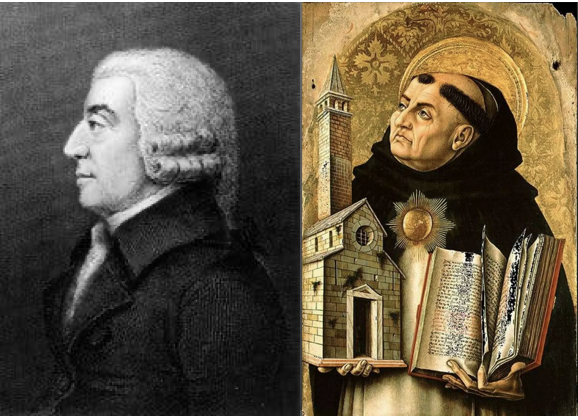
This past week, I have been attending a symposium at the Thomistic Institute in Washington, D.C. The institute is named in honor of St Thomas Aquinas, the great 13th-century philosopher, theologian, and Doctor of the Church, so I could not help but ask myself, What did Adam Smith the moral philosopher learn from Aquinas? My tentative answer is to say not much, since Smith does not even mention Aquinas once in The Theory of Moral Sentiments. Alas, the closest Smith comes to referring to the scholastic tradition of the great Christian thinkers of the medieval period is in Book 7 of The Theory of Moral Sentiments, when Smith derisively describes the ancient Greek Stoic philosopher Chrysippus as the thinker who reduced the doctrines of the Stoics “into a scholastic or technical system of artificial definitions, divisions, and subdivisions; one of the most effectual expedients, perhaps, for extinguishing whatever degree of good sense there may be in any moral or metaphysical doctrine.”
In other words, it looks like Smith has a low opinion of scholasticism as a methodology of reasoning. But at the same time, that can’t be the whole story, for both Aquinas and Smith wrote in the virtue ethics tradition of Aristotle. Smith, for example, extols the virtues of prudence, benevolence, and self-command in Book 6 of his treatise on moral sentiments, while Aquinas identifies four cardinal virtues in his magnum opus, the Summa theologiae: prudence, justice, temperance, and courage. (See Question 61, Article 2 of the Summa, available here via the Thomistic Institute!) So, I suspect we should be able to trace an indirect intellectual path between Aquinas and Adam Smith, something which I shall try to do in the future.










 prior probability