
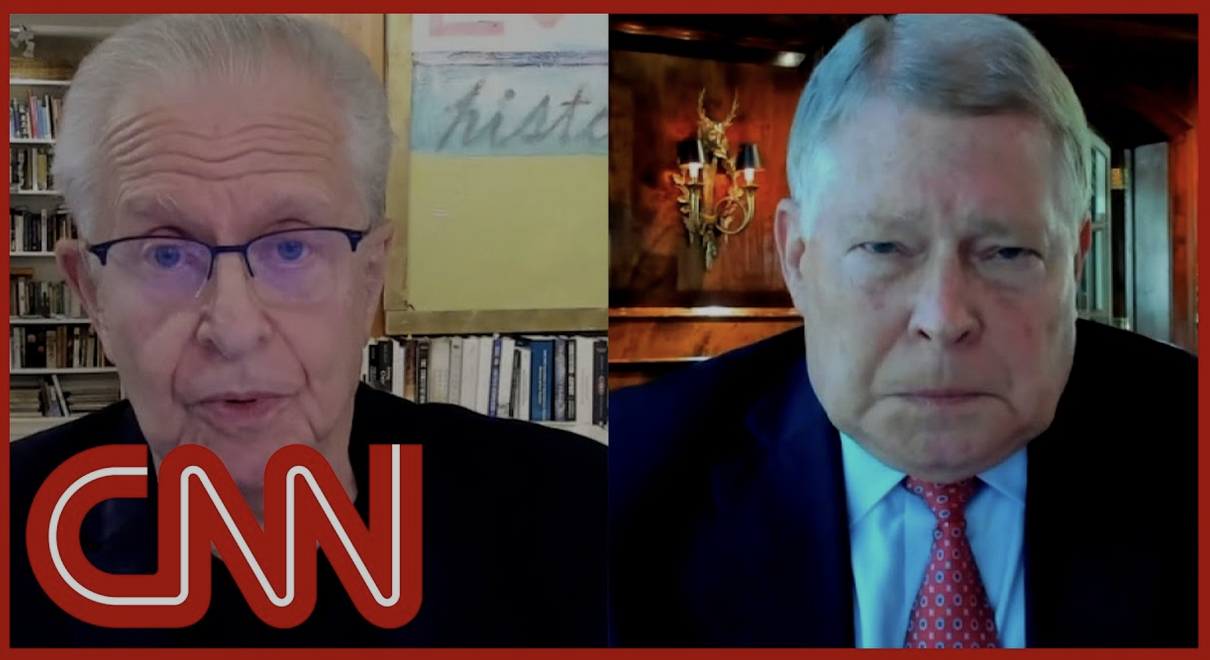
As I mentioned in my previous post, Judge Michael Luttig and Professor Larry Tribe (who are pictured below) recently published a polemical essay in The Atlantic concluding that the Constitution prohibits Donald J. Trump from being re-elected president. (By way of background, Section 3 of the 14th Amendment states in no uncertain terms that any person who has “engaged in insurrection or rebellion against the [United States]” or who has “given aid or comfort to the enemies thereof” is disqualified from federal office.) Here, as a public service, I will present a simple and straightforward critique of Judge Luttig and Professor Tribe’s attempted hit job against former president Trump.
In summary, there are two fatal flaws with Luttig and Tribe’s feeble screed. The first one is their bald-face and unsubstantiated claim that the disqualification clause in Section 3 of the 14th Amendment is somehow self-executing, or in the breathtaking words of Mssrs Luttig and Tribe themselves: “the disqualification clause operates independently of any … criminal proceedings and, indeed, also independently of impeachment proceedings and of congressional legislation.” But this conclusion is flat-out wrong. Before Trump or anyone else can be disqualified from any federal office, they must first be found guilty of being “engaged in insurrection or rebellion” against the U.S. (or of giving “aid or comfort” to her enemies) by a regular court of law or by a duly-elected legislature. Like it or not, ladies and gentlemen, we must give Trump due process before we can disqualify him from office.
More importantly, my point above about the non-self-executing nature of the Constitution leads me to the other inescapable problem with Luttig and Tribe’s polemic. Simply put, they beg the $64 question, Who decides what actions (or in the case of Trump, inaction) constitute an “insurrection or rebellion” against the U.S. or the giving of “aid or comfort” to her enemies? (And by the same token, I might add, who decides who the enemies of the U.S. are?) Moreover, just posing the “Who Decides?” question, in turn, tells us precisely why the disqualification clause cannot be self-executing: in the case of Trump, for example, someone has to first determine whether his tweets on January 6th or his phone call to Georgia election officials a few days earlier, etc., rose to the level of an “insurrection or rebellion”–and that “someone” cannot simply consist of hyper-progressive media pundits or biased outlets like The Atlantic, CNN, or The Times. File under (again): Due Process, the most basic constitutional right of all.
So, who decides? For their part, instead of citing a legal precedent or a prior act of Congress, Luttig and Tribe (one a former federal judge; the other a retired Harvard professor) can only muster between them a single source in support of their overly-broad and utterly unprecedented interpretation of the Constitution’s disqualification clause. They cite … wait for it … an obscure non-peer-reviewed article that is over 100 pages long. (No, you cannot make this stuff up!) For the record, the massive law review article cited by Luttig and Tribe was written by my constitutional law colleagues William Baude and Michael Stokes Paulsen and is titled “The Sweep and Force of Section Three.” Alas, in law, especially constitutional law, the quality of an argument and its quantity are independent variables. (If you prefer, here is a synopsis of Baude and Paulson’s erudite 126-page article.) I will therefore turn to Baude and Paulsen’s work in a future post.










 prior probability
Pingback: Trump *disqualification* update | prior probability
Pingback: Due process and the disqualification clause | prior probability
Pingback: Trump ballot disqualification update | prior probability