
Alternate Title: Critique of Baude & Paulsen (2023), Part 2
My previous two posts have featured a forthcoming law review article titled “The Sweep and Force of Section Three” by my conlaw colleagues William Baude and Michael Stokes Paulsen (pictured below). Among other things, Professors Baude and Paulsen not only claim that the disqualification clause in Section 3 of the 14th Amendment is “self-executing”, or in plain English: former president Donald J. Trump can be automatically prohibited from holding any federal office for his role in instigating the riot at the United States Capitol on January 6, 2021. They also further claim that the disqualification clause somehow “supersedes” or trumps (pun intended!) the fundmental right to due process.
Their “self-execution” argument, however, looks more like a red herring than a serious scholarly point: an intellectually dishonest rhetorical ploy designed to fool the public and the media. Why? Because Baude and Paulsen themselves readily concede that the actual application of the disqualification clause would not — and in fact could not — really be self-executing. (See especially Part II.B of their paper, or pp. 22-34.) To the point: before Trump can be disqualified from running for president, someone somewhere must first determine whether he “engaged in insurrection or rebellion” against the United States or gave “aid or comfort” to her enemies, i.e. whether Trump’s efforts to overturn the 2020 presidential election or his connection to the J-6 riot meets either of the two alternative conditions that trigger disqualification under the 14th Amendment.
For their part, Baude and Paulsen claim that the disqualification clause empowers “state or local election boards” (p. 23) to unilaterally or sua sponte to exclude Trump off their ballots. It is true that state or local election officials have to initially decide whether a declared candidate is eligible to run for federal office, but my point in reply is this. In making this threshold ruling, the potential disqualification of a disputed candidate — even the terrible Trump — would never be a foregone conclusion, since local election officials would first have to determine whether the disputed candidate is or was a rebel or gave comfort to the enemy. In Trump’s case, for example, reasonable men can disagree whether J-6 was a riot or a rebellion.
Either way, this initial determination by local election officials would not be final, for as Baude and Paulsen also concede, however grudgingly or reluctantly, an adverse or negative decision by local officials regarding a candidate’s eligibility for office would most likely be subject to judicial review by a regular court of law, or in their own words: “such determinations about ballot eligibility may also be subject to further judicial review” (p. 24, emphasis added). Alas, Baude and Paulsen are like two poker-players with a non-verbal but information-revealing cue or “tell”. The very fact that they so grudgingly and reluctantly concede the possibility of judicial review of the disqualification clause itself shows us just how disingenuous and politically-motivated their “self-execution” argument really is.
Worse yet, Baude and Paulsen’s “self-execution” argument is not only patently wrong on its face; it also poses an unprecedented level of peril in these trying times, for in their zeal to weaponize the Constitution to keep former president Trump off the ballot, these two law professors, as well as other legal academics, are playing a very volatile and dangerous game — one that is antithetical to the most bedrock principle of our Anglo-American common law and constitutional traditions: due process of law, a concept that can be traced back to the Magna Carta of 1215 A.D. By way of example, buried deep in the inner bowels of their massive 126-page paper (see especially pp. 56-57), Professors Baude and Paulsen dismiss due process altogether, devoting just a few pithy paragraphs to this fundamental rule-of-law principle, where they simply assert that the domain of due process does not extend to election law or disputes over the disqualification clause. This dangerous claim is not only flat-out wrong; it begs the critical question, Why does due process apply only to civil and criminal cases and not to contested elections?
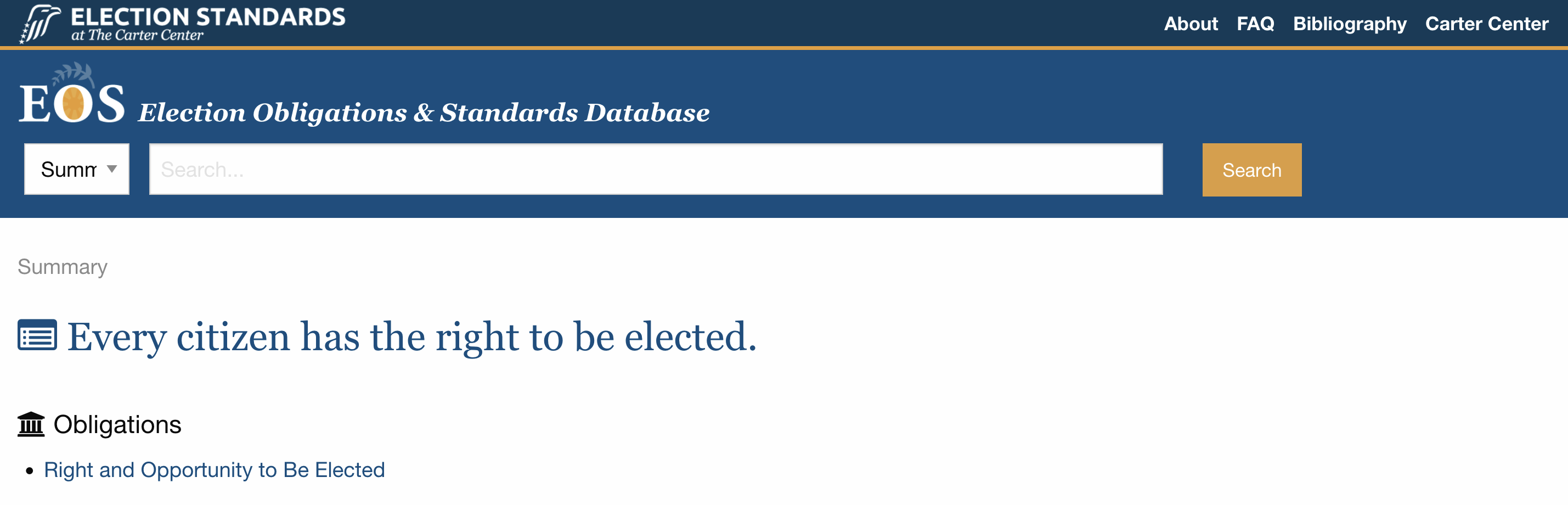
For now, I will conclude my critique with the eloquent slogan of the Carter Center, a progressive organization that was founded by Jimmy and Rosalynn Carter: “Every citizen has the right to be elected“. Of course, no constitutional or legal right is absolute, but at the very least candidates who are excluded from the electoral process are at some point entitled to due process of law — i.e. adequate notice and a fair hearing before a neutral arbiter — and the disqualification clause does not and cannot override these bedrock common law/constitutional principles. Elite intellectuals might be willing to sacrifice due process today in order to deny the detested Trump the ability to run for office tomorrow. I, for one, am not.
Note: I am going to take a couple of days off to watch some college football, catch up on my other readings, and enjoy the holiday weekend, but when I return to Baude and Paulsen’s Trumpian paper on Tuesday, I will further explain why due process is non-negotiable, even in the domain of the disqualification clause.







 prior probability
Pingback: Trump ballot disqualification update | prior probability
Pingback: Taking the *con* out of constitutional law: yes, even Donald Trump is entitled to due process | prior probability