
In their massive 126-page law review article (see here), William Baude and Michael Stokes Paulsen claim that former president Donald J. Trump is automatically disqualified from holding federal office under 14th Amendment’s Disqualification Clause (Amend. XIV, § 3). I already wrote up a formal reply to their article explaining why disqualification cannot be automatic or self-executing. Here, however, I will compare and contrast the various provisions in the Constitution that refer to insurrections or rebellions and then pose some questions directly to Baude and Paulsen.
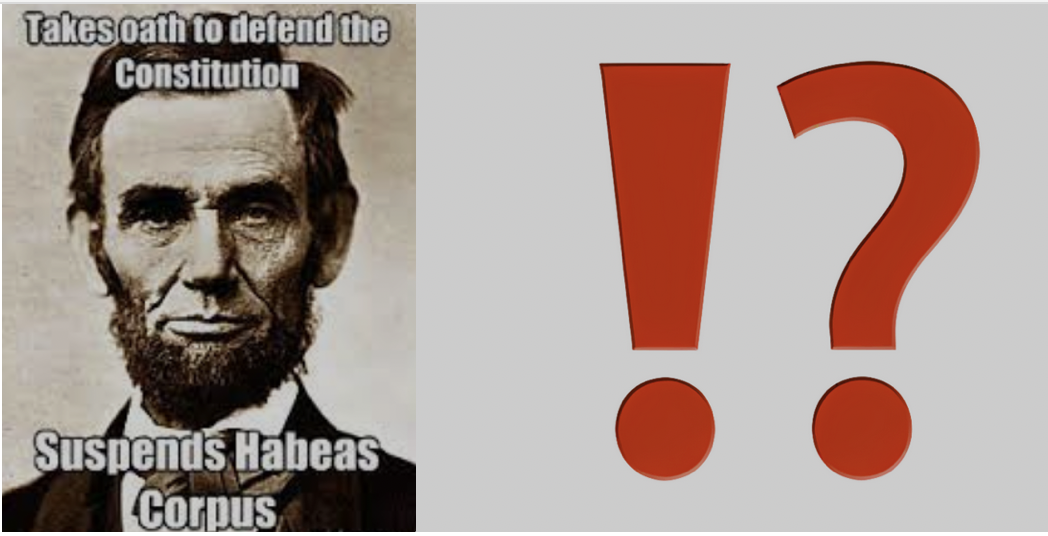
For starters, aside from Sections 3 and 4 of the 14th Amendment of 1868, where else does the U.S. Constitution refer to rebellions or other serious domestic strife? As it happens, the Constitution makes only two references–one direct; the other indirect–to insurrections, invasions, and the like. A direct mention appears in the Habeas Corpus Clause of the Constitution (Art. I, § 9, cl. 2), which uses the actual words “Rebellion or Invasion”. (For the record, the Habeas Corpus clause states: “The Privilege of the Writ of Habeas Corpus shall not be suspended, unless when in Cases of Rebellion or Invasion the public Safety may require it.”) The indirect reference, by contrast, appears in the Guarantee Clause of the Constitution (Art IV, § 4), which refers more broadly to “domestic Violence” as well as invasions. (For its part, the Guarantee Clause states: “The United States shall guarantee to every State in this Union a Republican Form of Government, and shall protect each of them against Invasion; and on Application of the Legislature, or of the Executive (when the Legislature cannot be convened) against domestic Violence.”)
Broadly speaking, both of these constitutional provisions anticipate the possibility of a state of emergency, such as a full-scale rebellion by a domestic group or an invasion/sneak attack by a foreign force. One provision (Article I, § 9) contemplates the curtailment of procedural rights during the emergency situation, while the other (Article IV, § 4) appears to allow for the use of military force and martial law. Alas, both of these provisions raise many more questions than they answer. Who decides what constitutes an emergency? The Congress, the president, or the courts? What other common law or judicial rights, in addition to habeas corpus, can be suspended during the emergency? (If habeas corpus can be suspended, for example, what about due process?) And last but not least, can governmental actions under either constitutional provision be challenged in a court of law, or are such actions “non justiciable” political questions beyond the scope of judicial review? (See, for example, the leading Guarantee Clause case of Luther v. Borden.)
For my part, I will not attempt to address these thorny questions here. Instead, I just want to point out that many of these same questions apply to the 14th Amendment’s Disqualification Clause. In brief, the Disqualification Clause can be used to disqualify a candidate from federal office when two conditions are met: 1st, the candidate must be someone who has “previously taken an oath, as a member of Congress, or as an officer of the United States, or as a member of any State legislature, or as an executive or judicial officer of any State, to support the Constitution of the United States,” and 2nd, the candidate must “have engaged in insurrection or rebellion against the [United States], or given aid or comfort to the enemies thereof.” But who decides, for example, who is an “officer of the United States” under Section 3 of the 14th Amendment, and who decides what forms of violence rise to the level of an “insurrection or rebellion”?
For now, I will conclude this post with the following observation: the Disqualification Clause refers only to internal insurrections and rebellions–not to foreign-led invasions or mere cases of “domestic Violence” more generally. This observation, in turn, generates several more key questions. First off, why does the Disqualification Clause omit the words “domestic Violence” from its scope? Was this omission a deliberate one? Either way, where should we draw the line between a full-scale insurrection/rebellion and an isolated case of “domestic Violence”? I await Baude and Paulsen’s reply …







 prior probability
Face it, there seems to be a movement afoot to de-legitimize the 14th Amendment by whatever means.
Of course, any disqualification to run for office would require a court to declare it and enforce it. Which plays right into the schemes of people like Trump whose modus operandi is to buy a big bag of wrenches and throw them regularly into the works, making the judicial branch as ineffective and floundering as if the Constitution had been hacked.
May I, as a legal novice, also bring up a distinction between acts that a police-officer may with-little-question prevent/detain, vs the abstract acts that a diabolical actor may engage in, knowing that his fate rests in a byzantine court system that he can play and play and play… Trump could get arrested BY POLICE if he shot someone; he might get arrested BY THE POLICE VIA THE DA if he told someone to shoot someone; he would simply have a court battle on his hands if he told a crowd to go shoot their way into the Capitol and out of democracy. He’s a psychopath. He’ll play this to the end.
Yet Trump is not the only president with blood on his hands …