
Here is a revised excerpt from my new work “Gödel’s Interbellum”; the footnotes are below the fold:
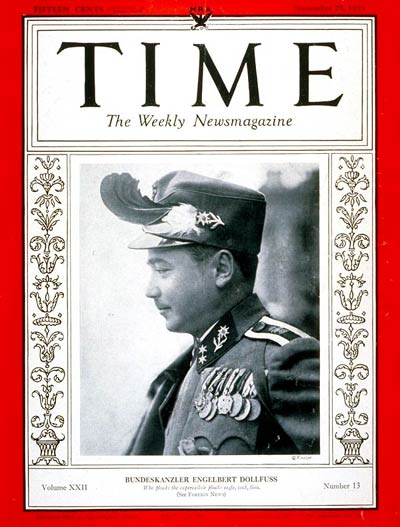
In many ways, Gödel’s fate was inextricably intertwined with Austria’s during the interwar period. He was born in 1906 in the small town of Brünn in the Austrian part of the now-defunct Austro-Hungarian Empire. Although Gödel became a “citizen by fiat” of Czechoslovakia when the Czechs and the Slovaks declared their independence in 1918,[1] one of his schoolmates once confirmed that “Gödel considered himself always Austrian …”[2] In any case, Gödel officially became a citizen of the Republic of Austria in 1929, and Vienna was his primary residence from 1924 until early 1940.[3] The year 1933 is especially significant–not only for Gödel, but also for Austria as a whole–for it was in March of 1933 that Gödel was officially appointed Privatdozent or “private lecturer” at the School of Philosophy of the University of Vienna, a position he would hold until 1938, and it was also in March 1933 that Austria’s chancellor, Engelbert Dollfuss, declared the “self-elimination” of Austria’s parliament and orchestrated a cunning extra-constitutional self-coup.
Gödel’s Austria began as a parliamentary democracy with the enactment of a new constitution in October of 1920, a charter in which legal scholar Hans Kelsen played a large role.[4] In summary, the 1920 Austrian Constitution allocated legislative power in the Bundesversammlung or Federal Assembly, a body composed of two houses, the Nationalrat (National Council) and the Bundesrat (Federal Council), and allocated executive power in a cabinet led by a chancellor, who in turn was appointed directly by the Bundesrat. The president was elected by both houses of the Federal Assembly and served as head of state. Austria’s interbellum constitution was then amended on December 7, 1929, when the Federal Assembly approved a series of constitutional amendments creating a presidential system of democracy by providing for the direct or popular election of the president.[5]
In March of 1933, however, a national railway strike precipitated a dramatic constitutional crisis, when a procedural snafu in the lower house of Austria’s parliament created an unexpected constitutional vacuum. In brief, Karl Renner, the president of the Nationalrat or National Council, strategically resigned his presidency on March 4, 1933 in order to cast the deciding vote on a controversial proposal to deal with the railroad strike. That same day (March 4), the lower house’s two vice-presidents, who represented Austria’s other major political parties, Rudolf Ramek of the Christian Social Party and Sepp Straffner of the Greater German People’s Party, also resigned for the same reason. The National Council was thus left without a presiding officer, due to the strategic resignations of Renner, Ramek, and Straffner, and in the absence of a presiding officer, the lower house could not meet. (Sound familiar?)
As it happens, Austria’s interbellum constitution had no mechanism for the National Council to meet without a president. On March 7, 1933, Chancellor Dollfuss described this constitutional vacuum as the “self-elimination of Parliament” (Selbstausschaltung des Parlaments) and assumed full legislative powers, citing an emergency law enacted during World War I, the Economic War Powers Act (Kriegswirtschaftliches Ermächtigungsgesetz).[6] After Dollfuss’s March 7 self-coup, the Austrian president Wilhelm Miklas issued a decree adjourning parliament indefinitely. When Austria’s main opposition parties, the Greater German People’s Party and the Social Democrats, attempted to reconvene the National Council on March 15, the opposition members were physically prevented from entering parliament by the police on Dollfuss’s orders. In a matter of days (March 4-15), democracy was dead.
Was Dollfuss’s self-coup “unconstitutional”? Thirteen months later (April 1934), Dollfuss convened a rump parliamentary session with only the members of his political party present. The psuedo-parliament not only retrospectively legalized all of the chancellor’s legislative decrees since the constitutional crisis of March 1933; it also enacted a new constitution, sweeping away the last remnants of parliamentary democracy. Among other things, the 1934 constitution abolished freedom of the press, established a one-party system, and created a state monopoly on employer-employee relations. (As a brief postscript, the 1934 psuedo-constitution remained in force until Adolf Hitler’s annexation of Austria in March 1938. After the defeat of Nazi Germany, the 1920 Constitution or BV-G was reinstated on May 1, 1945, and it remains in force to this day.)
Given the undemocratic ex post ratification of Dollfuss’s self-coup (opposition parties were excluded from the rump parliament), one could argue that Dollfuss lacked the legal authority to fill the constitutional vacuum that arose when the lower house of Austria’s parliament was left without a presiding officer. On the other hand, one could argue that politics abhors constitutional vacuums. In the absence of a legislature, the executive branch must legislate by default. Either way, Austria’s constitutional crisis of March 1933 offers an instructive lesson: constitutional vacuums are dangerous.
As an historical aside, just a few days after Dollfuss’s self-coup Adolf Hitler assumed the power to rule by decree via a constitutional amendment, the passage of the Enabling Law of March 23, 1933.[7] Did Kurt Gödel take notice of Hitler’s rapid rise to power in Berlin? If so, he would have noticed that, from a constitutional law perspective, Hitler’s evil dictatorship was a perfectly legal one! In fact, Germany’s democratic Weimar Constitution was never formally suspended or abrogated during the Hitler dictatorship, nor did the Austrian-born Führer stage a military coup or suspend his country’s constitution when he assumed power in 1933. Instead, after Hitler was appointed chancellor in January of 1933, he worked to subvert his country’s constitutional system internally from within, or in the words of one historian, “Though despising the rule of law, Hitler appreciated, after the fiasco of the 1923 Munich putsch, that he could gained power only through, not against the existing institutions.”[8]
In retrospect, March 1933 represents a symbolic turning point in the constitutional history of Central Europe during the interwar period–an “anti-constitutional” moment, if you will. In Austria, a legislative stalemate produced a constitutional vacuum that was filled by the chief executive, while in Nazi Germany the legislature effectively voted itself out of existence once it to transferred its powers to Hitler. Would-be dictators now had a new model for taking power: first, play by the rules of the political game to win power; then, once in power, change the rules of the game in order to stay in power. It is the recursive nature of this model that Gödel may have had in mind many years later when he reportedly discovered a logical contradiction in the U.S. Constitution. But that is getting ahead of our story, for the interbellum years were not over. Many more countries in Central Europe would become constitutional dictatorships.
[1] See John W. Dawson, Jr. (1997), Logical dilemmas: the life and work of Kurt Gödel, A. K. Peters, p. 21.
[2] Letter of Harry Klepetaŕ to John Dawson, dated December 30, 1983, quoted in Dawson, op. cit., p. 15.
[3] See generally Dawson, op. cit.
[4] The Constitution of Austria (Österreichische Bundesverfassung or B-VG) was enacted on October 1, 1920. See generally Oskar Lehner (2007), Österreichische Verfassungs- und Verwaltungsgeschichte. Mit Grundzügen der Wirtschafts-und Sozialgeschichte (4th ed.). Linz: Trauner.
[5] This provision, however, did not become effective until 1951, when Theodor Korner became the first president directly elected by the Austrian people. See Lehner, op. cit., p. *.
[6] KWEG 24, Juli 1917 RGBl, Nr. 307.
[7] Anson Rabinbach and Sander L. Gilman (2013), The Third Reich Sourcebook, University of California Press, p. 52.
[8] Peter Pulzer (1997), Germany, 1870–1945, Oxford University Press, p. 128.










 prior probability