
As promised, here is another excerpt from my new work “Gödel’s Interbellum”; the footnotes are below the fold:
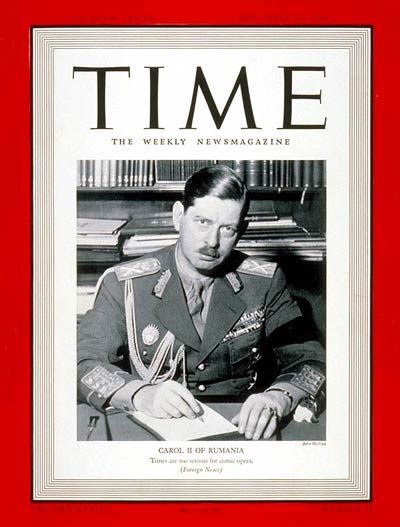
Romania not only went from a constitutional monarchy to a constitutional dictatorship on February 10, 1938, when King Carol II unilaterally suspended his country’s interwar constitution (the Constitution of 1923), proclaimed martial law, and established a de facto royal dictatorship.[1] King Carol’s “self-coup” also provides a textbook example of what this article refers to as a recursive transfer of power–a coup within a coup–for Carol himself had assumed the throne in June of 1930 via a parliamentary coup d’etat, when Romania’s parliament had proclaimed him the king of Greater Romania, a country consisting of 295,000 sq. km. and a population of over 18,000,000 persons.[2]
In summary, the coup in 1930 was carried out within the confines of the 1923 Constitution, since it was approved by the legislature; the 1938 coup, however, was not. King Carol’s self-coup thus poses a deep constitutional conundrum or paradox: was his proclamation suspending the constitution itself constitutional? What about the new constitution that his government promulgated in the days after the self-coup: was the new constitution unconstitutional? Does it matter that the new constitution was approved by the electorate in a constitutional referendum held on February 24, 1938,[3] just two weeks after the coup?
There are at least two ways of answering this question in the affirmative. On the one hand, one could argue that the successor constitution–although drafted in secret and hastily approved two weeks later under dubious circumstances–expressly, though retroactively, legitimized the king’s abrogation of the 1923 constitution. In the alternative, one could argue that the king’s proclamation was inherently or impliedly constitutional because supreme power ultimately resides in the person of the king. By analogy, for example, one could also argue that the king’s wartime decree of September 5, 1940 suspending the 1938 Constitution and investing full powers on General Ion Antonescu was a constitutional act, since the 1938 Constitution explicitly enshrined the supremacy of the king.
In either case, this constitutional contradiction presents two important theoretical queries, two paradoxical questions that might throw light on Gödel’s subsequent discovery of a loophole in the U.S. Constitution. First and foremost, when a constitution confers supreme power on a given ruler, either by implication (as in the case of the Romania’s 1923 Constitution after the 1930 coup) or explicitly (as with her 1938 Constitution), does that ruler also have the power to disregard the constitution itself? If the answer to this question is no, then can an action that occurred outside the constitutional process, such King Carol’s self-coup of February 10, 1938, be converted into a constitutional act by a subsequent act, such as the popular plebiscite of February 24?
For his part, where was Kurt Gödel in February 1938, and was he aware of King Carol’s self-coup in Romania? Although he would spend the 1938-39 academic year in the United States, Gödel was still living in Vienna in February of 1938. According to his biographer John Dawson, “In mid-November 1937 Gödel [had] moved out of the building on Josefstädterstrasse and took up residence in a third-floor apartment at Himmelstrasse 43/5 in the Viennese suburb of Grinzing.”[4] In addition, “Gödel managed over the next three months [i.e. starting in December 1937] to fill three notebooks on the Continuum Hypothesis.”[5]
In the fall of 1937, Edgar Zilsel, a philosopher of science and a former student of Heinrich Gomperz (who, in turn, was also one of Gödel’s former professors), had re-established a philosophical discussion group and had invited Gödel to join his circle.[6] “It was agreed the group would meet every other Saturday, and Zilsel suggested to Gödel that he report at an upcoming meeting on the status of consistency questions in logic …”[7] As fate would have it, Gödel eventually accepted Zilsel’s invitation and agreed to a lead a discussion on the question of consistency in logic. He presented a paper on this subject on 29 January 1938, and “so far as is known his lecture to the Zilsel circle on January 29, 1938 was his last presentation to a Viennese audience.”[8]
So, was Gödel aware of the dramatic events unfolding in Romania in the winter of 1938? Perhaps, for after his lecture of January 29, 1938, Gödel may have had extra time to reflect on the events unfolding in Central Europe. According to his biographer John Dawson, “Presumably, Gödel devoted the winter and spring of 1938 to the preparation of his manuscript and to making arrangement for his upcoming year abroad,”[9] since with Hans Hahn and Karl Menger gone, “there was little in the way of seminars or colloquia for Gödel to take part in.”[10] Presumably, too, Gödel also read about the events unfolding simultaneously in Greater Romania. Ten years later, as Gödel was preparing for U.S. citizenship exam in December of 1947, perhaps he asked himself whether a self-coup in the United States was theoretically possible.
Regardless of whether he was aware of King Carol’s self-coup, one of the most traumatic and unjust events in Kurt Gödel’s professional life was about to occur, when his authorization to teach would officially lapse and his academic position at the University of Vienna, abolished. This ugly experience, perhaps more than any other, may shed the most light on Gödel’s loophole.
[1] See, e.g., Haynes (2007), p. 121. The people of Romania approved the new constitution via plebiscite on February 24, 1938.
[2] Prior to 1918, Romania consisted of just 137,000 sq. km. and only 7.8 million persons.
[3] See, e.g., Payne (1996), p. 288. The 1938 Constitution would prove to be a short-lived one, however, when King Carol signed a decree dated September 5, 1940 suspending the 1938 Constitution and transferring his powers to General Ion Antonescu.
[4] Dawson (1997), p. 126.
[5] Ibid.
[6] Ibid., pp. 124-125.
[7] Ibid., p. 125.
[8] Ibid.
[9] Ibid., p. 127. Note that Gödel spent the 1938-1939 academic year at the Institute for Advanced Studies (IAS) in the United States, i.e. October 1938 to June 1939.
[10] Ibid., p. 124.







 prior probability