
Note: below is part 2 of my review of Rousseau’s Discourse on the Origin of Inequality (1754)
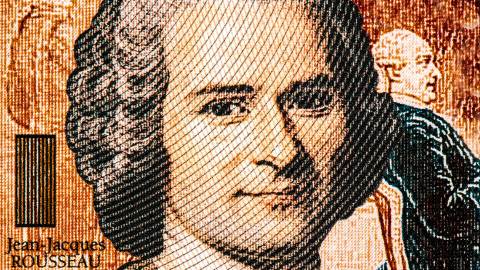
The preface to Rousseau’s Discourse on Inequality consists of only 15 paragraphs, but it was music to my law professor ears, for it not only contains an original discussion of “the law of nature”; the preface also reveals what motivated Rousseau to write the Second Discourse in the first place: to discover “the real foundations of human society” and the true “nature of man” (Para. 7). According to Rousseau: “… [although] all human institutions seem at first glance to be founded merely on the banks of shifting sand [,] … only by taking a closer look, and removing the dust and sand that surround the edifice, [are we able to] perceive the immovable basis on which it is raised, and learn to respect its foundations” (Para. 14). So, what are these foundations?
For Rousseau, these foundation are the precepts of natural law! But this observation begs the deeper question, how do we discover these supposedly eternal and unchanging precepts, or “principles prior to reason” (Para. 11)? Here is where Rousseau’s discussion of natural law takes an especially refreshing and totally novel and unexpected turn, for Rousseau concedes that no one really knows for sure! Or in the immortal words of the Swiss recluse himself: “We cannot see without surprise and disgust how little agreement there is between the different authors who have treated this great subject” (Para. 9). In fact, “the definitions [of natural law] of these learned men, all differing in everything else, agree only in this, that is impossible to comprehend the law of nature …” (Ibid.).
Undaunted, Rousseau makes a further contribution to the natural law literature by presenting his own definition of the true law of nature! In summary, Rousseau reduces natural law to two basic precepts: one is the law of self-preservation (“one of [these natural law principles] deeply interest[s] us in our own welfare and preservation”); the other is what I will call, for lack of a better term, the law of pity, i.e. our genuine concern for the welfare of others (“the other [principle] excit[es] a natural repugnance at seeing any other sensible being … suffer pain and death”). (Note: all the quotes cited here are from Para. 11 of the preface.) For Rousseau, these two precepts or principles play the same role in law and politics that axioms do in mathematics, for it is from “these two principles … that all the [remaining] rules of natural right appear … to be derived.”
To conclude, why is Rousseau’s approach to the law of nature so original and novel? Because Rousseau totally eschews the idea of the “common good” as part of his definition of natural law! This omission is a feature — not a bug — because trying to figure out what the “common good” is a fool’s errand, especially in a pluralist society like ours. (Paging Thomas Aquinas!) My next post will make two preliminary points about what Rousseau refers to as “the state of nature” (Saturday, Jan. 20), and I will then proceed to the First Part of Rousseau’s Discourse proper on Monday, Jan. 22.










 prior probability
Pingback: Rousseau through the eyes of Adam Smith | prior probability
Pingback: Postscript to Rousseau’s Second Discourse | prior probability