
Note: this is part 4 of my review of Rousseau’s Discourse on the Origin of Inequality (1754)
Today, I will survey the first part of Rousseau’s Discourse on the Origin of Inequality (a/k/a “the Second Discourse”), which by my count contains 50 paragraphs. Among other things, the first part of Rousseau’s Second Discourse contains a lengthy but fascinating digression on the origins of language, attempts to rebut the Hobbesian picture of life in the state of nature (recall that, according to Hobbes, life outside of society is “solitary, poor, nasty, brutish, and short“), and then concludes with one of the most memorable literary pictures of all time: Rousseau’s rosy portrait of the noble savage.
For my part, I will skip over Rousseau’s lengthy digression on the origins of language — except to note that these passages may have been of great interest to someone like Adam Smith, who began his scholarly career by delivering a series of lectures on “rhetoric and belles lettres”; see here, for example: “Adam Smith’s first lectures after his university studies (at Glasgow and then Oxford) were on rhetoric and belles lettres (polite learning)” — and proceed directly to Rousseau’s rebuttal of Hobbes, which by my count appears in Paragraph 34 of the first part of the Discourse. This rebuttal is so spellbinding, if not mesmerizing, that I shall requote it in full below the fold:
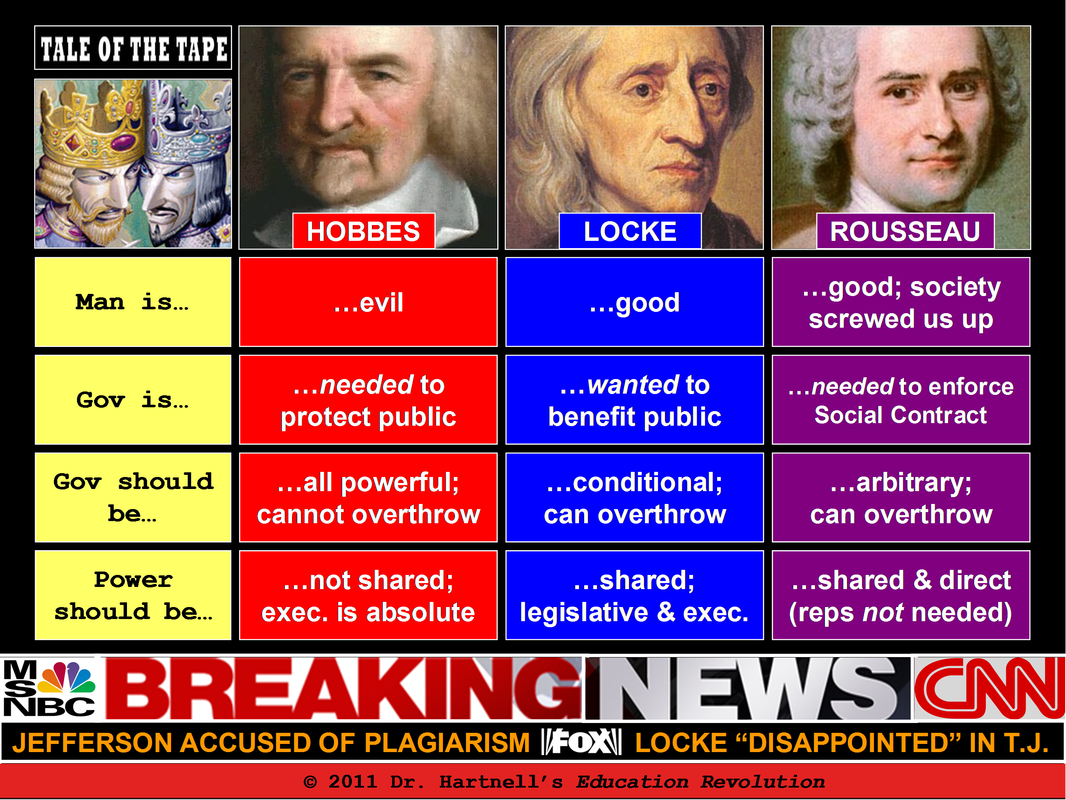
Above all, let us not conclude, with Hobbes, that because man has no idea of goodness, he must be naturally wicked; that he is vicious because he does not know virtue; that he always refuses to do his fellow-creatures services which he does not think they have a right to demand; or that by virtue of the right he truly claims to everything he needs, he foolishly imagines himself the sole proprietor of the whole universe. Hobbes had seen clearly the defects of all the modern definitions of natural right: but the consequences which he deduces from his own show that he understands it in an equally false sense. In reasoning on the principles he lays down, he ought to have said that the state of nature, being that in which the care for our own preservation is the least prejudicial to that of others, was consequently the best calculated to promote peace, and the most suitable for mankind. He does say the exact opposite, in consequence of having improperly admitted, as a part of savage man’s care for self-preservation, the gratification of a multitude of passions which are the work of society, and have made laws necessary. A bad man, he says, is a robust child. But it remains to be proved whether man in a state of nature is this robust child: and, should we grant that he is, what would he infer? Why truly, that if this man, when robust and strong, were dependent on others as he is when feeble, there is no extravagance he would not be guilty of; that he would beat his mother when she was too slow in giving him her breast; that he would strangle one of his younger brothers, if he should be troublesome to him, or bite the arm of another, if he put him to any inconvenience. But that man in the state of nature is both strong and dependent involves two contrary suppositions. Man is weak when he is dependent, and is his own master before he comes to be strong. Hobbes did not reflect that the same cause, which prevents a savage from making use of his reason, as our jurists hold, prevents him also from abusing his faculties, as Hobbes himself allows: so that it may be justly said that savages are not bad merely because they do not know what it is to be good: for it is neither the development of the understanding nor the restraint of law that hinders them from doing ill; but the peacefulness of their passions, and their ignorance of vice: tanto plus in illis proficit vitiorum ignoratio, quam in his cognitio virtutis. There is another principle which has escaped Hobbes; which, having been bestowed on mankind, to moderate, on certain occasions, the impetuosity of egoism, or, before its birth, the desire of self-preservation, tempers the ardour with which he pursues his own welfare, by an innate repugnance at seeing a fellow-creature suffer. I think I need not fear contradiction in holding man to be possessed of the only natural virtue, which could not be denied him by the most violent detractor of human virtue. I am speaking of compassion, which is a disposition suitable to creatures so weak and subject to so many evils as we certainly are: by so much the more universal and useful to mankind, as it comes before any kind of reflection; and at the same time so natural, that the very brutes themselves sometimes give evident proofs of it. Not to mention the tenderness of mothers for their offspring and the perils they encounter to save them from danger, it is well known that horses show a reluctance to trample on living bodies. One animal never passes by the dead body of another of its species: there are even some which give their fellows a sort of burial; while the mournful lowings of the cattle when they enter the slaughter-house show the impressions made on them by the horrible spectacle which meets them. We find, with pleasure, the author of the Fable of the Bees obliged to own that man is a compassionate and sensible being, and laying aside his cold subtlety of style, in the example he gives, to present us with the pathetic description of a man who, from a place of confinement, is compelled to behold a wild beast tear a child from the arms of its mother, grinding its tender limbs with its murderous teeth, and tearing its palpitating entrails with its claws. What horrid agitation must not the eye-witness of such a scene experience, although he would not be personally concerned! What anxiety would he not suffer at not being able to give any assistance to the fainting mother and the dying infant! (Para. 34; footnotes omitted, emphasis added)
In other words, for Rousseau man is an innately “compassionate” animal, one who “does good to himself with as little evil as possible to others” (Para. 37), and this natural pro-social endowment is so strong and powerful that it “supplies the place of laws, morals, and virtue” while man is in the state of nature. (See ibid.) Furthermore, it is from this idyllic picture of the state of nature that Rousseau is able to “reverse-engineer”, so to speak, the origins of equality:
If we compare the prodigious diversity, which obtains in the education and manner of life of the various orders of men in the state of society, with the uniformity and simplicity of animal and savage life, in which every one lives on the same kind of food and in exactly the same manner, and does exactly the same things, it is easy to conceive how much less the difference between man and man must be in a state of nature than in a state of society, and how greatly the natural inequality of mankind must be increased by the inequalities of social institutions. (Para. 45)
Having now painted this compelling picture of the state of nature, a mythical time when man was a good-hearted savage ruled by the sentiment of compassion, Rousseau will next pinpoint the origin of inequality and “trace its progress in the successive developments of the human mind” in the second and last part of his Discourse, so we shall turn to the second part in my next post …










 prior probability
I love the table at the bottom cross -comparing Hobbs, Locke, & Rousseau.
Pingback: Rousseau through the eyes of Adam Smith | prior probability
Pingback: Postscript to Rousseau’s Second Discourse | prior probability