
Note: my next few blog posts are from the third and last part of my revised paper “Adam Smith in the City of Lights”, which revisits Smith’s last days in Paris (October 1766). Below is an excerpt, where I describe an oft-overlooked aspect of Smith’s travels–his short stay in Compiègne in August 1766. (The works cited are below the fold.)
… for centuries Compiègne was the site where kings stopped on their way to Reims for coronation and where Charles IX (r. 1560-1574) and Louis XIII (r. 1610-1643) celebrated their marriages.” (Plax 2017, p. 109, footnote omitted)
Adam Smith’s second sojourn in Paris (February to July 1766) concluded when Smith and his pupils travelled to Compiègne sometime in August of 1766. (Rae 1895, p. 197.) As an aside, both John Rae and Ian Simpson Ross incorrectly describe the Scottish philosopher’s stay in Compiègne as an “excursion”. Rae (1895, p. 22), for example, reports that Smith “had been in the habit while in Paris of taking his pupils for excursions to interesting places in the vicinity, … and in August 1766 they went to Compiègne to see the camp and the military evolutions which were to take place during the residence of the Court there”, while Ross (2010, p. 227) writes, “[Smith] took his protégés, Buccleuch and his brother, on excursions to places of interest such as Compiégne when the Court went there for the diversion of hunting.”
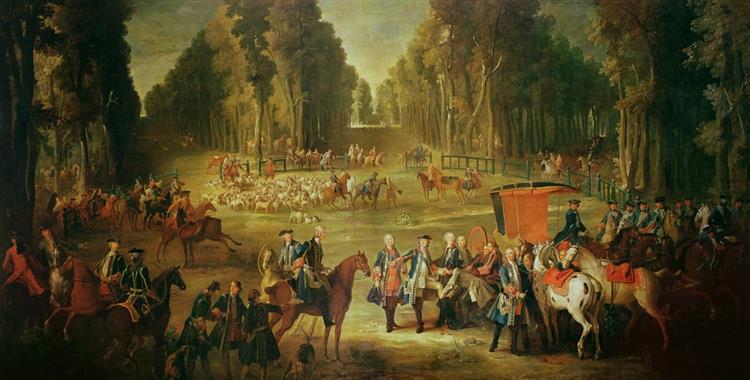
But the visit to the royal hunting park at Compiègne was not a mere “day trip” or weekend excursion. Instead, it was most likely one of the highlights of Adam Smith’s three-year grand tour travels and probably deserves a chapter or paper of its own, for it was in Compiègne that Smith and his pupils got to reside at a royal château and attend one or more hunts with the King of France. The pristine 20,000-acre forest at Compiègne was not only one of the oldest royal hunting grounds in France, dating to the time of the Merovingian king Clovis; the whole area was saturated with the history of past French kings and the origins of the monarchy: “French kings, beginning with Francis I, began the habit of short, but frequent, stays to enjoy the hunt” (Plax 2017, p. 109).
As it happens, Compiègne was also the site of Louis XV’s favorite chateau and hunting grounds, and the Chateau de Compiègne was the center of court life and the exercise of royal power when Louis XV and his Court were in town during the summer months (Plax 2017). In the words of art historian Julie Anne Plax, “Versailles was and always would be associated with Louis XIV, but Compiègne, with its well-ordered hunting park, would bear the mark of Louis XV …” (ibid., p. 116). Among other things, Louis XV had commissioned the construction of a new royal château, the plans for which were drawn by Ange-Jacques Gabriel, and every summer the king moved his royal court to Compiègne, where he hunted on the average of four to five days a week (ibid., p. 103). In 1764, for example, David Hume, in his capacity as Secretary of the British Embassy, had followed the French Court to Compiégne and spent the months July and August there (Mossner 1970, p. 461). For his part, Smith must have somehow secured a coveted invitation to make this visit, perhaps through Smith’s contacts at Britain’s embassy in Paris.
What is unclear, however, is how long Smith’s sojourn in Compiègne lasted. In a letter dated August 1766 from David Hume addressed to Adam Smith, Smith’s Paris mailing address “Anglois Hotel du Parc roiale, Fauxbourg St Germain a Paris” is crossed out and a new forwarding address, consisting of the words “a Compiègne”, are added twice, in another hand. (See Letter #96, note 1, in Mossner & Ross 1987.) Additionally, in a letter dated 26 August 1766 (Letter #94), Smith reports to Lord Townshend that Duke Henry became ill “on Thursday last” (ibid.). Following the Gregorian calendar, which was adopted in France in 1582 (see, e.g., E. Cohen 2000), 26 August 1766 would have been a Tuesday. We can therefore surmise that Smith and his pupils had arrived in Compiègne toward the middle part of August, perhaps even earlier, but how long did they stay there? Smith’s only other letter from Compiègne is dated 27 August 1766 (Letter #95), so he must have remained there until the end of August or the beginning of September, at least until Duke Henry recovered from his illness.
Alas, upon their return to the French capital at the end of the summer/beginning of fall 1766, Smith’s last days in Paris would be somber ones, marred by the death of Duke Henry’s younger brother, Hew Campbell Scott.
To be continued …
Cohen, E. (2000) Adoption and reform of the Gregorian calendar, Math Horizons, 7(3): 5–11.
Plax, J. A. (2017) J.-B. Oudry’s Royal Hunts and Louis XV’s hunting park at Compiègne: landscapes of power, prosperity and peace, Studies in the History of Gardens & Designed Landscapes, 37(2): 102–119.
Rae, J. (1895) Life of Adam Smith, London: Macmillan.
Ross, I. S. (2010) The Life of Adam Smith (2nd edn), Oxford: Oxford University Press.







 prior probability