
Why did Adam Smith go out of his way to travel to the little Swiss city-state of Geneva in the fall of 1765? At the time, Geneva was an independent and self-governing republic, but she was much smaller than now, covering an area of 124 square kilometers. [See, e.g., Phillip Judd, “On this day 200 years ago Geneva nearly doubled in size“, Le News (3 March 2016). As an aside, Geneva did not officially join the Swiss Confederation until 19 May 1815 (ibid.).] As it happens, my colleague, friend, and co-author Alain Alcouffe and I have been researching this very question for many months now.
In summary, our point of departure is Chapter 13 of John Rae’s Life of Adam Smith, which recounts many of the most salient events and encounters during the middle phase of Smith’s Grand Tour years–specifically, the time Smith spent in the Republic of Geneva beginning in October 1765. (As an aside, Rae incorrectly has Smith departing Geneva as early as December 1765, but as my colleague Alain Alcouffe and I have discovered, this is wrong, for Smith’s sojourn in Geneva most likely lasted until the end of January or beginning of February 1766.) In brief, Rae and subsequent biographers rightly emphasize Smith’s encounters with his intellectual hero, the famed Voltaire, especially given the stature of this famed Enlightenment figure as well as their mutual interest in l’affaire Calas, a major legal and religious controversy that played out in Toulouse, where Smith had spent most of 1764 and 1765.
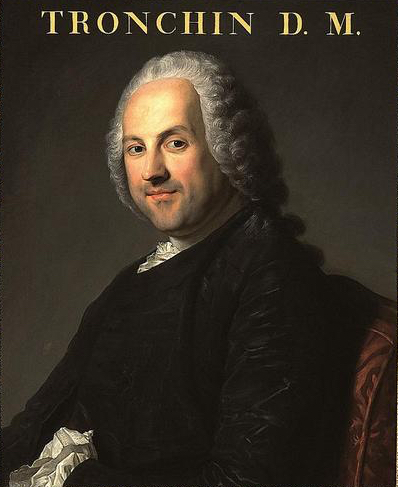
But at the same time, it is also worth pointing out that Smith met, befriended, and exchanged ideas with many other notable historical figures and intellectuals during his stay in Switzerland, including, in alphabetical order, (1) the botanist Charles Bonnet, who by all accounts abhored Smith’s intellectual mentor David Hume; (2) the wealthy and beautiful widow Louise Elisabeth de La Rochefoucauld (duchesse d’Enville), described as Turgot’s “muse” by some of our primary sources; (3) the physicist Georges-Louis Le Sage, who invented the electric telegraph; (4) the hospitable Lord and Lady Stanhope, who hosted many dinner parties for British visitors during their residency in Geneva; and (5) one of the most famous medical doctors of the Enlightenment era, Theodore Tronchin (pictured below), whose son had recently attended Smith’s foundational philosophy lectures at the University of Glasgow.
Prior to his sojourn in Switzerland, however, Smith did not know any of these Lumières; accordingly, Alain Alcouffe and I will explain in our next post why the “City of Calvin” or “Protestant Rome” was such a popular destination for 18th century British aristocrats on their grand tours of Europe.










 prior probability
Pingback: Adam Smith and Rousseau the fugitive | prior probability
Pingback: Adam Smith in Switzerland | prior probability