
Why did Adam Smith decide to visit Geneva in the fall of 1765? As it happens, the Scottish philosopher and travelling tutor would have had many good reasons for wanting to visit this pious and prosperous republic with his pupils during their grand tour years (1764-66), for Geneva was not only one of the leading centers of international scientific training at this time — Smith, for example, would befriend such leading “natural philosophers” as Charles Bonnet and Georges-Louis Le Sage during his sojourn in Switzerland — this little republic was also one of the last remaining self-governing city-states in all of Europe, a political anomaly that might have piqued the curiosity of any keen student of contemporary political economy and the classical Greek polei of lore.
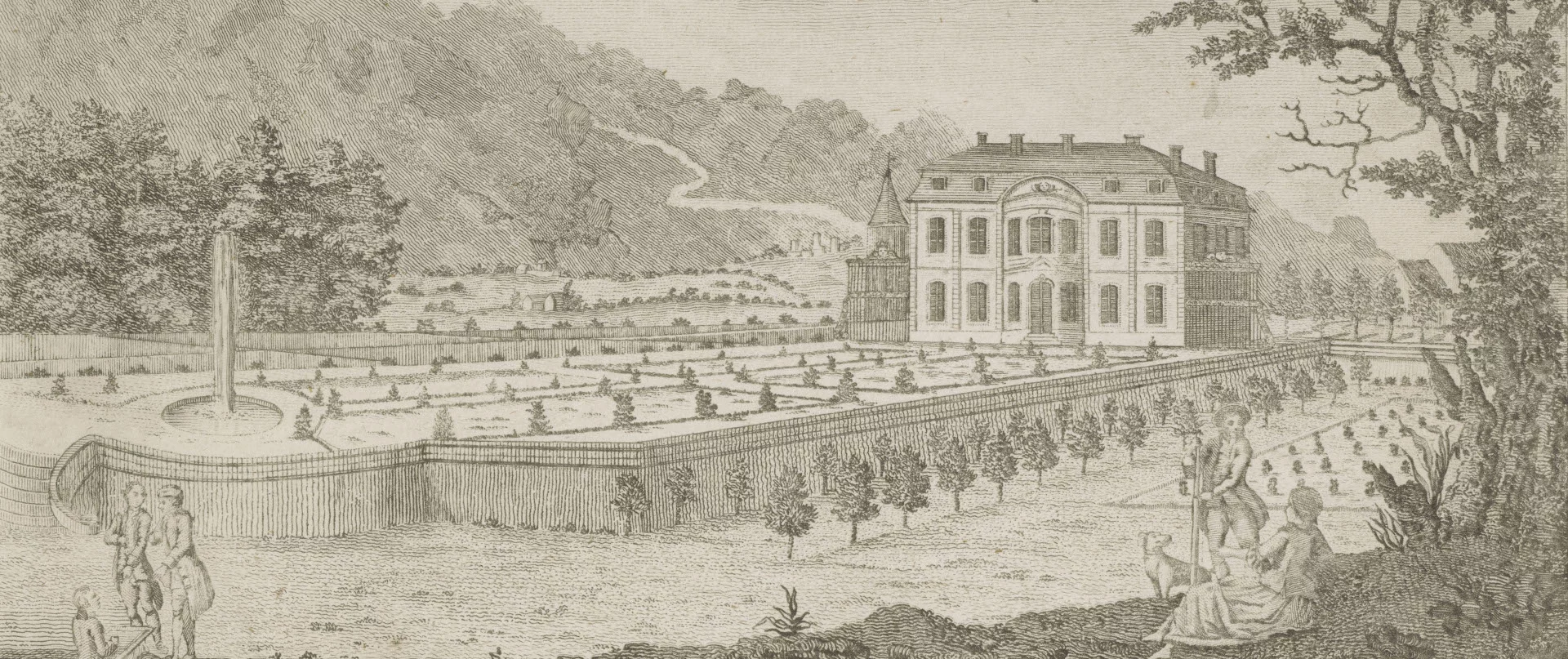
According to most of his biographers, however, Smith’s first and foremost reason for visiting Geneva was the city’s proximity to the famed château de Ferney (pictured below), home of the celebrated Voltaire from 1761 to 1778. This claim is plausible, for the French freethinker was one of the most famous literary figures of the Enlightenment, and when Adam Smith was a professor at Glasgow, he devoted the last paragraph of one of his earliest writings to be published, a letter to the Edinburgh Review, to the great Voltaire, who he described as “the most universal genius” that France has ever produced. [This lengthy letter is reprinted in W. P. D. Wightman, et al., editors, Essays on Philosophical Subjects (Oxford University Press, 1980), and is available here.] So, how could the Scottish philosopher pass up the opportunity to meet one of his intellectual heroes? Alas, as great as Voltaire’s reputation was, the opportunity to exchange ideas with this intellectual giant cannot be the whole story. Why not? Because Smith’s remained in Geneva for several months: from October 1765 until the end of January or beginning of February 1766. If all Smith had wanted to do was to meet Voltaire, then why stay so long in this little republic?
What if Smith had another reason for visiting Geneva, one even more powerful than the intellectual prestige or academic allure of meeting the famed Voltaire? And more to the point, what if this additional motive had to do with Voltaire’s lifelong nemesis and polar opposite, Jean-Jacques Rousseau? Alain Alcouffe and I will explore this intriguing possibility in our next blog post; for now, however, it suffices to say that Geneva was not only Rousseau’s hometown, the city of his birth; Rousseau himself had dedicated his famed Second Discourse to the “Republic of Geneva”. These are important clues for us because, as much as Smith admired Voltaire, the one philosopher who Smith devotes even more space to than Voltaire in his second letter to the Edinburgh Review is none other than Rousseau.










 prior probability
Pingback: Adam Smith and Rousseau the fugitive | prior probability
Pingback: Voltaire-Adam Smith Postscript | prior probability
Pingback: Rousseau against the world | prior probability
Pingback: Adam Smith in Switzerland | prior probability