
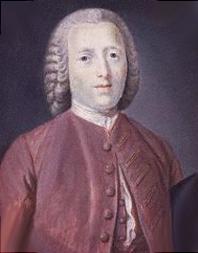
In our previous post “Adam Smith and the Voltaire-Needham Affair“, Alain Alcouffe and I introduced “Collection des lettres sur les miracles: écrites a Geneve, et a Neufchatel” (better known today as Questions sur les Miracles), a series of twenty witty letter-essays that the world-famous Voltaire was busy composing during Smith’s sojourn in Switzerland in the fall of 1765. We also mentioned that some of these letter-essays are addressed to a contemporary natural philosopher and priest, John Turberville Needham (pictured below). That, however, is putting it mildly, for Voltaire did not just “address” some of his pamphlets to Needham; instead, it would be more accurate to say that the famed Enlightenment literary figure launched a full-scale personal vendetta against the English natural philosopher, one that he would pursue in one form or another until his death in 1778! (See generally Roe 1985, especially pp. 73-82.)
Among other things (see Shirley Roe, “Voltaire Versus Needham: Atheism, Materialism, and the Generation of Life,” Journal of the History of Ideas, Vol. 46, No. 1 (Jan.-Mar., 1985), pp. 65-87, p. 75; see also Roe 1983, p. 181), Voltaire christens Needham “the eelmonger” (“l’Anguillard“) and falsely accuses him of being an Irish Jesuit to boot (“Jésuite Irlandois“). (One can only imagine what Voltaire must have thought of him in private!) In addition to these spurious ad hominem attacks, the supposedly-enlightened Frenchman commits the strawman fallacy in many of his letter-essays: Voltaire paints an intentionally inaccurate picture of Needham’s “ridiculous system” (“système ridicule“) and ascribes a godless and dangerous materialist-atheist outlook to him, a worldview that the English natural philosopher himself had repeatedly and vehemently rejected. But these observations beg an important question: If Needham’s scientific theories were so absurd or “ridiculous”, then why did one of the greatest men of letters of the Enlightenment era direct so much fury and invective against them? What fueled Voltaire’s literary and intellectual fire? And did Adam Smith take notice of “Voltaire’s vendetta” during his sojourn in Switzerland?
Suffice it to say, Alain Alcouffe and I will address these questions in our next few posts …







 prior probability
Pingback: Origins of Voltaire’s vendetta | prior probability
Pingback: Adam Smith in Switzerland | prior probability