
In this post (and our next one), Alain Alcouffe and I will address the following questions: Why did the leaders of the Republic of Geneva try to suppress The Social Contract, and what role, if any, did Marc Turretin — one of the magistrates or “syndics” of Geneva that Adam Smith met during his sojourn in the Swiss city-state — play in this sordid affair? Also, did Adam Smith take notice of this controversy during his visit to Geneva, and if so, whose side was he on, the Syndics’ or Rousseau’s?
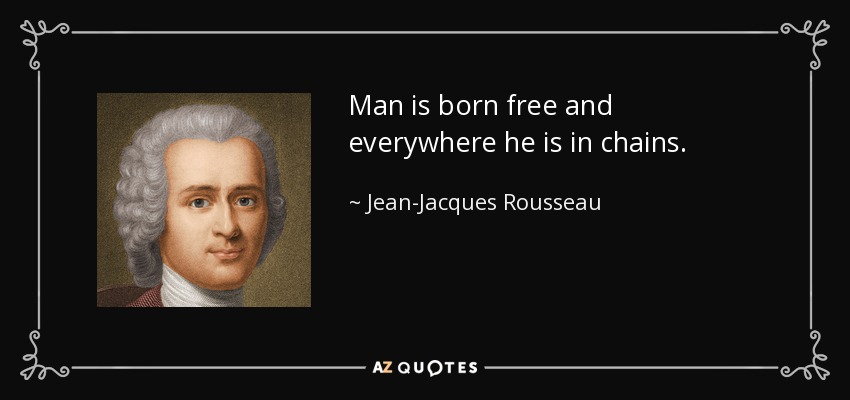
By all accounts, the main reason the authorities in Geneva (including syndics like Marc Turretin) had for censoring The Social Contract and issuing an arrest warrant against Rousseau himself was his chapter on civic religion. (See Book 4, Ch. 8 of The Social Contract.) Among other things, Rousseau presents a scathing indictment of organized religion and concludes that Christianity and democracy are incompatible (emphasis in the original):
But I’m wrong to speak of a Christian republic—those two terms are mutually exclusive. Christianity preaches only servitude and dependence. Its spirit is so favourable to tyranny that it always profits by such a régime. Genuine Christians are made to be slaves, and they know it and don’t much mind: this short life counts for too little in their eyes. (The Social Contract, Book 4, Ch. 8)
At the time, however, the Republic of Geneva presented herself as a bastion of religious and political liberty (a reasonable assessment given the prevalence of absolute monarchies in the rest of Europe), and many Genevans prided themselves on their Calvinist and republican traditions. [See generally Pamela A. Mason, “The Genevan political background to Rousseau’s ‘Social Contract'”, History of Political Thought, Vol. 14, no. 4 (1993), pp. 547-572.] Rousseau’s Social Contract, however, not only questioned this conventional wisdom; it threw a metaphorical grenade into an already volatile political situation. To put Rousseau’s dangerous diatribe against Geneva’s faux democracy into historical context, some background information about Geneva’s 18th-century constitutional system is in order.
In brief, the power to make and enforce laws in Geneva was divided among three corporate entities or political bodies, a constitutional arrangement going back to the days of John Calvin: (i) a general council consisting of all the male citizens of Geneva aged 25 or older, (ii) a legislature called the Grand Council or Council of the Two Hundred (as its name implies, this body contained 200 members), and (iii) a quasi executive-judicial body called the Small Council or Council of Twenty-Five. (See, e.g., Mason 1993, p. 551.) The small council, in turn, was led by four magistrates called “syndics”, whose appointments were rubber-stamped by the general council from pre-approved slates (ibid.).
But the one aspect of this constitutional arrangement that must have infuriated someone like Rousseau the most was the utter political impotency of Geneva’s general council. It could not deliberate on any matters not previously approved by the grand and small councils; it lacked the power to impeach or recall the syndics; and to make matters worse, it played no role in the election of the grand and small councils (Mason 1993, p. 555). Indeed, the most odd aspect of Geneva’s constitution was that the Grand Council and the Small Council formed a “closed loop”: the Small Council chose the membership of the Two Hundred and the Two Hundred chose the membership of the small council (ibid.).
During the 18th century, however, a group of reformers calling themselves the Représentants began to question these arrangements and rebel against the syndics. Their struggle would culminate in the so-called “Geneva Revolution of 1782” (see here, for example), a precursor to the great French Revolution that began in 1789. [See generally Richard Whatmore, Against War and Empire: Geneva, Britain, and France in the Eighteenth Century, Yale University Press (2012).] But at the time of the publication of Rousseau’s “Social Contract” in 1762 and Adam Smith’s sojourn in Switzerland in late 1765, the Geneva Revolution of 1782 was still decades away. Nevertheless, although this decades-long constitutional struggle in Geneva had yet to be fully resolved in the 1760s, Rousseau’s radical critique of Geneva’s morally and politically corrupt constitution — corrupt because the general council did not represent the true will of the people given its limited power and the closed loop between the grand and small councils — no doubt struck a raw chord among the syndics and defenders of the status quo and must have been a topic of conversation in Adam Smith’s Geneva circle during his sojourn in Switzerland.
Assuming the Scottish philosopher did take notice of this constitutional controversy during his visit to Geneva, what did he make of it? Specifically, did he openly defend the marketplace of ideas in true classical liberal fashion (i.e. did he champion Rouseau’s freedom to criticize the system without fear of legal prosecution), or was he complicit in Rousseau’s predicament and in the censorship of the syndics through his esoteric silence? Alain Alcouffe and I will turn to these all-important questions in our next post …










 prior probability
Pingback: Adam Smith in Switzerland | prior probability