
Continued from yesterday: What was the Voltaire-Tronchin conspiracy, and why did these two leading denizens of Geneva decide to conspire to ruin Rousseau’s reputation and expose him as an intellectual and moral fraud? (And where does Adam Smith, who was in close contact with both conspirators during his sojourn in Switzerland, fit in?) In short, this conspiracy was not an imagined plot or feigned intrigue. It involved a deep secret about Rousseau’s dark past, about acts so shameful and deplorable that their disclosure to the public would all but destroy Rousseau’s reputation.
According to one Rousseau scholar (Matthew D. Mendham), Voltaire’s doctor, Théodore Tronchin, became aware of the Swiss philosopher’s shameful secret through one of his most glamorous private patients, Madame Louise d’Epinay, a wealthy salonnière and woman of letters who had been Rousseau’s patroness — she had furnished Rousseau a cottage called “the Hermitage” in the valley of Montmorency — and it was this same Dr Tronchin who then divulged Rousseau’s secret to Voltaire. [See, e.g., Matthew D. Mendham, Hypocrisy and the Philosophical Intentions of Rousseau: The Jean-Jacques Problem, (2021), pp. 170-171 n.25 & p. 129. See also R. A. Leigh, “Review: Jean-Jacques Rousseau”, Historical Journal, Vol. 12, No. 3 (1969), pp. 549-565.]
So, did Madame d’Epinay, in fact, reveal Rousseau’s dark secrets to Dr Tronchin during one of her visits to Geneva, and did Tronchin then conspire with Voltaire to air Rousseau’s dirty laundry? Here is what we know for certain. First off, we know that Madame d’Epinay had been under Dr Tronchin’s personal care and attention during a visit to Geneva in 1757 — in fact, it was Rousseau who had introduced his patroness to Tronchin in the spring of 1756 (see Cranston 1991, pp. 22-23, cited in our previous post) — and we also know that “Dr Tronchin was by this time [i.e. 1757] on fairly intimate terms with Mme d’Epinay, addressing her as ‘ma bonne amie‘” (again, see Cranston, op. cit., p. 41 & p. 368 n.98, citing “BPUG, Archives Tronchin, 204, p. 29”).
In addition, we know that Dr Tronchin was in close and frequent contact with his lifelong friend and patient Voltaire. [Indeed, the earliest known letter written by Voltaire to Theodore Tronchin is dated 20 February 1741! See Theodore Besterman, “An Unpublished Voltaire Letter to Theodore Tronchin, and Some Notes on Dates”, Modern Language Notes, Vol. 67, No. 5 (May, 1952), pp. 289-292.] Moreover, Tronchin and Voltaire had also been in regular correspondence with each other — as well as with Rousseau — on various matters since the summer of 1756 (see Cranston, cited above, pp. 29-31). And third and last, we now know that it was none other than Voltaire (with information provided by Tronchin) who wrote up a devastating exposé of the Swiss philosopher’s misdeeds. [See generally Chapter 5 of Mendham’s 2021 book, cited above, as well as Chapter 4 of Robert Zaretsky and John T. Scott, The Philosophers’ Quarrel: Rousseau, Hume, and the Limits of Human Understanding, Yale University Press (2009).]
To the point, Voltaire’s anonymous pamphlet, titled The Sentiment of the Citizens, was published on 27 December 1764 (see Mendham 2021, op. cit., p. 206 n.6). [For reference, Voltaire’s pamphlet is reprinted in Frédéric Eigeldinger, editor, Voltaire: Sentiment des citoyens, Champion (2000), and as a further aside, Rousseau’s reply to Voltaire’s anonymous pamphlet is reprinted in Volume 12 of Roger D. Masters and Christopher Kelly, editors, The Collected Writings of Rousseau, University Press of New England (2007), pp. 45-49, available here.] Among other things, Rousseau’s shocking crimes and salacious secrets are put on full display for all posterity:
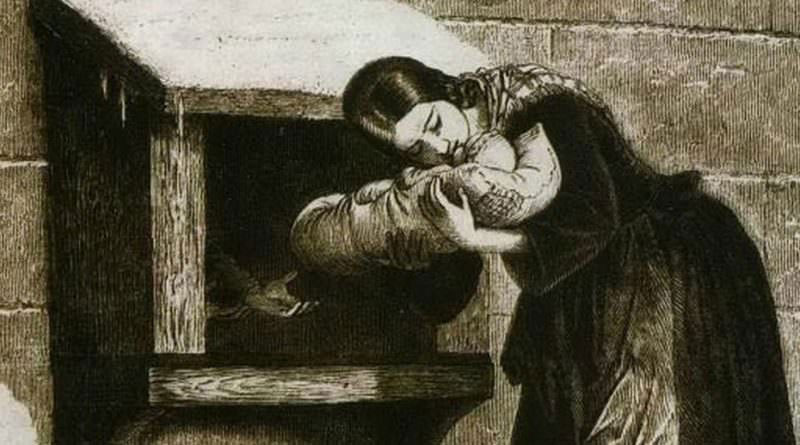
Is [Rousseau] a scholar who is disputing against scholars? No, [he] is the author of an opera and of two comedies that were hissed at. Is [he] a good man who, deceived by a false zeal, is making indiscreet reproaches to virtuous men? We admit, blushing and with sorrow, that this is a man who still bears the marks of his debaucheries, and who, dressed up as a street-swindler, drags with him from village to village, and from mountain to mountain, the unfortunate woman whose mother he killed, and whose children he exposed at the door of a hospital, rejecting the cares that a charitable person wanted to provide them, and renouncing all the feelings of nature, as he casts off those of honor and religion.
As it happens, the allegation that Rousseau somehow killed his putative mother-in-law is pure fabrication; the other major revelations, however, are not: the Swiss philosopher had not only fathered several children out of wedlock (five in all!); he had also forced the unfortunate unwed mother to discard her own children on the cold doorstep of an orphanage, never to be seen or heard from again. Alas, although the abandonment of unwanted babies was an accepted practice in many places at the time (for a survey, see Roberta Wollons, “Abandonment and Infanticide” in Richard A. Shweder, editor, The Child: An Encyclopedic Companion, University of Chicago Press (2009), pp. 1-4, available here), the damage was done; Rousseau’s darkest skeletons were now out of the closet. The Swiss philosopher was no scholar; he was a heartless rogue who had abandoned his own children!
Postscript: What is Adam Smith’s part in this sordid affair? Although Smith was in close contact with both Dr Tonchin and Voltaire during his sojourn in Switzerland in late 1765 and early 1766, he could not have played a direct role in the plot to tarnish Rousseau’s reputation, for Voltaire had already published his withering exposé in late 1764, when Smith was still in the South of France. That said, however, Tronchin and Voltaire’s backstabbing machinations may have shaped Smith’s priors when the Hume-Rousseau affair exploded in 1766.







 prior probability
Pingback: Adam Smith in Switzerland | prior probability