
What did Adam Smith learn during his Swiss sojourn in late 1765/early 1766? As Alain Alcouffe and I mentioned in our previous post, he must have learned a lot, for The Wealth of Nations contains a plethora of references to Switzerland as well as to several specific Swiss cantons, including Berne, Geneva, Lucerne, and Unterwald. Here, we shall survey some remarkable but prescient observations Smith makes about the role of religion on Swiss politics, education, and income inequality, among other things — remarkable because his observations are deep and original; prescient because Smith extends economic analysis to new domains beyond firms and markets. [See, e.g., Gary M. Anderson, “Mr. Smith and the Preachers: The Economics of Religion in the Wealth of Nations”, Journal of Political Economy, Vol. 96, No. 5 (Oct., 1988), pp. 1066-1088.]
For starters, the Scottish philosopher-economist has something to say about the politics of pastoral elections. According to Smith, when the members of a particular parish have the right to elect their own pastors — a Protestant practice at the time — then the inevitable result would be faction and polarization. Smith’s stunning observation about the politics of religion is so avant-garde, eloquent, and memorable that it deserves to be quoted in full:
As long as the people of each parish preserved the right of electing their own pastors, they acted almost always under the influence of the clergy, and generally of the most factious and fanatical of the order. The clergy, in order to preserve their influence in those popular elections, became, or affected to become, many of them, fanatics themselves, encouraged fanaticism among the people, and gave the preference almost always to the most fanatical candidate. So small a matter as the appointment of a parish priest occasioned almost always a violent contest, not only in one parish, but in all the neighbouring parishes, who seldom failed to take part in the quarrel. When the parish happened to be situated in a great city, it divided all the inhabitants into two parties; and when that city happened either to constitute itself a little republic, or to be the head and capital of a little republic, as is the case with many of the considerable cities in Switzerland and Holland, every paltry dispute of this kind, over and above exasperating the animosity of all their other factions, threatened to leave behind it both a new schism in the church, and a new faction in the state. In those small republics, therefore, the magistrate very soon found it necessary, for the sake of preserving the public peace, to assume to himself the right of presenting to all vacant benefices. [WN, Glasgow ed., pp. 808-809 (para. 36).]
Next, Smith not only compares and contrasts the incentive effects of “church benefices” [note: a benefice is a reward or benefit — such as land, rents, or other rewards — received in exchange for services rendered and as a retainer for future services]; he also reveals why he himself chose to become a professor instead of joining the clergy in Scotland as he was required to do under the terms of his “Snell Exhibition”, which he was awarded in 1740. According to Smith, in Protestant countries where church benefices are “very moderate” (like Scotland and Switzerland), talented men of letters will generally prefer a chair in a university to becoming a clergyman: “a chair in a university is generally a better establishment than a church benefice”, and the universities in these places can cherry pick the best and brightest from the ranks of would-be clergy. [WN, Glasgow ed., p. 811 (para. 39).] By contrast, in Roman Catholic countries where such benefices are “very considerable”, talent flows in the opposite direction: “the church naturally draws from the universities the greater part of their eminent men of letters, who generally find some patron who does himself honour by procuring them church preferment”. [Ibid.] Smith also cites the great “Voltaire” (see here) in support of his conclusion and then goes on to discuss the situation in Geneva:
In Geneva, on the contrary, in the Protestant cantons of Switzerland, in the Protestant countries of Germany, in Holland, in Scotland, in Sweden, and Denmark, the most eminent men of letters whom those countries have produced, have, not all indeed, but the far greater part of them, been professors in universities. In those countries the universities are continually draining the church of all its most eminent men of letters. [Ibid.]
Moreover, on the next page of his magnum opus, Smith posits an inverse relation between the wealth of churches and the wealth of their parishioners: “the richer the church, the poorer must necessarily be, either the sovereign on the one hand, or the people on the other”(!). [WN, Glasgow ed., p. 812 (para. 41).] In reaching this remarkable, if not prescient, conclusion (cf. Anderson 1988, cited above), the Scottish philosopher-economist not only cites “the Protestant cantons of Switzerland” as evidence in support of his observation; he also uses the phrase “all other things being supposed equal” for the first time in history [note: the only other place a similar phrase is used is on page 677 of the Glasgow edition of The Wealth of Nations], a phrase that would become a staple of modern economists everywhere:
It may be laid down as a certain maxim that, all other things being supposed equal, the richer the church, the poorer must necessarily be, either the sovereign on the one hand, or the people on the other; and, in all cases, the less able must the state be to defend itself. In several Protestant countries, particularly in all the Protestant cantons of Switzerland, the revenue which anciently belonged to the Roman Catholic Church, the tithes and church lands, has been found a fund sufficient, not only to afford competent salaries to the established clergy, but to defray, with little or no addition, all the other expenses of the state. [Ibid.]
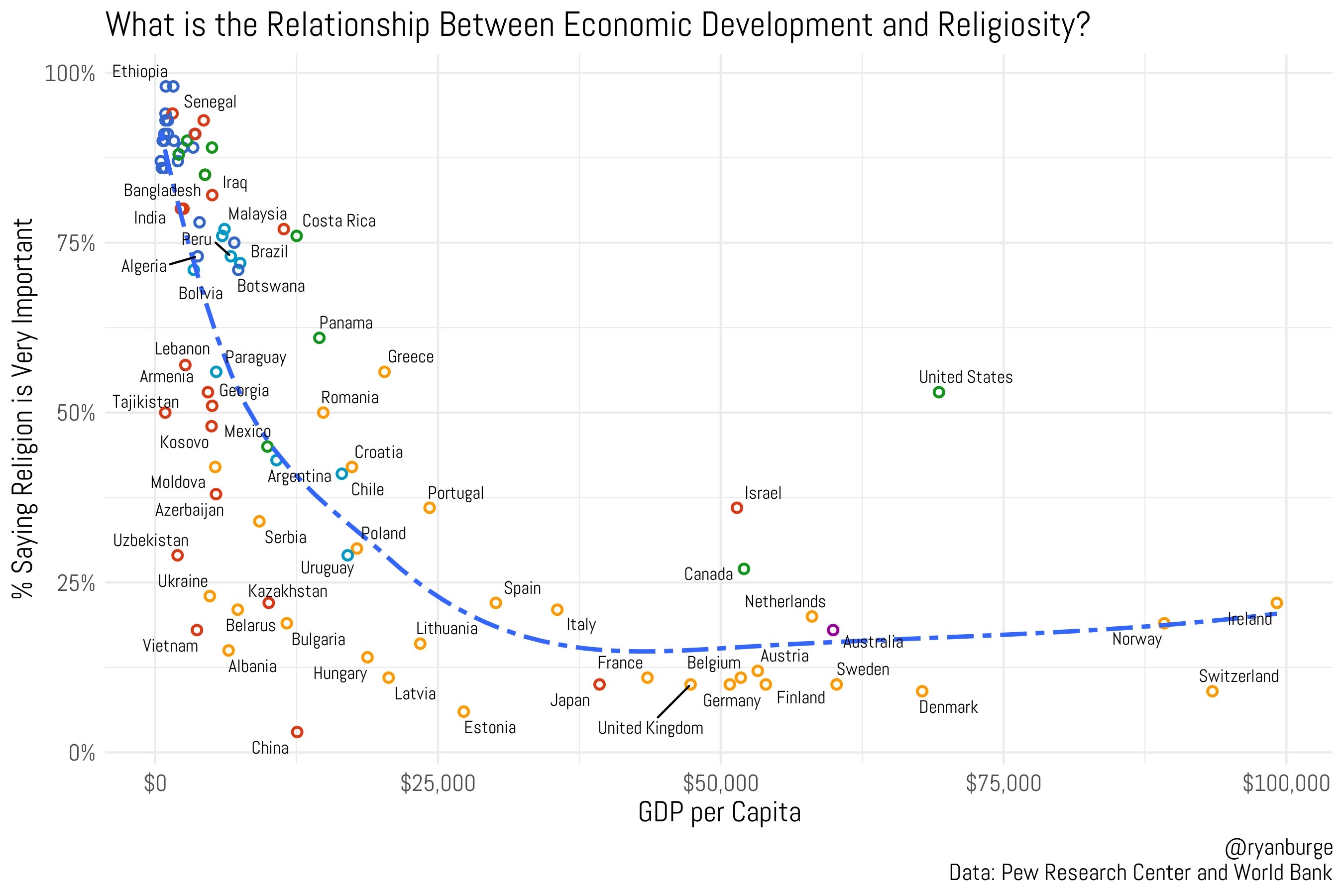
Last but not least, Smith also has something novel and interesting to say about the effects of church endowments on religious devotion. Specifically, are people who attend more “opulent” churches themselves more religious and less sinful than the members of more “poorly endowed” churches, such as those of Scotland or Switzerland? Smith’s remarkable conclusion is that a church’s level of endowment has no effect on the relative levels of religious devotion and sin; if anything, the arrow of causation runs in the opposite direction:
The most opulent church in Christendom does not maintain better the uniformity of faith, the fervour of devotion, the spirit of order, regularity, and austere morals in the great body of the people, than this very poorly endowed Church of Scotland. All the good effects, both civil and religious, which an established church can be supposed to produce, are produced by it as completely as by any other. The greater part of the Protestant churches of Switzerland, which in general are not better endowed than the Church of Scotland, produce those effects in a still higher degree. In the greater part of the Protestant cantons there is not a single person to be found who does not profess himself to be of the established church. If he professes himself to be of any other, indeed, the law obliges him to leave the canton. [Glasgow ed., p. 813 (para. 41).]
Were any of these observations about religion informed by Adam Smith’s sojourn in Switzerland during his grand tour years? Hold that thought, for Alain Alcouffe and I will resume our “Adam Smith in Switzerland” series after Christmas …










 prior probability
Pingback: Adam Smith in Switzerland | prior probability