
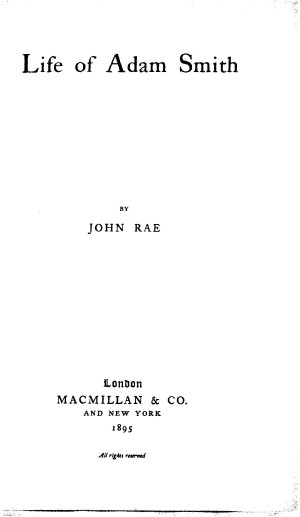
By all accounts, Adam Smith visited Geneva in the fall of 1765, yet the precise dates and locations of this brief but memorable chapter in his life are murky at best. [See, e.g., Brian Bonnyman, “Adam Smith in Geneva”, in Valérie Cossy, Béla Kapossy, & Richard Whatmore, editors, Genève, lieu d’Angleterre, Slatkine (2009), pp. 153-167.] The best account of Smith’s sojourn in Switzerland is still John Rae’s Life of Adam Smith (the cover page of which is pictured below), and Rae (1895, p. 188) has him arriving in Geneva in October of 1765: “They [Adam Smith, the two pupils under his care, and their respective servants] seem to have arrived in Geneva some time in October, and stayed about two months in the little republic of which … Smith had long been a fervent admirer.”
Although we do not know the precise date on which Smith arrived in Geneva, we do know that he was still in Toulouse as late as 4 October 1765, for on that date he played a small part in a celebrated case known as the “Douglas Cause“. According to the official record of this cause célèbre, the Scottish philosopher had been appointed as a special “commissioner” by two of the lead lawyers in this case — Andrew Stuart, who represented the Duke of Hamilton, and Alexander Maconochie, who represented Archibald Douglas — to take the testimony of the “Abbé de Colbert”, the Vicar-General of the Archdiocese of Toulouse and a distant relation to one of the parties. [See “Proof, in the conjoined processes, George-James Duke of Hamilton, Lord Douglas Hamilton, and their tutors, … pursuers, against the person pretending to be Archibald Stewart, alias Douglas, only son now on life of the marriage between Colonel John Stewart, afterwards Sir John Stewart of Grandtully, and Lady Jane Douglas …” (1766), p. 1019.] And so it was on the afternoon of 4 October 1765, acting in his capacity as commissioner, that Adam Smith duly took the deposition of his friend and close confidante Abbé Colbert. [See “Abbé Colbert’s examination, 4th October 1765” in ibid., pages 1019-1022.]
But when did Smith and his party leave the South of France for good? What route did they take on their way to Geneva? (Did they, perchance, visit Lyon?) And how long did it take them to complete their travels? Although these quotidian questions about Smith’s grand-tour itinerary are still open ones, we now know that Smith was already in the Swiss city-state by December 1765, for he attended a dinner party on Christmas Day at the house of Lord and Lady Stanhope: Philip Stanhope, 2nd Earl Stanhope, and his wife Grizel Hamilton. According to Brian Bonnyman (via historian Angela Bennett), “New evidence, in the form of an entry in Lady Stanhope’s guest lists, shows that Smith was definitely still in Geneva on Christmas day 1765, when he dined with the Stanhopes”. [See Bonnyman 2009, cited above, p. 165 n.374, citing the Kent County Archives, Maidstone, U1590 C42/2.3 (Stanhope Papers), Lady Stanhope’s Table Plans and Guest Lists.]
In fact, Smith may have already been in Geneva as early as the first week of December, if not earlier, for among Smith’s surviving correspondence and papers was another legal document, a formal legal memorandum dated 10-11 December 1765 attributed to Voltaire’s mistress and niece Madame Denis and describing an incident that took place on Voltaire’s country estate at Ferney on 7 December. (The small village of Ferney is located about three miles from the Swiss city-state on the French side of Geneva’s border with France; for further reference, Alain Alcouffe and I discuss the significance of the memo here, here, and here.) Although this memo is not addressed to Smith by name, why was it nevertheless in the Scottish philosopher’s possession? Perhaps he had visited Ferney shortly after the incident of 7 December or had developed a good rapport with Voltaire and Mme Denis around this time. [As an aside, Smith had been awarded the degree of Doctor of Laws (LL.D.) on 21 October 1762 by the University of Glasgow. See GUAS Ref: GUA 26645, p. 110, available here.]
Next is the question of Smith’s departure: how long did he stay in Geneva? Did he, for example, stay long enough to witness the dramatic and unprecedented political showdown that took place in the Swiss city-state in January 1766, when Geneva’s General Council refused to ratify the election of any leaders, thus leaving the little republic without a functioning government? Rest assured, Alain Alcouffe and I will revisit these questions in the next day or two …







 prior probability
Pingback: Adam Smith in Switzerland | prior probability