
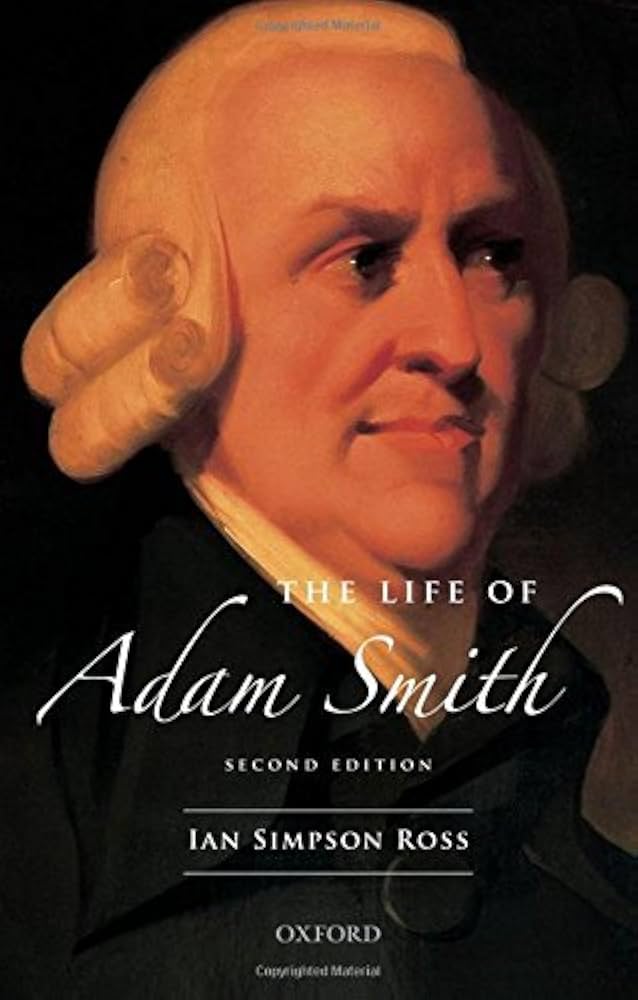
Who was the duchesse d’Enville, and what was Adam Smith’s relation to her? The one scholar who has the most to say about these enigmas is the late great historian Ian Simpson Ross. [See I. S. Ross, The Life of Adam Smith, Oxford U Press, 2nd edition (2010).] Among other things, Ross writes:
Genevan society was opened to Smith through Dr Théodore Tronchin, whose son Francois Louis had been a pupil in Glasgow from 1761 to 1763, and about whose education the father and Smith corresponded …. One of Tronchin’s patients at this time was the comtesse Rohan Chabot, who was accompanied in Geneva by her brother the duc de La Rochefoucauld and their mother, the duchesse d’Enville. This great lady of France was passionately interested in the newest advances in the sciences and humanities, and the range of possibilities for human improvement. The friend and confidante of Turgot, Intendant of Limoges from 1761, she encouraged him to study the Physiocratic writers carefully (Ruwet et al., 1976). Thus she is a possible channel for Smith’s awareness of the teaching and personalities of the Physiocrats, in addition to what he may have learned from articles by Quesnay and Turgot in the Encyclopédie, such as those on Epingle, Fermiers, Grain, and Foires et Marchés, in the volumes he bought for Glasgow University Library in 1759 (Ross, 1984a: 178-9, 183). [Ross 2010, p. 221]
According to Ross, the duchesse d’Enville also introduced Smith to many other Enlightenment intellectuals in addition to Turgot, including the the mathematician 2nd Earl Stanhope, the naturalist Charles Bonnet, and the physicist Georges-Louis Le Sage:
It was in the circle of the duchesse d’Enville that Smith met the mathematician 2nd Earl Stanhope. Smith came to be on such good terms with him that he acted as a go-between in 1774, when Stanhope secured the services of Adam Ferguson as travelling tutor to his ward, Lord Chesterfield (Corr. Nos. 138-42, also app. E, c-0; Raphael et al., 1990; Raphael, 1994). Genevan scientists with philosophical interests whom Smith met in the d’Enville circle were the naturalist, Charles Bonnet (1720-93), and the mathematical physicist, Georges-Louis Le Sage (1724-1803). [Ross 2010, p. 221]
Furthermore, Ross reports that “Smith attended the salons of the duchesse d’Enville in Paris, also those of Julie de L’Espinasse, a little further off, in rooms at No. 6 rue Saint Dominique, where d’Alembert was installed…. There was the difficulty that Smith spoke French very badly, a point that Mme d’Enville corroborated, though she claimed that she had learned English before Smith left Paris (Corr. No. 142).” [Ross 2010, p. 223] Although Ross cites a number of sources in support of his observations, he fails to mention in these passages his scholarly precursor John Rae, who wrote the most complete account of Smith’s sojourn in Switzerland. So, what does Rae have to say about about Adam Smith and the Duchesse d’Enville? (To be continued…)







 prior probability
Pingback: Adam Smith in Switzerland | prior probability