
Who was the Duchesse d’Enville, and what was Adam Smith’s relation to her? Among other things, according to Smith’s biographer John Rae, she “was a woman of great ability”, a “devoted friend of Turgot”, as well as a highly-educated and consummate hostess, for the Scottish philosopher was a “steady guest” at her house during his sojourn in Geneva:
The Duchesse d’Enville, at whose house Smith seems to have been so steady a guest, was herself a Rochefoucauld by blood, a grand daughter of the famous author of the Maxims, and was a woman of great ability, who was popularly supposed to be the inspirer of all Turgot’s political and social ideas, the chief of the “three Maries” who were alleged to guide his doings. Stewart tells us that Smith used to speak with very particular pleasure and gratitude of the many civilities he received from this interesting woman and her son, and they seem on their part to have cherished the same lively recollection of him. When Adam Ferguson was in Paris in 1774 she asked him much about Smith, and often complained, says Ferguson in a letter to Smith himself, “of your French as she did of mine, but said that before you left Paris she had the happiness to learn your language.” After two and a half years’ residence in France, Smith seems then to have been just succeeding in making himself intelligible to the more intelligent inhabitants in their own language …. The young Due de la Rochefoucauld, who, like his mother, was a devoted friend of Turgot, became presently a declared disciple of Quesnay, and sat regularly with the rest of the economist sect at the economic dinners of Mirabeau, the “Friend of Man.” When Samuel Rogers met him in Paris shortly after the outbreak of the Revolution, he expressed to Rogers the highest admiration for Smith, then recently dead, of whom he had seen much in Paris as well as Geneva, and he had at one time begun to translate the Theory of Moral Sentiments into French, abandoning the task only when he found his work anticipated by the Abbe Blavet’s translation in 1774. The only surviving memorial of their intercourse is a letter from the Duke … and in which he begs Smith to modify the opinion pronounced in the Theory on the writer’s ancestor, the author of the Maxims. (Rae 1895, pp. 192-193, footnote omitted.)
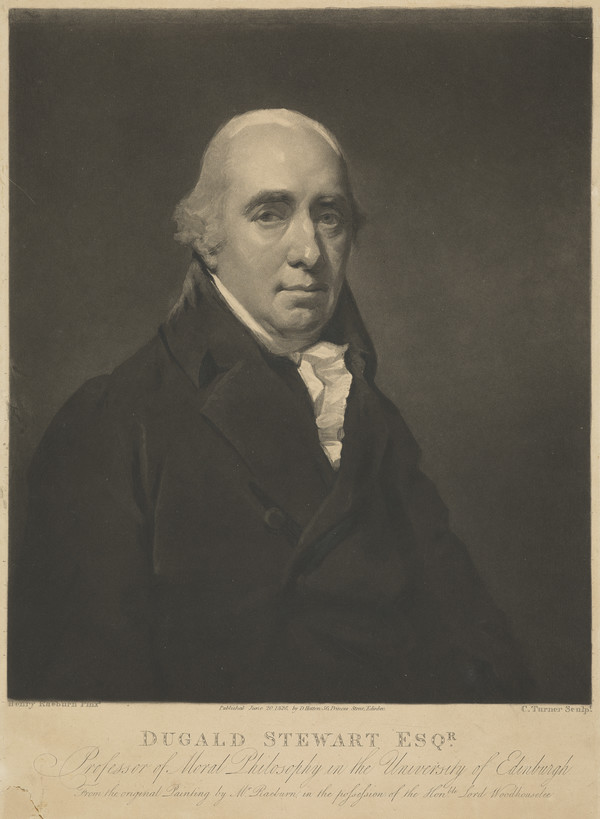
The reference to Stewart in the passage above is to Professor Dugald Stewart (pictured below), a Scottish philosopher and mathematician who not only knew Adam Smith personally; he also wrote the very first biography of the philosopher-economist. [See Dugald Stewart, “Account of the Life and Writings of Adam Smith, LL.D.”, in W. P. D. Wightman, editor, Essays on Philosophical Subjects, Liberty Fund (1982), pp. 263-351, available here.] But the only thing Stewart has to say about the duchesse’s relationship to Smith is this: “From Madam d’Anville, the respectable mother of the late excellent and much lamented Duke of La Rochefoucauld, he [Smith] received many attentions, which he always recollected with particular gratitude.” (Stewart 1982, p. 303, footnote omitted.)
What did these “many attentions” that Smith received from the Duchesse d’Enville consist of? Could some of these attentions have been romantic or amorous in nature? According to one historical source — a primary source no less — this intriguing possibility cannot be dismissed out of hand! Alain Alcouffe and I will introduce this source in our next post …










 prior probability
Pingback: Adam Smith in Switzerland | prior probability