
As I was saying in my previous two posts, I began teaching Roman and Constitutional Law in 1998, but one thing that I failed to mention is that I soon became frustrated with traditional legal analysis. Why? Because most legal scholars, like most economists, are prone to the Nirvana fallacy (if you know, you know!), and worse yet, most legal scholarship is tedious, normative (i.e. ideological), and non-falsifiable.
I therefore turned to game theory, a branch of mathematics, and by 2008 I had published my first formal paper, A Game-Theoretic Analysis of the Impasse over Puerto Rico’s Status, in which I model the legal and political debate about Puerto Rico’s constitutional status as a “truel” or three-man showdown.
And then, over the next 12 years, I extended the methods of game theory to a wide variety of legal and political questions, including the Coase theorem, litigation strategy, and the strategic decision whether to evade or comply with the law. Though only half of my body of formal work ever got published (indicated by an asterisk below), I ended up writing up an average of one game-theory paper per year during this span of time, 2008 to 2019:
- A game-theoretic analysis of public-private contracts in the water sector (2009). I presented this paper at the National University of Singapore in July of 2009.
- *El caso de Puerto Rico: a game-theoretic analysis of the Puerto Rican status debate (2010). I presented this paper at a LatCrit conference at American University in October of 2010.
- **Modelling the Coase Theorem (2012). This was my second peer-reviewed research article, which was published in Volume 5, Issue 2 of The European Journal of Legal Studies.
- Evade or comply? (2013). This work in progress models the strategic decision whether to evade or comply with the law.
- *The evolutionary path of the law (2014). Not really a game theory paper — it’s a review of a book about a theoretical biologist who made many contributions to game theory: Ullica Segerstråle’s beautiful biography of W. D. (Bill) Hamilton.
- *Does the prisoner’s dilemma refute the Coase Theorem? (2014). This paper, co-authored with my friend and colleague Orlando Martinez, relaxes some assumptions about the prisoner’s dilemma in order to allow Coasian bargaining between the prisoners.
- The poker-litigation game (2015). This paper presents a simple game-theoretic model of litigation.
- Law is a battlefield: the Colonel Blotto litigation game (2016). This draft paper presents a more complex game-theoretic model of litigation.
- Condorcet’s Paradox and Puerto Rico Status (2018). This draft paper models the Puerto Rico status debate as a voting paradox.
- **So long suckers: bargaining and betrayal in Breaking Bad (2019). My last game theory paper presents a four-player bargaining game called “So long suckers”.
* = published paper; ** = refereed
Why did I decide for all practical purposes to abandon game theory after 2019? In two words: I rediscovered Adam Smith … (To be continued.)
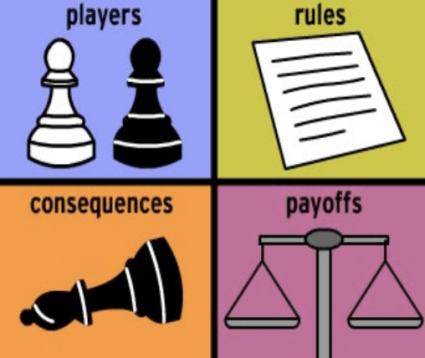
Postscript: If you want to look “under the hood” and learn about the nuts and bolts of game theory, check out this online course on “Game Theory” led by Professor Ben Polak (Yale) or this online course on “Model Thinking” led by Scott Page (Michigan). Enjoy!










 prior probability
Pingback: Blog update: future installments | prior probability
Pingback: A compilation of some of my book reviews | prior probability