
I have been busy working on a new whimsical literary project this week and will be sharing the fruits of my intellectual labors here starting today. My prologue is below the fold:
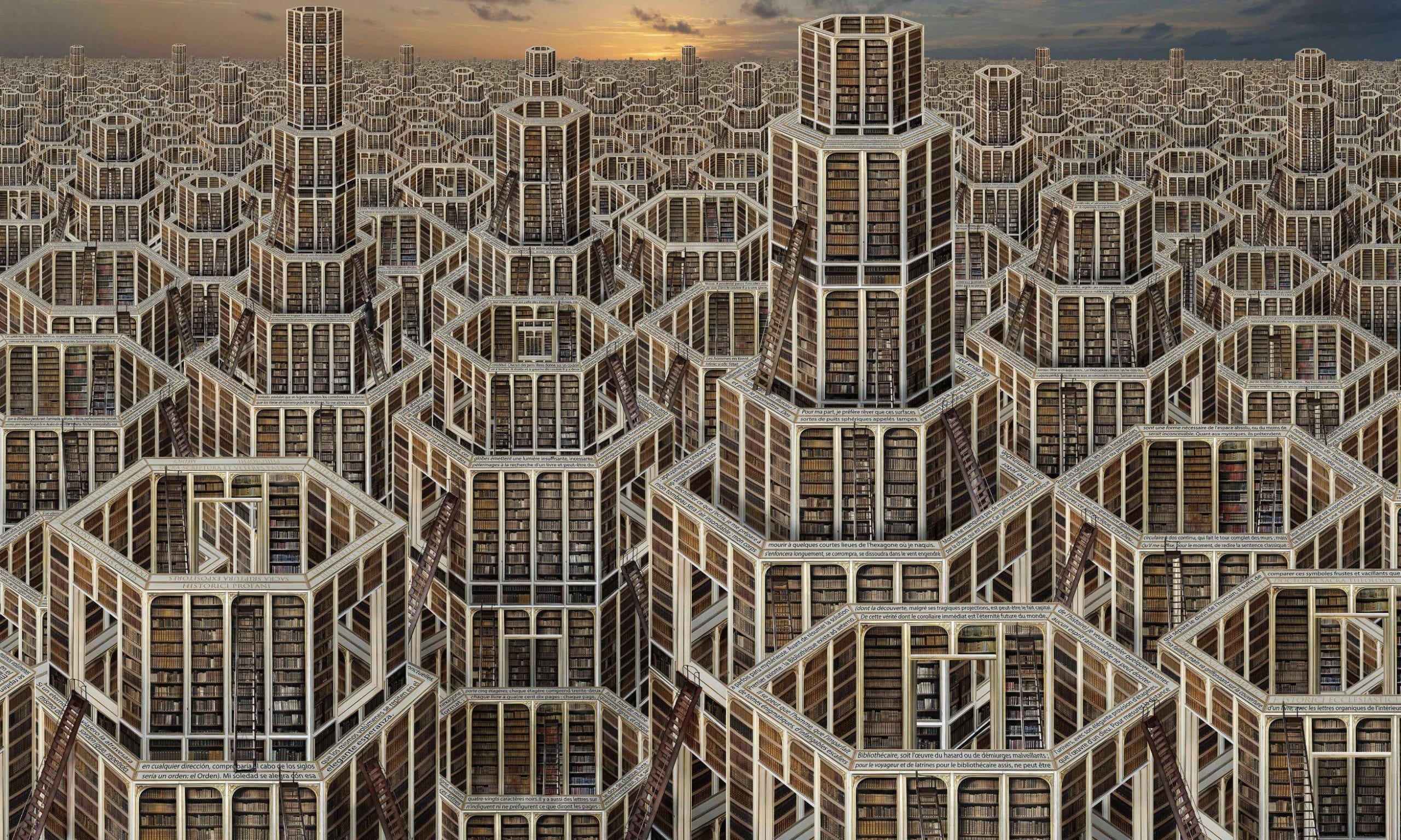
Is truth stranger than fiction? After all, popular culture is replete with the impossible and the magical: alien abductions, crazy conspiracy theories, superhero comic books and movies, sci fi novels, the list goes on and on. (See generally Jeffrey J. Kripal, Authors of the Impossible: The Paranormal and the Sacred, University of Chicago Press, 2010.)
To this motley list I would add one of the strangest and most haunting works of popular literary fiction that I have ever encountered: Jorge Luis Borges’ The Library of Babel. (Here is the relevant Wikipedia entry.) Although this fascinating short story consists of just 15 paragraphs (or about 2940 words), it is a great example of what Jeffrey Kripal has called “interdimensional bridging” (Kripal 2010, p. 24) or “the art of the impossible” (ibid., p. 4), for it not only presents an imaginary world consisting of a universal or total library containing every possible book that has ever been or could ever be written; it is also chock full of religious themes and references on every single page, including gods and malevolent demiurges, heaven and hell, mystics and idealists, infidels and inquisitors, gospels and heretical discords, just to name a few.
But is The Library of Babel meant to be a critique or a defense of either faith or reason? What if David Hume were to find himself in Borges’ imaginary library? How would this disorienting experience influence his famous argument against miracles? Stay tuned, I will jump into Borges’ infinite library in my next post, but in my retelling of the library story through a Kripalian lens, I will reframe the story as a three-act morality play as follows:
- Act I tracks the first seven paragraphs of the story, where Borges introduces the narrator of his story, who in turn identifies the fundamental laws or “axioms” of the universal library.
- Next, Act II refers to the middle paragraphs (8 to 11) of the story, which recounts three possible reactions, some more rational than others, to the sheer vastness and astronomical scale of Borges’ imaginary library.
- Lastly, Act III, the final act, which corresponds to the last part of the story (paragraphs 12 to 15), explores what Kripal might call “the impossible art of the infinite.”
Following this simple three-part narrative structure, I will survey the deeper spiritual meaning of Borges’ short story and imagine how a David Hume would react were he to find himself among the infinite hexagons of Borges’ library.







 prior probability