
Note: This blog post is based on the first draft of part 6 of my forthcoming paper with Alain Alcouffe, “Adam Smith and the salons of pre-revolutionary Paris” (footnotes omitted):
In addition to the celebrated salons of Madame du Deffand (see here) and the Duchesse d’Enville (here), it is also likely that Adam Smith visited the Paris salon of Madame la Comtesse de Boufflers, Marie Charlotte Hippolyte de Saujon (1725-1800), who was not only one of the most prominent salonnières of the Ancien Régime; she was also one of the most prominent Anglophiles in Paris, a femme de lettres who corresponded with and hosted such great Enlightenment figures as David Hume and Jean-Jacques Rousseau.
Among other things, Madame la Comtesse de Boufflers and her consort, the 6th Prince of Conti, Louis François de Bourbon (1717-1776), also hosted twice-weekly soirées and dinner parties (soupers) in their townhouse on the grounds of the Prince of Conti’s urbane Parisian compound, known as Le Temple. Historian Ernest Mossner describes their sumptuous soupers thus:
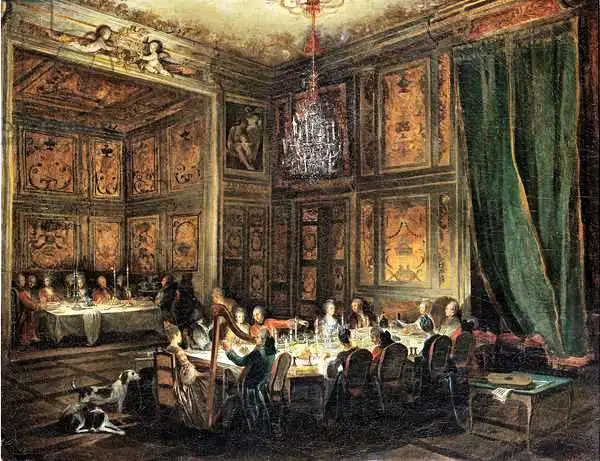
On Mondays the Prince de Conti was accustomed to give suppers to fifty or a hundred people. In the centre of the grand assembly room, the Prince and the Comtesse received their guests with formal dignity. The men stood in three ranks, the ladies sat on dainty chairs in a circle. But it was in the small Salon of the Four Mirrors that the distinctive reputation of the Temple was made. Mme de Boufflers was the soul of the salon, and Anglomania its prevailing atmosphere. Tea in the English fashion was served early in the evening as the last rays of the sun, reflected in the mirrors, tinted the walls with living colours. In the tradition inaugurated by the Regent to encourage free conversation, no servants were present. The ladies, wearing dainty aprons, lighted the lamps under the urns, poured the tea, cut the cakes, and passed the plates. For-incidental music, there might be a singer or a player upon the lute or the harpsichord. In the painting of Tea in the English fashion at the Prince de Conti’s made by Michel Barthelémy Ollivier in 1766, the child prodigy Mozart is seated upon a high chair before an open harpsichord. (Mossner 1980, p. 459, footnote omitted)
For visual reference, below is a reproduction of another 1766 oil painting by Michel Barthelemy Ollivier, Supper of Prince de Conti at the Temple:
The Prince of Conti’s lavish Paris compound, Le Temple, was located in the Marias district of the French capital (in today’s 3rd arrondissement), about 2.4 kilometers (1.5 miles) from the intersection of the rue de Seine and the original rue du Colombier. It was originally a medieval fortress built by the Knight Templars in the 12th and 13th centuries. Years later, Le Temple would be used to imprison Louis XVI, Marie Antoinette, and their children after the storming of the Tuileries palace in 1792. Although this historic structure was later destroyed during the tumult of the French Revolution (Mossner 1980, p. 459), it was immortalized on Plate 9 of the 1739 Turgot map of Paris, a close-up of which is presented below:

As it happens, we know that Smith and Madame la Comtesse de Boufflers met on more than one occasion. Although neither Boufflers nor the Prince of Conti are mentioned in Smith’s surviving Paris correspondence, other evidence indicates that Smith was personally acquainted with her and was a guest at her salon. In a letter addressed to her close friend and confidant David Hume, which is dated 6 May 1766, the Comtesse de Boufflers writes: “Je vous ai dit, ce me semble, que j’ai fait connoissance avec M. Smith, et que, pour l’amour de vous, je l’avois fort accueilli.” (“I told you, it seems to me, that I became acquainted with Mr. Smith, and that, for your sake, I warmly welcomed him.”)
In other words, the Comtesse de Boufflers tells Hume that she “warmly welcomed” Smith (“je l’avois fort accueilli”). This declaration implies that Smith must have attended her famed salon at least once in the spring of 1766, i.e. during his second visit to Paris. In fact, Smith may have visited the Temple and Madame de Boufflers more than once, for in another letter addressed to David Hume, this one dated 25 July 1766, the Comtesse reports: “Je fait prier votre ami Mr Smith de venir chez moi. Il me quitte à l’instant.” (“I prayed for your friend Mr Smith to pay me a visit. He’s leaving me right now.”)










 prior probability