
N.B.: This is Part 3 of my series on “Critical thinking in the age of A.I.”
As I mentioned in my previous post, critical thinking is supposed to help us overcome our biases, but is my own approach to critical thinking itself biased, incomplete, or otherwise off-base? (Recall how I defined critical thinking in Humean and Bayesian terms: careful evaluation and scrutiny of the available evidence, followed by periodic “updating” as new evidence becomes available.) David Hitchcock identifies several salient criticisms of the theory, pedagogy, and practice of critical thinking in his survey article for the Stanford Encyclopedia of Philosophy:
- Kal Alston (2001), “Re/Thinking Critical Thinking: The Seductions of Everyday Life”, Studies in Philosophy and Education, 20(1): 27–40. doi:10.1023/A:1005247128053
Among other things, Alston argues that the theory, pedagogy, and practice of critical thinking are biased because they favor written and spoken assignments over other forms of expression and focus attention to written and spoken communications over attention to human problems. For Alston, “critical thinking that reads arguments, texts, or practices merely on the surface without connections to feeling/desiring/doing or action lacks an ethical depth that should infuse the difference between mere cognitive activity and something we want to call critical thinking” (Alston 2001: 34, quoted in Hitchcock 2024, 12.2).
By way of example, she reports that the students in her women’s studies class were able to see the flaws in the Cinderella myth that pervades much romantic fiction but in their own romantic relationships still acted as if all failures were the woman’s fault and still accepted the notions of love at first sight and living happily ever after. Students, she writes, should “be able to connect their intellectual critique to a more affective, somatic, and ethical account of making risky choices that have sexist, racist, classist, familial, sexual, or other consequences for themselves and those both near and far” (Ibid.).
- David Hitchcock, “Critical Thinking“, in Edward N. Zalta & Uri Nodelman (eds.), Stanford Encyclopedia of Philosophy (Summer 2024 Edition).
What is the relationship of critical thinking to problem solving, decision-making, higher-order thinking, creative thinking, and other recognized types of thinking? As Hitchcock points out, the nature of this relationship is unclear. If critical thinking is conceived broadly to cover any careful thinking about any topic for any purpose, then problem solving and decision making will be kinds of critical thinking, if they are done carefully. If, however, critical thinking is conceived more narrowly as consisting solely of appraisal of intellectual products, then it will be disjoint with such constructive activities as problem solving and decision making. (See Hitchcock 2024, 12.3.)
- Jane Roland Martin, “Critical Thinking for a Humane World”, in Stephen P. Norris (ed.), The Generalizability of Critical Thinking, New York: Teachers College Press (1992), pp. 163–180.
Jane Roland Martin also highlights the problem of bias. For Martin, the theory, pedagogy, and practice of critical thinking are biased because of their supposed indifference to the situation of others over care for them (the indifference problem), their distancing from the object of inquiry over closeness to it (the distancing problem), and their orientation to thought over orientation to action (the thought over action problem). (See Hitchcock 2024, 12.2.)
- John E. McPeck, Critical Thinking and Education, New York: St. Martin’s Press (1981).
For McPeck, it is a conceptual truth that all critical thinking abilities are specific to a subject (the “strong subject-specificity thesis”). He therefore argues that there are no general thinking skills, since thinking is always thinking about some subject-matter. (See Hitchcock 2024, 12.1.)
- Richard W. Paul (1981), “Teaching Critical Thinking in the ‘Strong’ Sense: A Focus on Self-Deception, World Views, and a Dialectical Mode of Analysis”, Informal Logic, 4(2): 2–7.
Paul “bemoans the tendency of atomistic teaching of methods of analyzing and evaluating arguments to turn students into more able sophists, adept at finding fault with positions and arguments with which they disagree but even more entrenched in the egocentric and sociocentric biases with which they began” (Hitchcock 2024, 12.2).
- Barbara J. Thayer-Bacon, Transforming Critical Thinking: Thinking Constructively, New York: Teachers College Press (2000).
For her part, Thayer-Bacon argues that the theory, pedagogy, and practice of critical thinking are biased because they privilege reason over emotion, imagination, and intuition and solitary thinking over collaborative thinking. She contrasts the embodied and socially embedded learning of her elementary school students in a Montessori school, who used their imagination, intuition, and emotions as well as their reason, with conceptions of critical thinking as “thinking that is used to critique arguments, offer justifications, and make judgments about what are the good reasons, or the right answers” (Thayer-Bacon 2000, pp. 127-128, quoted in Hitchcock 2024, 12.2).
So, which of these objections (if any) is the most damaging one to my own Humean/Bayesian approach to critical thinking, and which of the critiques above are also relevant to large language models like ChatGPT? I will address these key questions in my next post …










 prior probability
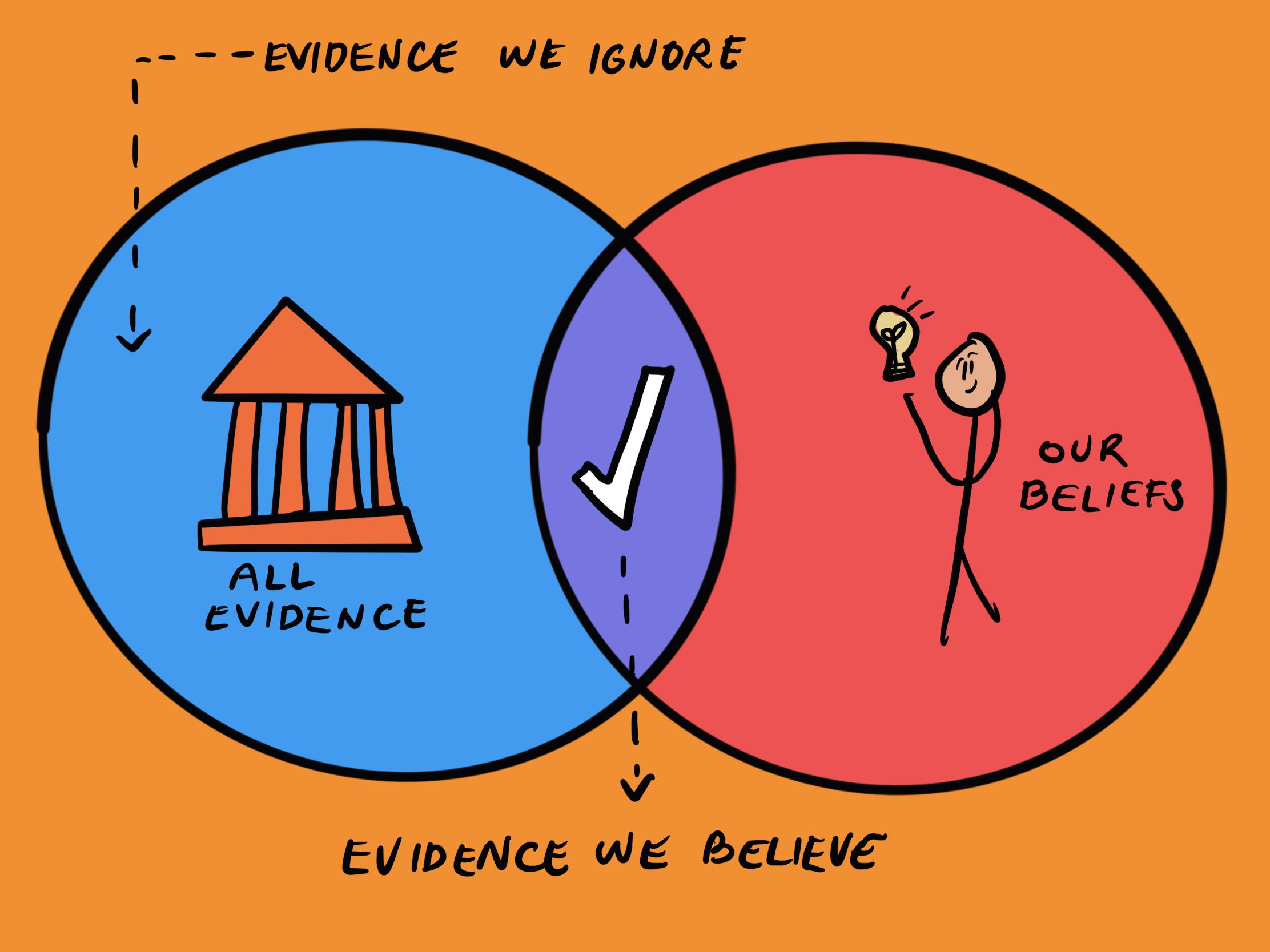
Interesting! Love the Venn diagram which definitely sums up your point.
A picture really is worth a 1000 words!!!
Pingback: ChatGPT’s pincer attack on critical thinking | prior probability
Pingback: Critical thinking as a communal activity | prior probability
Pingback: *Your brain on ChatGPT* | prior probability
Pingback: *Your brain on ChatGPT* | prior probability