
In a previous post, I mentioned a new paper by my colleague and friend John A. List (University of Chicago) titled “Enhancing Critical Thinking Skill Formation: Getting Fast Thinkers to Slow Down”, available here. Now that I have read this work, allow me to highlight some contributions Professor List makes to the critical thinking literature:
- Multiplicity of critical thinking definitions — Professor List begins his paper with this provocative statement: “I asked 30 people to define critical thinking. I received 25 different answers.”
- Critical thinking as “connecting the dots” — List describes critical thinking as “connecting the dots” and he also identifies two ways these metaphorical dots can be connected: “Connecting the dots with empiricism: developing and assimilating empirical evidence and updating of one’s beliefs” and “Connecting the dots with abstract thought: putting the puzzle together with conceptual reasoning; thought experiments”
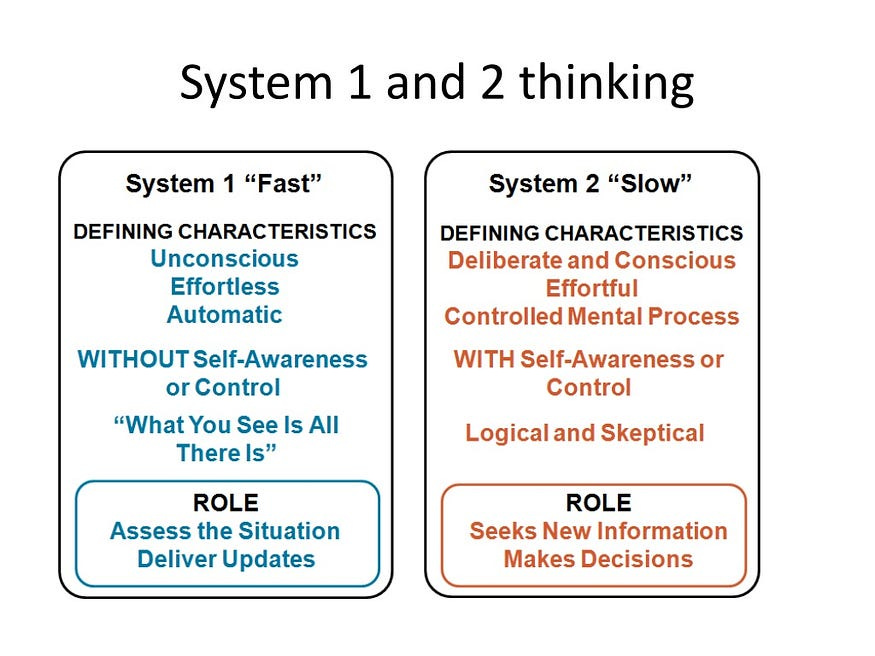
- Critical thinking as “slow thinking” — He then compares and contrasts so-called “slow” and “fast” thinking (see table below) and associates critical thinking with slow thinking. List writes, “… applying heuristics (‘fast thinking’) works well enough in most cases, making more effortful ‘slow thinking’ not worth it. The economic and psychological roots of this idea go back decades, and Kahneman scribed of its import in his 2011 popular book Thinking Fast and Slow. The unfortunate aspect of this human tendency is that in many cases cognitive biases creep into decisionmaking, so if we are not able to habitually think slowly, we will find it difficult to [engage in critical thinking].” (Postscript: For reference, here is a PDF of Kahneman’s influential book.)
Last but not least, Professor List describes “six basic tenets” of slow thinking/critical thinking on page 9 of his paper as follows:
- state, explain, and clarify the question(s)
- think through the question(s) from multiple points of view, expressing their own priors using logical thinking
- gather, organize, assimilate information and data
- identify assumptions, shortcomings, and implications of the data generation process
- update priors, both their own priors and consider how other’s views might change
- explain and apply what they learn, connecting what they just learned to other economic
concepts, learnings from another course, and/or their everyday life
For my part, I just want to add that Professor List’s set of “six basic tenets” looks a lot like my more simple Humean/Bayesian approach to critical thinking: careful evaluation and scrutiny of the available evidence, followed by periodic “updating” of one’s priors as new evidence becomes available. But that said, I really like how List breaks down both parts of my Humean/Bayesian approach into smaller components or steps. Now, with respect to the Generative A.I., however, the $64 question is this: do large language models like ChatGPT help us develop good questions, gather evidence, or update our priors, or do these models end up having the opposite effect? Alas, your guess is as good as mine!










 prior probability