
Buchanan versus Samuels, round 4
🇺🇸 Happy Independence Day! 🇺🇸 In my previous post, I explained why two great academic economists, James Buchanan and Warren Samuels, took an interest in Miller et al. v. Schoene (the cedar rust case). Simply put, this case illustrates a general problem in economics: the problem of harmful effects or negative externalities, when the activity of one firm creates spillover effects or imposes costs on third parties. But that said, why did they disagree so vehemently about how this old case was decided?
To appreciate the source of their disagreement, we must begin with Professor Samuels’s 1971 paper in the Journal of Law & Economics. (See Warren J. Samuels, Interrelations between Legal and Economic Processes, Journal of Law & Economics, Vol. 14, No. 2 (1971), pp. 435-450.) In that paper, Samuels (correctly, in my view) plays up “the ineluctable necessity of choice” whenever one party’s economic interests are harmed by another party’s conduct:
What Miller et al. v. Schoene illustrates first of all, indeed what the Court so clearly perceived, is the ineluctable necessity of choice on the part of government. The [legislature and the courts] had to make a choice as to which property owner was to be made not only formally secure but practically viable in his legal rights. The [Supreme] Court … had to make a judgment as to which owner would be visited with injury and which would be protected. (Samuels 1971, p. 438)
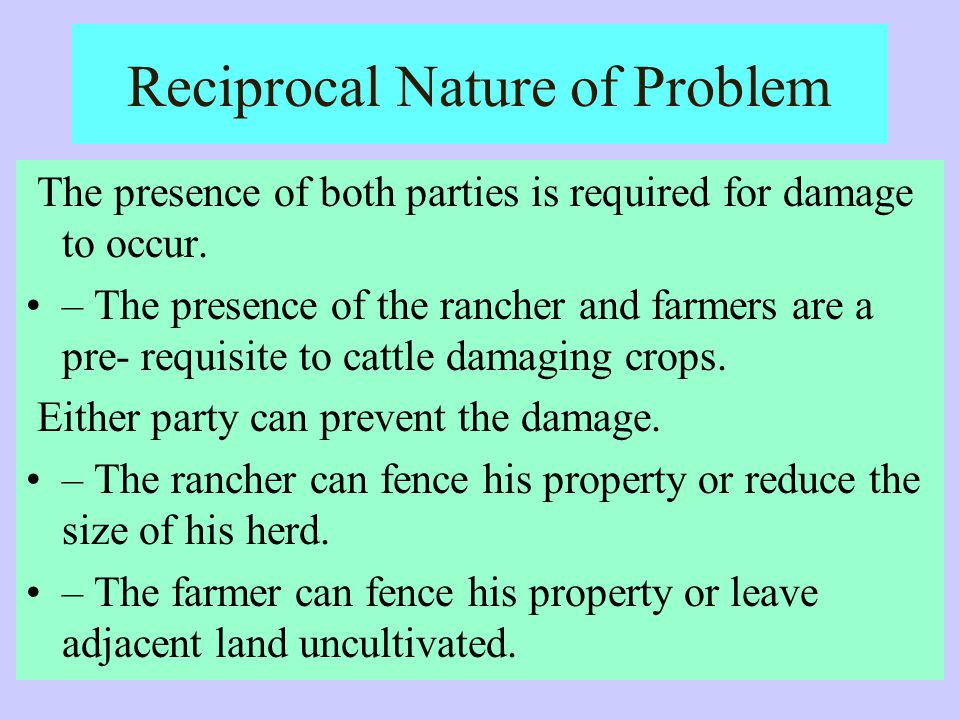
In other words, as the great Ronald Coase taught us long ago (see here or here, for example), the dispute between the owners of the red cedar trees and the owners of the apple orchids in Miller et al. v. Schoene is a “reciprocal” one for two reasons. First off, as Professor Samuels correctly notes in his 1971 paper, one of these two groups of owners is going to harmed no matter what action or inaction the State of Virginia takes or doesn’t take. Let me explain.
Recall that the law in dispute in Miller et al. v. Schoene was enacted to protect apple orchids from a plant disease known as cedar rust. Although cedar rust is harmless to most cedar trees, it can spread to apple orchids, cause the premature defoliation of apple trees, reduce their yield, and blemish their fruit. (See, for example, this summary by the U.S. Forest Service.) Now, imagine a world in which the State of Virginia does not enact the Cedar Rust Act. In that world, it is the owners of apple orchids who will be harmed, since they will be exposed to the risk of cedar rust if their orchids are located close enough to infected cedar trees. But at the same time, if the State of Virginia does enact a law like the Cedar Rust Act, it is the owners of red cedar trees who will be harmed, since they are exposed to risk of having to cut down their trees if their trees become infected with cedar rust. Either way, Professor Samuels’ main point is that one group or the other is going to be harmed.
(As an aside, the other reason why the dispute between the cedar tree owners and the apple growers is reciprocal is because either group of property owners could have taken pro-active steps to avoid the harm in the first place. Although Samuels omits this second reason from his paper, the simple truth is that the owners of the apple orchids could have cultivated a different type of fruit tree on their properties, one that is resistant to cedar rust, and likewise, the owners of the red cedar trees could have planted a different type of cedar tree on their properties, since not all cedar trees are susceptible to cedar rust. The Atlantic white cedar tree, for instance, is immune from cedar rust. Or in the alternative, fungicide sprays, if applied in a timely manner, are effective against cedar rust (see here), so either group could have applied fungicide treatments to their red cedars or to their apple orchids to reduce the risk of cedar rust.)
So, what is wrong with this Coasean picture of reciprocal harms? More specifically, what set James Buchanan off when he read Samuels’s 1971 paper, so much so that he wrote a strongly-worded reply paper? As it happens, Buchanan had a very good reason to object to Samuels’s analysis of the cedar rust case. I will explain why in my next post …










 prior probability
Pingback: Coase’s blind spot | prior probability
Pingback: James Buchanan-Warren Samuels Postscript | prior probability