
The penultimate part of my forthcoming survey of open Adam Smith problems with Salim Rashid (Chapter 12) contains a grab bag of additional sundry questions and miscellaneous Smith mysteries, all of which are deserving of further scrutiny. Below is an excerpt (footnotes are below the fold):
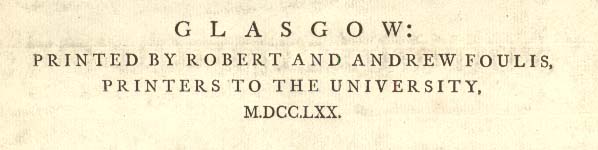
“In the very first letter that Adam Smith wrote to Charles Townshend (Corr. No. 39), Smith mentions that he ‘sent about a fortnight ago the books which you ordered for the Duke of Buccleugh [from] Mr. Campbell at Edinburgh.’[1] This letter is dated 17 September 1759, and according to Ernest Mossner and Ian Simpson Ross (1987, p. 57 n.2), the books Smith is referring to in his 17 September letter were supplied by Robert and Andrew Foulis, the printers to the University of Glasgow. Mossner and Ross also tracked down the complete list of books—46 separate tomes in all—meant for Duke Henry.[2] The list contains most of great works of ancient Greek and Roman literature, starting with Homer’s Iliad, and in the words of Mossner and Ross (ibid.), ‘The list is instructive in representing the range of authors thought suitable for educating the young Duke, and for reflecting the stock of the Foulis brothers, both as booksellers and printers.’[3] For reference, below is the list of books Smith had ordered for Duke Henry as reported by Mossner and Ross:
- Homeri Ilias 2 Vol. large folio
- —Odyssea 2 Vol. large folio
- Callimachus Gr. cum figuris folio
- Caesaris Opera folio
- Sophocles Gr. 4to
- Aeschylus Gr. 4to
- Plinij Epistolae & Panegyricus 4to
- Theocritus Gr. 4to
- Minucius Felix 4to
- Homeri Ilias 2 Vol. Gr. 4to
- Caesaris Opera 4to
- Boetius de Consolatione Philosophiae
- Tyrtaeus Gr. Lat. 4to
- Demetrius Phalereus de Elocutione
- Terentij Comoediae, 8vo
- Homeri Ilias Gr. Lat. 3 Vol. 8vo
- Sophocles Gr. Lat. 2 Vol. 8vo
- Aeschylus Gr. Lat. 2 Vol. 8vo
- Theocritus Gr. Lat. 8vo
- Minucius Felix 8vo
- Aristophanis Nubes Gr. Lat. 8vo
- Boetius de Consolatione, &c. 8vo
- Antoninus Gr. Lat. 8vo 2 Vol.[4]
- Plutarchus de Poetis audiendis Gr. Lat. 8vo
- Euripidis Orestes Gr. Lat. 8vo
- Aristoteles de Mundo Gr. Lat. 8vo
- Epictetus & Cebes Gr. Lat. 8vo large print
- Anacreon Gr. large print, 8vo
- Theophrasti Characteres Gr. Lat. large print 8vo
- Horatius, editio ultima 8vo
- Virgilius, editio ult. 8vo
- Sallustius 8vo
- Lucretius 8vo
- Paterculus 8vo
- Tibullus & Propertius 8vo
- Poetae Latini minores 8vo
- Iuvenalis & Persius 8vo
- Pomponius Mela de situ Orbis 8vo
- Phaedrus & P. Syrus 8vo
- Thucydides de Peste Gr. Lat. 8vo
- Plinij Epist. & Panegyr. 2 Vol. 12mo
- Tacitus 4 Vol. 12mo
- Hippocratis Aphorismi Gr. Lat. 12mo
- Epictetus & Cebes Gr. Lat. 12mo 2 6
- Pindari Opera 3 Vol. Gr. small size
- Ciceronis Opera 20 Vol. fine
“We have questions! Who put together this comprehensive list of classical readings? Adam Smith or Charles Townshend? Smith’s letter to Townshend informs us that it was the British politician who ordered the books, but it must have been Smith who recommended the titles in this list, right? Either way, how many of these classics had Smith himself read and studied, and which ones were his favorites? Also, how many of these great works were assigned readings in Smith’s own courses at the University of Glasgow?”
[1] According to Ernest Mossner and Ian Simpson Ross (1987, p. 57, n. 1), the reference to “Mr. Campbell” is to Archibald Campbell, “Writer to the Signet: agent of the Buccleuch family.”
[2] See Mossner & Ross 1987, pp. 57-58 n.2.
[3] Ibid.
[4] According to one source (the University of St Andrews Library, 2018), this text possibly refers to “Μαρκου Αντωνινου Αυτοκρατοροσ των εισ εαυτον βιβλια. Marci Antonini imperatoris eorum quae ad seipsum libri XII. By Marcus Aurelius. (Glasguae : In aedibus academicis, excudebat R. Foulis Academiae Typographus, MDCCXLIV. [1744]).” See: https://arts.st-andrews.ac.uk/transcribe/index.php/Antoninus_Meditations_Gr_Lat [https://archive.ph/bXhbc].










 prior probability