
Nota bene: this is the fourth of a series of blog posts on “the paradox of politics”; footnotes are below the fold.
“… where there is no law there is no freedom.” –John Locke, Second Treatise (quoted in Strauss & Cropsey 1987, p. 477)
In my previous post, we saw Thomas Hobbes’s elegant “social contract” solution to the paradox of politics: although men have the natural liberty to do whatever they please in a state of nature, they agree to transfer their liberty and other natural rights to a sovereign in exchange for protection. No mention of Hobbes, however, would be complete without John Locke (1632–1704), for Locke, building on Hobbesian foundations, presents a new and improved social contract solution.
For starters, although Locke’s picture of human nature appears to be more benign and pleasant than Hobbes’s, he ultimately agrees with Hobbes that the state of nature will often resemble a state of war. [1] Why? Because, as Locke himself concedes, “there is no common superior … to appeal to for relief” when one’s natural rights are violated in the state of nature. (p. 217) [2] In addition, Locke agrees with Hobbes that men will replace the state of nature with a sovereign or civil government: “I [Locke] easily grant, that civil government is the proper remedy for the inconveniences of the state of nature, which must certainly be great, where men may be judges in their own case ….” (p. 216, Locke’s emphasis)
So, how is Locke’s social contract theory any different from Hobbes’s. Simply put, Locke turns the logic of Hobbes’s social contract on its head. For Hobbes, we transfer our natural rights when we agree to the social contract for our mutual protection. Hobbes’s sovereign is not only our benefactor and protector; he is also our ultimate master. For Locke, it’s the other way around: we enter into a social contract to preserve our natural rights; the people are the ultimate masters!
There is another crucial difference between Hobbes and Locke: their definitions of natural liberty are totally different. Hobbes, for example, defines natural liberty as the right to do as one pleases: “The right of nature … is the liberty each man hath to use his own power as he will himself for the preservation of his own nature; that is to say, of his own life; and consequently, of doing anything which, in his own judgement and reason, he shall conceive to be the aptest means thereunto.” (p. 180) Locke, by contrast, imposes a limitation on our natural liberty: the harm principle. According to Locke, even when we are in the state of nature, we have a moral or natural law obligation not to harm others:
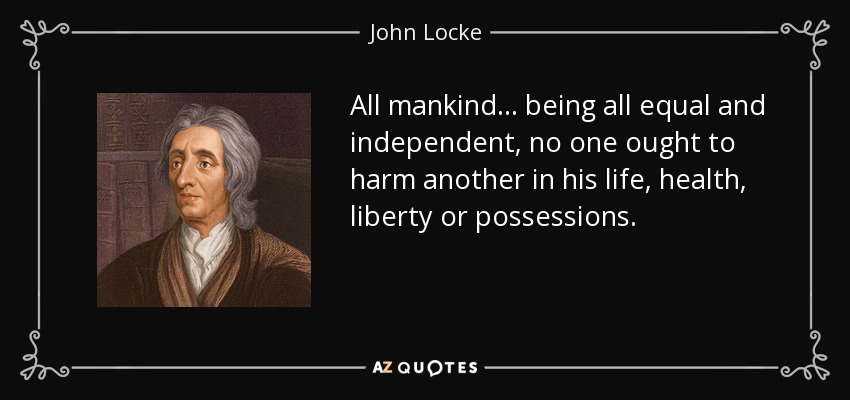
“The state of nature has a law of nature to govern it, which obliges every one: and reason, which is that law, teaches all mankind, who will but consult it, that being all equal and independent, no one ought to harm another in his life, health, liberty, or possessions.” (p. 214, Locke’s emphasis)
Locke’s harm principle sounds a lot like John Stuart Mill’s, but Locke’s conception of the harm principle is grounded in God-given natural law, whereas Mill’s is grounded in the principle of utility. But regardless of its source (God versus utility), Locke’s harm principle is crucial because it not only explains the ultimate purpose of civil government and law (harm prevention); it also appears to solve the paradox of politics by imposing an outer limit on government power, a red line that neither law nor politics may not cross. But does Locke’s solution (or Mill’s, for that matter) really work? Alas, it does not. (To be continued …)
[1] For a more detailed discussion of the similarities between Locke and Hobbes’s states of nature, see page 485 of Laurence Berns’s essay on Thomas Hobbes in Leo Strauss and Joseph Cropsey (eds.), History of Political Philosophy, 3rd ed. (University of Chicago Press, 1987).
[2] All remaining page references in the main body of this post are to Mitchell Cohen (ed.), Princeton Readings in Political Thought, 2nd ed. (Princeton University Press, 2018).







 prior probability
Pingback: David Hume’s devastating take-down of Hobbes, Locke, and Rousseau | prior probability
Pingback: The paradox of politics: part 2 | prior probability