
Nota bene: this is the sixth of a series of blog posts on “the paradox of politics”; footnotes are below the fold.
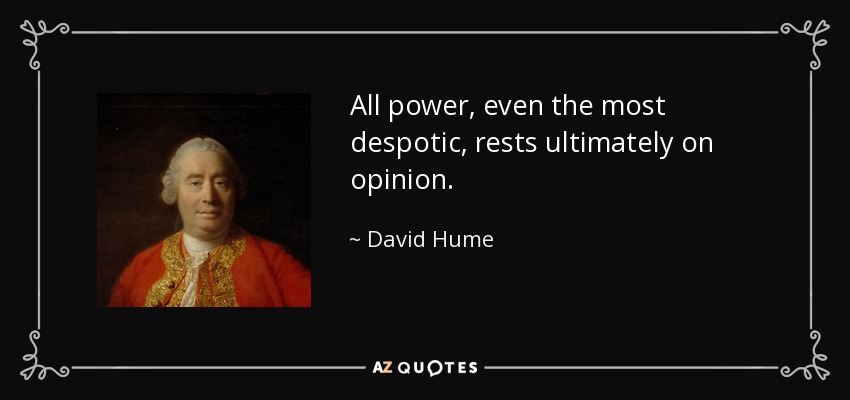
We saw David Hume’s devastating take-down of social contract theories in my previous post — governments and property rights did not originate in some fictitious or fanciful social contract; they are founded on force or fraud — but how does Hume resolve the tension between law and liberty? In a word (two words, actually), Hume’s solution to the paradox of politics is public opinion or “the common sentiments of mankind”:
“We shall only observe, before we conclude, that though an appeal to general opinion may justly, in the speculative sciences of metaphysics, natural philosophy, or astronomy, be deemed unfair and inconclusive, yet in all questions with regard to morals, as well as criticism, there is really no other standard by which any controversy can ever be decided.”[1]
But does political philosophy fall under “the speculative sciences of metaphysics, natural philosophy, or astronomy” or is it more like “all questions with regard to morals, as well as criticism”? Or more simply put, is the paradox of politics a science question or a moral/aesthetic one? For Hume, law and politics are practical matters rooted in human nature and social utility. [2] As a result, Hume’s standard for resolving high-level legal and political disputes is not some objective, universal truth grounded in a hypothetical contract; his standard is purely subjective: public opinion.
Hume’s public-opinion approach to political philosophy is not for the feint of heart; after all, public opinion can not only change over time; the public might also prefer a dictatorship over democracy or racial segregation over racial mixing or whatever. [3] Nevertheless, for my part, I find myself in agreement with Hume’s approach to law and politics: there are no universal or objective “right answers” to contentious legal, moral, and political questions, including the ultimate question of how to balance law and liberty. Instead, it is public opinion (“the common sentiments of mankind”) that is the final arbiter of all moral and political questions. For Hume and me, it is public opinion that ultimately decides how much liberty we are willing to give up in exchange for safety and security.
But Hume’s public opinion approach to politics poses two new open practical questions. One is the measurement question: how do we measure public opinion? Is it even possible to measure such a thing in a reliable and accurate manner? The other open question is the problem of conflicting or diametrically-opposed public opinions (plural): what happens when the public is split or polarized over any given matter? (Also, even if an overwhelming majority of the public agrees on X, what about the rights of the minority?) Stay tuned, I will discuss what I consider to be the most compelling and original reply to these questions in my next post. (To be continued …)
[1] Hume, Of the Original Contract, fourth to last paragraph (quoted in Cohen 2018, p. 269).
[2] Indeed, Hume says as much in the first paragraph of his essay “On the First Principles of Government” (Essay IV): “It is therefore, on opinion only that government is founded; and this maxim extends to the most despotic and most military governments, as well as to the most free and most popular.”
[3] See ibid.










 prior probability
Pingback: The paradox of politics: part 2 | prior probability
Pingback: Rousseau’s god | prior probability