
Nota bene: this is the seventh of a series of blog posts on “the paradox of politics”.
We saw in my previous post how David Hume replaces natural law and social contracts with public opinion, but is the Scottish skeptic right? Are questions of morality and politics just a matter of public opinion or “the common sentiments of mankind”?
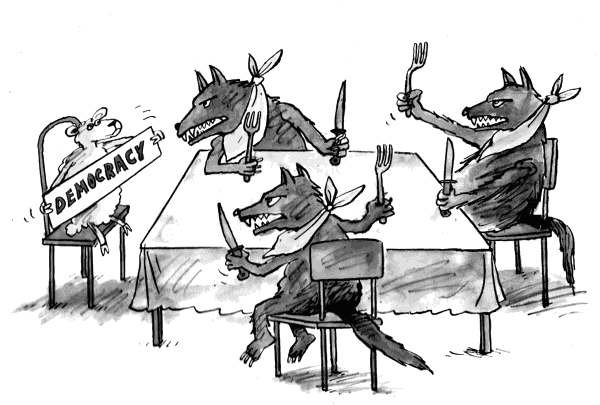
Let’s assume (for now) that Hume is right, that public opinion is the ultimate sovereign. Then what about the rights of those free spirits who dissent from public opinion on a particular topic? In other words, how do we protect ourselves against “the tyranny of the majority”? Also, what about polarization? What happens when the public is split dead even over a given topic? And how do we measure public opinion in the first place?
To my knowledge, only two thinkers have really taken Hume’s public opinion theory of politics seriously and have grappled with these difficult questions. One is John Rawls. The other was a North American contemporary of David Hume. Let’s call him X for now. (I don’t want to reveal his identity yet; instead, I will rehearse his argument to see if you can guess who he is.)
What I like most about X are two things: (1) his poignant diagnosis of the dangers of allowing public opinion to decide policy — among other things, he concedes right off the bat that public opinion, left unchecked and free to rear its ugly head, is a “dangerous vice” and destabilizing force, a “mortal disease” that promotes a “factious spirit” (i.e. an us-against-them mentality) and that generates nothing but “instability, injustice, and confusion” — and (2) his explanation of the central role liberty plays in promoting this mortal political disease.
According to X, there are two methods of curing this mortal political disease: “the one, by removing its causes; the other, by controlling its effects.” (p. 322) But how does one remove the causes of this dangerous vice, the tyranny of public opinion? One is an Orwellian dystopian dictatorship: compel and coerce every person to have the same opinions, the same passions, and the same interests. X, however, rejects this radical solution out of hand (and rightfully so!), for the problem with an Orwellian dictatorship is that people are different. We have different opinions, different passions, different interests, different talents, and “different and unequal faculties of acquiring property”:
“As long as the reason of man continues fallible, and he is at liberty to exercise it, different opinions will be formed. As long as the connection subsists between his reason and his self-love, his opinions and his passions will have a reciprocal influence on each other; and the former will be objects to which the latter will attach themselves. The diversity in the faculties of men, from which the rights of property originate, is not less an insuperable obstacle to a uniformity of interests.” (p. 322)
The other way of removing the causes of this mortal political disease is a Marxist-Leninist revolution: do away with liberty, eliminate the freedom to form opinions, express one’s passions, or pursue private interests. Again, X rightfully rejects this remedy as well:
“It could never be more truly said than of the [Marxist-Leninist] remedy, that it was worse than the disease. Liberty is to [public opinion] what air is to fire, an aliment without which it instantly expires. But it could not be less folly to abolish liberty, which is essential to political life, because it nourishes [public opinion], than it would be to wish the annihilation of air, which is essential to animal life, because it imparts to fire its destructive agency.” (ibid.)
Have you figured out who X is yet? I will reveal his identity and describe X’s ingenious solution to the paradox of politics — i.e. the tension between the dangers of public opinion and the importance of liberty — in my next post. (In the meantime, if only the 20th century had listened to X!)







 prior probability
Pingback: The paradox of politics: part 2 | prior probability