
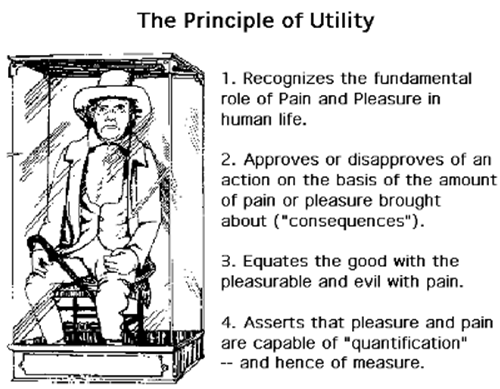
Why do I include the English social reformer Jeremy Bentham (1748-1843) in my survey on the “paradox of politics”? Because Bentham’s solution to the law-liberty dilemma is at once novel, original, and extremely dangerous! Before Bentham, the main goal of most Anglo-American political philosophers was to find a way of protecting us from each other while at the same time preserving or maximizing our natural liberty. Bentham’s approach, by contrast, replaces this emphasis on natural liberty with a totally new and alternative criterion. Simply put, Bentham would swap out liberty for utility. In his landmark work on “The Principles of Morals and Legislation” (first published in 1780!), Bentham presents a crude version of act-utilitarianism:
By the principle of utility is meant that principle which approves or disapproves of every action whasoever, according to the tendency which it appears to have to augment or diminish the happiness of the party whose interest is in question …. I say of every action whasoever; and therefore not only of every action of a private individual, but of every measure of government. (Bentham, An Introduction to the Principles of Morals and Legislation (1780), reprinted in Cohen 2018, p. 365, emphasis added)
In other words, the “principle of utility” is not only total–it applies to every decision, whether made by a private individual or by a collective body–it is also exclusive of any other moral or political value. Life, liberty, and property (and any other natural right, for that matter) are not just secondary values; they are irrelevant! And that, in a nutshell, is why Bentham’s appeal to utility is so dangerous. To see why, consider the following thought experiment inspired by Bernard William’s “Jim and the Indians” scenario (see here or here, for example): if killing an innocent man, enslaving him, or expropriating his wealth would promote the overall good or happiness of everyone else, then by all means: execute him, put him in chains, or steal his stuff. We are not only morally justified in violating the innocent man’s rights; the principle of utility, when taken to its logical conclusion, would require us to do so!
Suffice it to say that subsequent generations of utilitarians have tried to salvage Bentham’s utility criterion in many different ways. (Peter Singer, for example, famously expands the circle of people, including animals, whose interests we must include in our moral calculus.) Among the most heroic attempts to rescue utilitarianism is John Stuart Mill’s. More specifically, as we shall see in my next post, Mill qualifies the principle of utility in three ways …







 prior probability
Pingback: J. S. Mill’s effete and elitist rescue operation | prior probability
Pingback: Mill’s proviso: the harm principle | prior probability