
I introduced John Stuart Mill’s libertarian harm principle (or what I prefer to call “Mill’s proviso”) in my previous post: people should be free to think, speak, and act as they please as long as no else is harmed. But how far does Mill’s celebrated solution to the paradox of politics take us? As we shall see in today’s post, not very far, for Mill’s harm principle has a huge blind spot: who decides? Who gets to define what constitutes a harm?
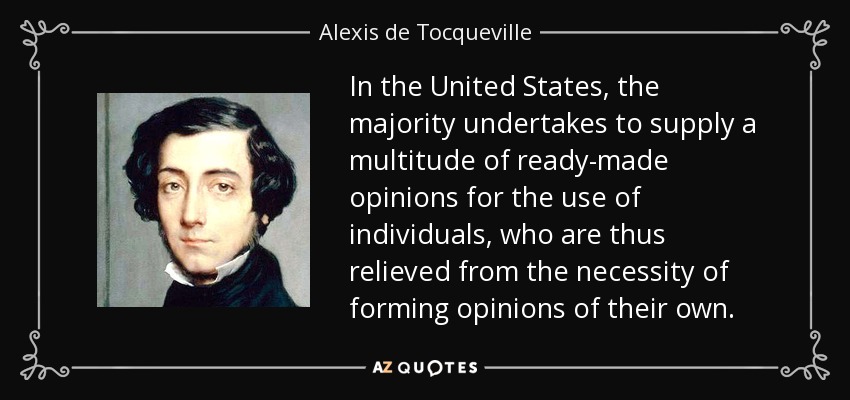
To the point, if it’s “the people” who have this power (the power to punish harms), then what is to prevent the majority from defining harms in a broad or biased manner? On this note, it was Alexis de Tocqueville, two decades before Mill’s On Liberty, who spotted this perilous loophole and warned of this great danger in his classic work Democracy in America: the tyranny of the majority. [1] For de Tocqueville, this majoritarian menace is not some remote peril or minor irritant; it is a clear and present danger that stifles dissent and tramples freedom of expression and thought, a looming and omnipresent hazard that is every bit as relevant today as when he visited the United States in the 1830s:
I know no country in which there is so little true independence of mind and freedom of discussion as in America…. In America the majority raises very formidable barriers to the liberty of opinion: within these barriers an author may write whatever he pleases, but he will repent it if he ever step beyond them…. Every sort of compensation, even that of celebrity, is refused to him. Before he published his opinions he imagined that he held them in common with many others; but no sooner has he declared them openly than he is loudly censured by his overbearing opponents, whilst those who think without having the courage to speak, like him, abandon him in silence. He yields at length, oppressed by the daily efforts he has been making, and he subsides into silence, as if he was tormented by remorse for having spoken the truth. [2]
In short, the tyranny of majority rule can be every bit as illiberal and oppressive as the most absolute monarch or tyrannical despot! And this is why Mill’s proviso, the harm principle, standing alone is such a toothless tiger. In a popular democracy, where the majority calls the shots and where public opinion rules the day, there is nothing preventing a stable or transient majority from defining harms so broadly or selectively as to include all manner of words, thoughts, and behavior that the majority does not approve of. [3]
But is it possible to tame or check this majoritarian menace without undermining popular democracy itself? Is there an effective antidote to the tyranny of the majority? As it happens, as I shall discuss in my next post, Alexis de Tocqueville identifies three practical cures or home remedies, so to speak, that might “mitigate” or lessen this danger. (To be continued …)
[1] See Alexis de Tocqueville, Democracy in America, especially Chapter XV, reprinted in Cohen 2018, pp. 401-406.
[2] Ibid., p. 403, emphasis added.
[3] See ibid., pp. 406-410.










 prior probability