
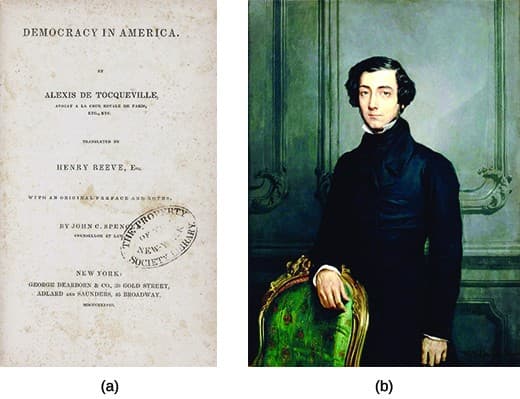
John Stuart Mill and Alexis de Tocqueville are in agreement that the “tyranny of the majority” poses the greatest danger of all to individual liberty, but what is to be done? We already saw Mill’s proposed remedy (the harm principle) and why this antidote is a toothless tiger (the majority itself gets to define what constitutes a harm), but what is de Tocqueville’s solution to the law-liberty dilemma? As it happens, de Tocqueville identifies three specific features of North American society that are supposed to “mitigate” or tame the tyranny of the majority: juries, the legal profession, and the small scale and limited powers of the central government. [1] Alas, for the reasons below, none of these three bygone checks on majority rule are relevant to our political world today:
1. Feature #1: Juries. Let’s start with juries. De Tocqueville extols juries as “a gratuitous public school, ever open, in which every juror learns his rights … and becomes practically acquainted with the laws ….” [2] But as my colleague and friend Marc Galanter has shown, fewer and fewer cases — State and federal, civil and criminal – now go to trial. [3] The number of jury trials in U.S. federal courts, for example, reached a peak in 1985, with a total of 12,529 civil and criminal trials. Since then, we have seen a dramatic decline in the number of jury trials: in 2023 there were a combined total of 2,912 civil and criminal jury trials. [4] Simply put, most cases get settled out of court. As a result, not only has public participation in law cases via juries declined; legal decisions have also become increasingly private, negotiated out of court, and thus invisible to the public.
2. Feature #2: Lawyers. What about the legal profession? According to de Tocqueville, lawyers are a kind of intellectual “aristocracy” who act as a check or “counterpoise” on the tyranny of the majority. [5] How? Because lawyers, by training, are cautious and conservative by nature — conservative not in a political sense but in terms of their “taste for formalities”, their respect for binding precedent, and above all their emphasis on process. [6] Members of the legal profession are thus a stabilizing force that conspire to maintain order: “they constantly endeavor to turn [the institutions of democracy] away from its real direction ….” [7]
Whether or not this idealized picture of the legal profession was true when de Tocqueville was writing Democracy in America, it is certainly not accurate today. According to a 2023 Gallup poll, for example, only 23% of the public view lawyers in a positive light, and fewer still (about 16%) of those surveyed rated their honesty as “high” or “very high”. [8] Either way, regardless how the legal profession is perceived by the public, one could argue that lawyers as a whole have done just as much to promote the tyranny of the majority as they have done to retard it. After all, it is perhaps no coincidence that so many lobbyists are lawyers1
In theory, lobbying allows any interest to be heard; in practice, however, lawyer-lobbyists tend to defend concentrated interests (i.e. factions) that already have clout: large corporations, trade associations, and labor unions. These factions hire lawyer-lobbyists not only to extract rents from government agencies (e.g. subsidies, tax breaks, or regulations that hinder competition) but also to justify their rent-seeking schemes to the broader public through slick ad campaigns and strategic political donations. So, instead of checking majority rule, lawyer-lobbyists often amplify it.
3. Feature #3: Limited Power. Last but not least, de Tocqueville describes a third feature of North American democracy that works to tame the tyranny of the majority, namely the “absence of centralized administration”:
In the American republics, the central Government has never as yet busied itself but with a small number of objects, sufficiently prominent to attract its attention. The secondary affairs of society have never been regulated by its authority, and nothing has hitherto betrayed its desire of even interfering in them. [9]
Hah! Although it is true that our federal government was supposed to have only limited and enumerated powers, [10] it has since grown into such a large behemoth of monstrous proportions that Hobbes’s despotic “Leviathan” pales in comparison! Our current federal regime is not only massive by any measure (the total amount of federal spending represents almost 25% of the U.S.’s total economic output [11]); the Feds now have the almost unlimited power to regulate every nook and cranny of the economy. Indeed, federal law has become so complex and massive no one knows for certain how many federal criminal laws there are! [12]
Are we therefore doomed? Is the tyranny of the majority destined to enslave us? What if, however, the “tyranny of the majority” is a total misnomer? What if, instead of being a force of oppression, majority rule were the true source of freedom? We will explore this counter-intuitive Rousseaian possibility when I resume my series on the paradox of politics next week. (To be continued …)
[1] Alexis de Tocqueville, Democracy in America, especially Chapter XV, reprinted in Cohen 2018, pp. 406-410.
[2] Ibid., p. 409
[3] Marc Galanter, “The Vanishing Trial: An Examination of Trials and Related Matters in Federal and State Courts”, Journal of Empirical Legal Studies, Vol. 1, No. 3 (2004), pp. 459-570.
[4] Jeffrey Q. Smith and Grant R. MacQueen, “Going, Going, But Not Quite Gone: Trials Continue to Decline in Federal and State Courts”, Judicature, Vol. 101 No. 4 (2017), pp. 26-39.
[5] de Tocqueville, op. cit., p. 408.
[6] Ibid., p. 407.
[6] See ibid., pp. 407-409.
[7] Ibid., p. 408.
[8] Debra Cassens Weiss, “Lawyers viewed as more ethical than car salespeople and US lawmakers”, ABA Journal (January 30, 2024).
[9] de Tocqueville, op. cit., p. 406.
[10] Cf. Federalist #51.
[11] According to the U.S. Department of Treasury, the federal government spent $7.01 trillion in fiscal year 2025, which represents about one-quarter of the U.S.’s total gross domestic product (GDP). See “How much has the U.S. government spent this year?“, Department of Treasury (last updated: September 30, 2025).
[12] See Gary Fields and John R. Emshwiller, “Many Failed Efforts to Count Nation’s Federal Criminal Laws”, Wall Street Journal (July 23, 2011).










 prior probability