
Before we resume my survey of the paradox of politics, let’s recap three major motifs in Rousseau’s Second Discourse, themes that still resonate with many people, especially progressives, today:
- Critique of Hobbes. First off, Rousseau rejects the Hobbesian portrait of man in the state of nature. According to Rousseau, men were once angels: the Second Discourse describes a bygone golden age unspoiled by any small-scale (let alone large-scale) cooperation, an idyllic world in which there is no specialization or division of labor.
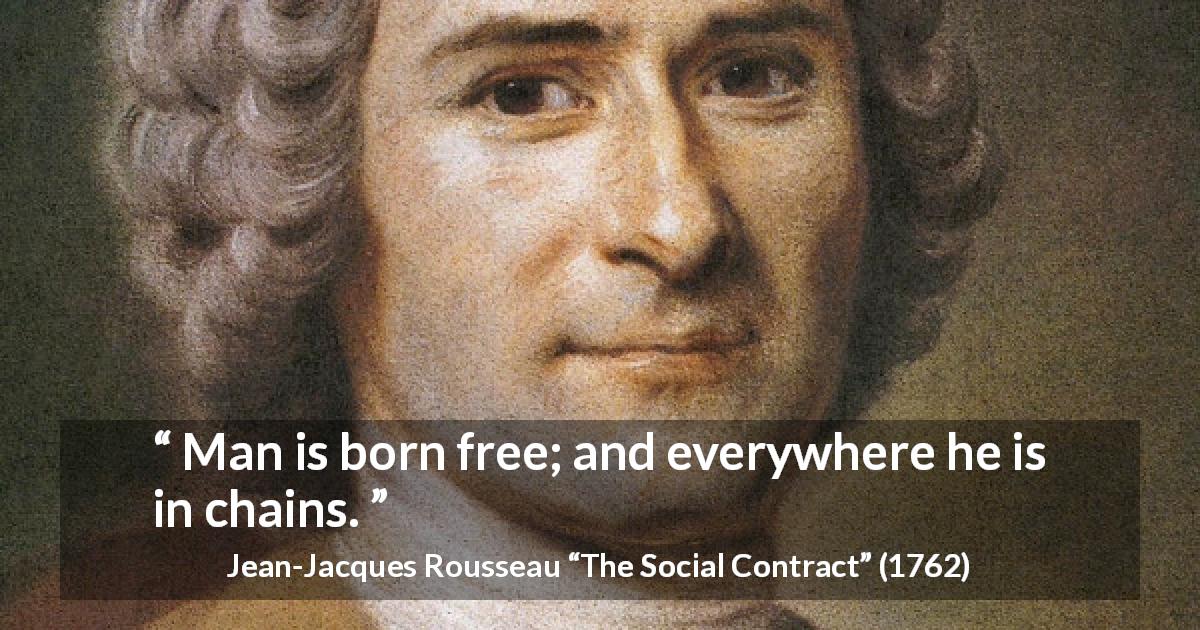
- Critique of Locke. Rousseau also rejects Locke’s classical liberal defense of property rights. For Rousseau, the first man who said “this is mine” committed the original sin of private property, for the pursuit of property not only makes us dependent on others; it is also the root cause of social inequality, human conflict, and moral corruption.
- Critique of commercial society. Even if you disagree with Rousseau’s critiques of Hobbes and Locke (as I do), Rousseau’s Second Discourse is still worth reading. Why? Because Rousseau’s main point seems to be a valid one: we are stuck in a never-ending and pointless rat race; worse yet, the accumulation of property transmutes man into the moral equivalent of a slave, a slave to his self-interest, his vanity, and a desire for distinction.
In short, where James Madison, John Stuart Mill, and Alexis de Tocqueville warn us against the tyranny of the majority, Rousseau rails against private property, social inequality, and moral corruption. So, what is to be done? Can man be redeemed now that property is an established institution and the pursuit of self-interest, the norm? I will present Rousseau’s ingenious but treacherous proto-Rawlsian solution to the law-liberty dilemma in my next post …










 prior probability
Pingback: Christmas season update | prior probability