
The first three chapters of The Wealth of Nations (WN, I.i-iii) are devoted to the division of labor. Although Adam Smith will later have some bad things to say about the individual effects of the division of labor in Book V of his magnum opus, [1] in chapter one (available here) his focus is on the aggregate effects of specialization on the economy as a whole. Here (chapter 1), he makes three original observations:
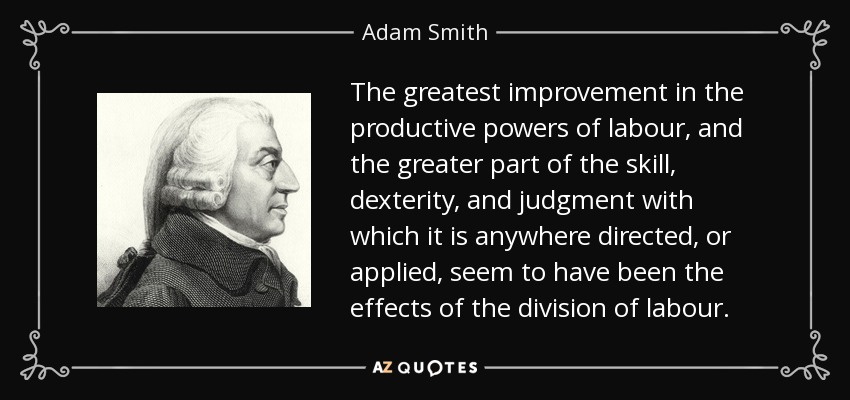
- The division of labor promotes productivity. Smith begins his book with his now famous pin factory to show how the division of labor (specialization) makes the economy as a whole more productive: when we work together as a team and when each member of the team focuses on a small number of specific tasks, the resulting increase in our combined productivity becomes exponential because we can now produce more goods and services than if we each tried to produce everything ourselves.
- The division of labor improves our quality of life. At the end of the first chapter, in one of the most memorable passages in the entire Wealth of Nations, Smith patiently points out that it has been the steady process of specialization that has improved our material standard of living:
Were we to examine, in the same manner, all the different parts of his dress and household furniture, the coarse linen shirt which he wears next his skin, the shoes which cover his feet, the bed which he lies on, and all the different parts which compose it, the kitchen-grate at which he prepares his victuals, the coals which he makes use of for that purpose, dug from the bowels of the earth, and brought to him perhaps by a long sea and a long land carriage, all the other utensils of his kitchen, all the furniture of his table, the knives and forks, the earthen or pewter plates upon which he serves up and divides his victuals, the different hands employed in preparing his bread and his beer, the glass window which lets in the heat and the light, and keeps out the wind and the rain, with all the knowledge and art requisite for preparing that beautiful and happy invention, without which these northern parts of the world could scarce have afforded a very comfortable habitation, together with the tools of all the different workmen employed in producing those different conveniencies; if we examine, I say, all these things, and consider what a variety of labour is employed about each of them, we shall be sensible that without the assistance and co-operation of many thousands, the very meanest person in a civilized country could not be provided, even according to what we very falsely imagine, the easy and simple manner in which he is commonly accommodated. Compared, indeed, with the more extravagant luxury of the great, his accommodation must no doubt appear extremely simple and easy; and yet it may be true, perhaps, that the accommodation of an European prince does not always so much exceed that of an industrious and frugal peasant, as the accommodation of the latter exceeds that of many an African king, the absolute master of the lives and liberties of ten thousand naked savages. (WN, I.i.11)
3. The division of labor also promotes science and the production of knowledge. Or in the immortal words of Adam Smith: “In the progress of society, philosophy or speculation becomes, like every other employment, the principal or sole trade and occupation of a particular class of citizens. Like every other employment too, it is subdivided into a great number of different branches, each of which affords occupation to a peculiar tribe or class of philosophers ….” (WN, I.i.9) More importantly, “this subdivision of employment” not only “improves dexterity, and saves time”; it also promotes knowledge: “Each individual becomes more expert in his own peculiar branch, more work is done upon the whole, and the quantity of science is considerably increased by it.” (ibid.) In short, for Smith the division of labor is not a disease; it is, on balance, a blessing!
[1] The division of labor also has a dark side. In Book V, Chapter 1, Part 3, Article II of The Wealth of Nations (WN, V.i.f.50), Smith writes:
“In the progress of the division of labour, the employment of the far greater part of those who live by labour, that is, of the great body of the people, comes to be confined to a few very simple operations, frequently to one or two. But the understandings of the greater part of men are necessarily formed by their ordinary employments. The man whose whole life is spent in performing a few simple operations, of which the effects are perhaps always the same, or very nearly the same, has no occasion to exert his understanding or to exercise his invention in finding out expedients for removing difficulties which never occur. He naturally loses, therefore, the habit of such exertion, and generally becomes as stupid and ignorant as it is possible for a human creature to become. The torpor of his mind renders him not only incapable of relishing or bearing a part in any rational conversation, but of conceiving any generous, noble, or tender sentiment, and consequently of forming any just judgment concerning many even of the ordinary duties of private life. Of the great and extensive interests of his country he is altogether incapable of judging, and unless very particular pains have been taken to render him otherwise, he is equally incapable of defending his country in war. The uniformity of his stationary life naturally corrupts the courage of his mind, and makes him regard with abhorrence the irregular, uncertain, and adventurous life of a soldier. It corrupts even the activity of his body, and renders him incapable of exerting his strength with vigour and perseverance in any other employment than that to which he has been bred. His dexterity at his own particular trade seems, in this manner, to be acquired at the expense of his intellectual, social, and martial virtues. But in every improved and civilised society this is the state into which the labouring poor, that is, the great body of the people, must necessarily fall, unless government takes some pains to prevent it.” (WN, V.i.f.50)







 prior probability
I have been thinking about this post for a few weeks now. I think everything, including the Division of Labor, is subject to the Law of Diminishing Returns. Occupational specialization can lead to increased efficiency, but after a certain point too much of it can result in procedural inefficiencies. Even resulting in profound information asymmetries that make coordination of tasks much more complicated.
My observations may be anecdotal, but I have seen this happen at my current job. Company didn’t want to use SAP and decided to create a bunch of BS jobs to support their own proprietary system. The process does not move nearly as smoothly as it used to.
This is an excellent observation! I will give it some further thought and report back soon …
Sounds good.