
Chapter 5 of The Wealth of Nations (available here) draws a distinction between “real” and “nominal” prices. To begin, the “nominal” price of any given good or service is its money price, which can change over time, since the value of currencies is determined by supply and demand:
“Gold and silver … vary in their value, are sometimes cheaper and sometimes dearer, sometimes of easier and sometimes of more difficult purchase. The quantity of labour which any particular quantity of them can purchase or command, or the quantity of other goods which it will exchange for, depends always upon the fertility or barrenness of the mines which happen to be known about the time when such exchanges are made. The discovery of the abundant mines of America reduced, in the sixteenth century, the value of gold and silver in Europe to about a third of what it had been before. As it cost less labour to bring those metals from the mine to the market, so when they were brought thither they could purchase or command less labour; and this revolution in their value, though perhaps the greatest, is by no means the only one of which history gives some account. But as a measure of quantity, such as the natural foot, fathom, or handful, which is continually varying in its own quantity, can never be an accurate measure of the quantity of other things; so a commodity which is itself continually varying in its own value, can never be an accurate measure of the value of other commodities….” (WN, I.v.7)
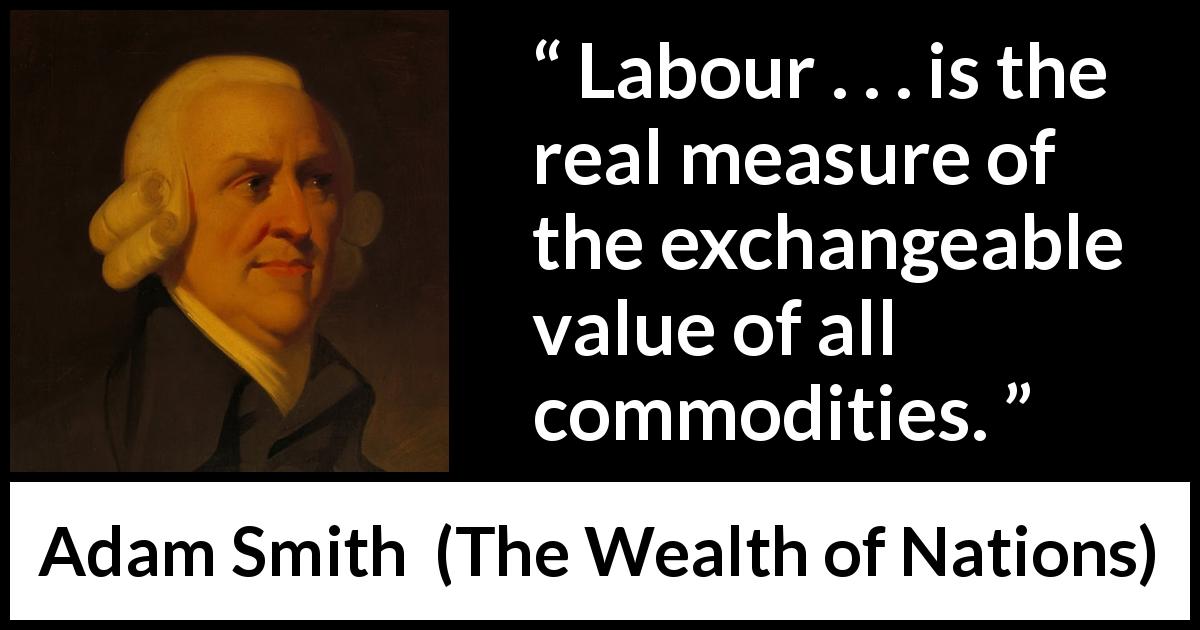
By contrast, the “real” price of a good or service is the amount of labor (i.e. the amount of time, skill, effort) that went into producing it, or in the immortal words of Adam Smith: “Labour alone, therefore, never varying in its own value, is alone the ultimate and real standard by which the value of all commodities can at all times and places be estimated and compared. It is their real price; money is their nominal price only.” (WN, I.v.7)
But this distinction between real and nominal prices begs the question: what determines the price or value of labor? For Smith, this price is determined by the “higgling and bargaining” of the market:
“But though labour be the real measure of the exchangeable value of all commodities, it is not that by which their value is commonly estimated. It is often difficult to ascertain the proportion between two different quantities of labour. The time spent in two different sorts of work will not always alone determine this proportion. The different degrees of hardship endured, and of ingenuity exercised, must likewise be taken into account. There may be more labour in an hour’s hard work than in two hours easy business; or in an hour’s application to a trade which it cost ten years labour to learn, than in a month’s industry at an ordinary and obvious employment. But it is not easy to find any accurate measure either of hardship or ingenuity. In exchanging indeed the different productions of different sorts of labour for one another, some allowance is commonly made for both. It is adjusted, however, not by any accurate measure, but by the higgling and bargaining of the market, according to that sort of rough equality which, though not exact, is sufficient for carrying on the business of common life.” (WN, I.v.4)
Before proceeding any further, however, let’s be clear about what Smith is — and is not — saying. He is not saying that labor is the true or ultimate source of economic value, for Smith is not a metaphysicist. What he is saying instead is this: labor is a more accurate and reliable measure of the value of goods and services. (Shout out to my colleagues and friends Jimena Hurtado and Maria Pia Paganelli for this clarification. [1])
[1] Jimena Hurtado and Maria Pia Paganelli, Where is the labor theory of value in Adam Smith? Adam Smith’s value theory revisited. Journal of Contextual Economics–Schmollers Jahrbuch, Vol. 143 (2023), pp. 105-121, available here.










 prior probability