
Let’s pick up my survey of Adam Smith’s Wealth of Nations where we left off: with Chapter 8 on “The Wages of Labour” (available here). As it happens, this particular chapter is one of the lengthiest and most tedious chapters in Book I of the The Wealth of Nations — it consists of no less than 57 paragraphs and spans over 30 pages of the Glasgow edition of Smith’s magnum opus — but it is also one of the most intriguing and relevant chapters for our times, for buried deep inside (Para. 36) is the following immortal passage:
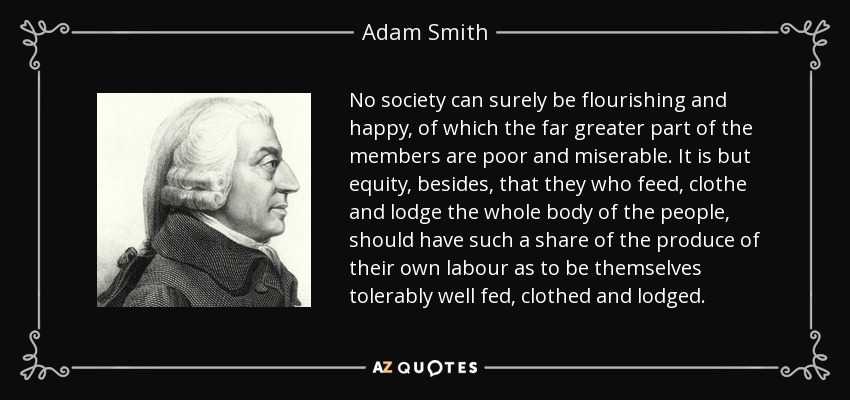
“Is this improvement in the circumstances of the lower ranks of the people to be regarded as an advantage or as an inconveniency to the society? The answer seems at first sight abundantly plain. Servants, labourers, and workmen of different kinds, make up the far greater part of every great political society. But what improves the circumstances of the greater part can never be regarded as an inconveniency to the whole. No society can surely be flourishing and happy, of which the far greater part of the members are poor and miserable. It is but equity, besides, that they who feed, clothe, and lodge the whole body of the people, should have such a share of the produce of their own labour as to be themselves tolerably well fed, clothed, and lodged.” (WN, I.viii.36; my emphasis)
We thus get to see a side of Adam Smith that is often overlooked or ignored: the Scottish philosopher as champion of the worker! He tells us that the working classes deserve their fair share of the overall wealth of society. But unlike Karl Marx, Thomas Piketty or John Rawls, Smith’s concern for ordinary working men (and women!) is grounded in economic reality:
“It deserves to be remarked, perhaps, that it is in the progressive state [i.e. expanding GDP],while the society is advancing to the further acquisition, rather than when it has acquired its full complement of riches, that the condition of the labouring poor, of the great body of the people, seems to be the happiest and the most comfortable. It is hard in the stationary, and miserable in the declining state. The progressive state is in reality the cheerful and the hearty state to all the different orders of the society. The stationary is dull; the declining, melancholy.” (WN, I.viii.43)
In other words, economic growth is more important than economic equality, or more simply put, for the working classes to prosper the economy as whole must be growing! (To be continued …)










 prior probability
Pingback: *The first thing we do, let’s kill all the … landlords?* | prior probability