
Chapter 9 of Adam Smith’s Wealth of Nations (available here) is another intellectual and historical tour de force. Among other things, Smith not only compares and contrasts the levels of wealth of many different nations and regions of the world — England and Scotland, Bengal and China, and North America and Holland, just to name a few — Smith also formulates another general principle or general law regarding the relationship between profits and interest rates: “… as the usual market rate of interest varies in any country, we may be assured that the ordinary profits of stock must vary with it, must sink as it sinks, and rise as it rises. The progress of interest, therefore, may lead us to form some notion of the progress of profit.” (WN, I.ix4)
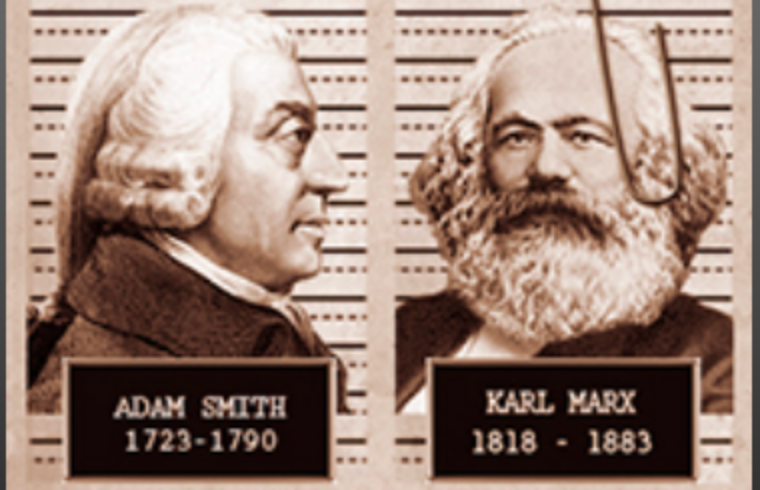
More importantly, Smith anticipates and refutes Karl Marx’s dire thesis in Das Kapital. According to Marx, the profits of the owners of capital come at the expense of the wages of the workers: as the wealthy acquire greater amounts of capital and produce more efficiently (i.e. hire fewer workers), the owners are able to exploit the working classes because of the existence of a large and ever-growing pool of unemployed men (Marx’s famous “reserve army of labor”). For Adam Smith, however, the opposite is true: it’s the workers who, in effect, “exploit” the owners of capital! In Paragraphs 6 and 7 of Chapter 9, for example, Smith writes:
“Since the time of Henry VIII. the wealth and revenue of the country have been continually advancing …. The wages of labour have been continually increasing during the same period, and in the greater part of the different branches of trade and manufactures the profits of stock have been diminishing.” (WN, I.ix.6)
“It generally requires a greater stock to carry on any sort of trade in a great town than in a country village. The great stocks employed in every branch of trade, and the number of rich competitors, generally reduce the rate of profit in the former below what it is in the latter But the wages of labour are generally higher in a great town than in a country village. In a thriving town the people who have great stocks to employ frequently cannot get the number of workmen they want, and therefore bid against one another in order to get as many as they can, which raises the wages of labour, and lowers the profits of stock….” (WN, I.ix.7)
Furthermore, according to Smith, the profits of the owners of capital will tend to decrease toward zero as the stock of capital increases! Why? Because an increase in profits in a given market attracts new entrants and new investments in capital by existing firms, and the resulting competition and investments in capital have the effect of increasing wages and decreasing profits. It suffices to say that history has vindicated Adam Smith and condemned Karl Marx.










 prior probability
Pingback: *The first thing we do, let’s kill all the … landlords?* | prior probability