
What is the relationship between rent, profit, and wages — the ostensible subject of the second half of Book 1 of The Wealth of Nations — or between rents and prices more generally? Adam Smith grapples with these difficult theoretical and practical questions in Chapter 11 (available here) of his magnum opus. [1] Unlike the wages of workers and the profits of owners, however, one often gets the feeling from Smith that landlord rents are a necessary evil! In a previous chapter (Ch. 6), for example, Smith takes a direct swipe at landlords:
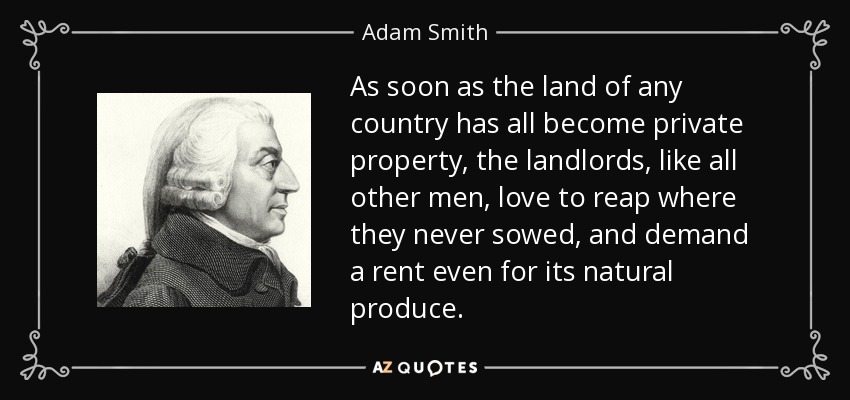
As soon as the land of any country has all become private property, the landlords, like all other men, love to reap where they never sowed, and demand a rent even for its natural produce. The wood of the forest, the grass of the field, and all the natural fruits of the earth, which, when land was in common, cost the labourer only the trouble of gathering them, come, even to him, to have an additional price fixed upon them. He must then pay for the licence to gather them; and must give up to the landlord a portion of what his labour either collects or produces. This portion, or, what comes to the same thing, the price of this portion, constitutes the rent of land, and in the price of the greater part of commodities makes a third component part. (WN, I.vi.8)
After devoting three chapters to wages and profits (Chs. 8-10; see here, here, and here), Smith returns to the subject of landlords and rents in Chapter 11. Here, although Smith’s tone is less judgmental and more analytical, he goes to great lengths to point out how rents generally bear little to no relation to the skill or foresight of landlords. In the preamble to this lengthy concluding chapter (I.xi.a.1-9), for example, Smith defines rent as “the price paid for the use of land” (I.xi.a.1 & I.xi.a.5); then he asserts the following general principle:
Rent, it is to be observed, therefore, enters into the composition of the price of commodities in a different way from wages and profit. High or low wages and profit are the causes of high or low price; high or low rent is the effect of it. It is because high or low wages and profit must be paid, in order to bring a particular commodity to market, that its price is high or low. But it is because its price is high or low; a great deal more, or very little more, or no more, than what is sufficient to pay those wages and profit, that it affords a high rent, or a low rent, or no rent at all. (I.xi.a.8)
In other words, while the price of any given good or service is a function of profits and wages — i.e. the higher these profits or wages are, the higher the price of the good or service will be — rent, by contrast, is a function of price: the higher the price of any given good or service is, the higher landlord rents will be as a general rule. The key phrase here, however, is “as a general rule,” for Smith devotes the remainder of this chapter to describing three different scenarios regarding rents:
- Scenario #1: Positive Rents (I.xi.b) — i.e. the circumstances under which landlords (like monopolists) are able to charge high rents;
- Scenario #2: Negative or Zero Rents (I.xi.c) — i.e. the circumstances under which landlords are in no position to charge high rents; and
- Scenario #3: Fluctuating Rents (I.xi.d) — i.e. the circumstances under which landlords’ position to charge high rents is unstable or in flux. It is here, when describing this third scenario, that Smith inserts a lengthy digression. [2] (To be continued …)
[1] As an aside, Chapter 11 is by far the most lengthy and tedious chapter of Book 1 of The Wealth of Nations: it spans over 180 pages of the Glasgow edition of Wealth and includes a protracted “Digression concerning the Variations in the Value of Silver during the Course of the Four last Centuries.” (I.xi.e-o)
[2] Smith’s “digression” takes up two-thirds of this lengthy chapter, or 119 pages of the Glasgow edition!







 prior probability