
To my friends “down under”, 🇦🇺 Happy Australia Day 🇦🇺! And to my friends in the twin cities of Minneapolis and Saint Paul, keep resisting and keep on fighting for our freedoms! The heavy-handed and lawless Gestapo tactics by masked federal officials — extrajudicial murders and warrantless home invasions — must stop immediately!
Now, as promised, to the business at hand: Chapter 2 of Book II of Adam Smith’s Wealth of Nations. It is here, in this prolonged and protracted chapter — it contains more than 100 paragraphs and spans over 75 pages of the Glasgow edition of Smith’s magnum opus! — where the Scottish philosopher explains the pivotal roles that money, banking, and finance play in promoting (and in potentially destroying) economic growth and development. To begin, Smith makes three contributions to our understanding of finance and economics in the first part of this chapter (Paras. 1-25):
- Contribution #1: What is “money”? Smith points out two possible meanings of the word “money” — money as a unit of accounting, and money as purchasing power: “When we talk of any particular sum of money, we sometimes mean nothing but the metal pieces of which it is composed; and sometimes we include in our meaning some obscure reference to the goods which can be had in exchange for it, or to the power of purchasing which the possession of it conveys.” (WN, II.ii.16)
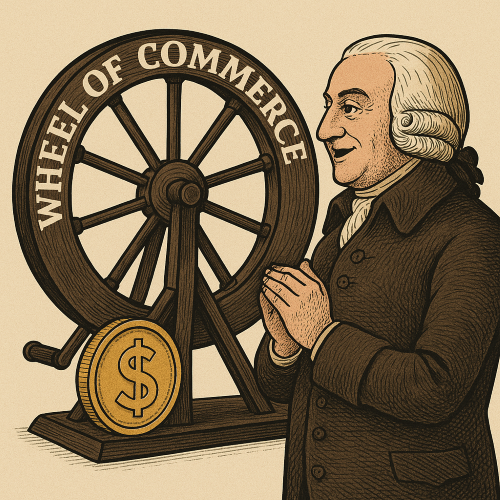
- Contribution #2: Smith’s money wheel metaphor. Smith’s focus, however, is not on mere accounting; it’s on the function of money. At several points in this chapter (WN, II.ii.14, II.ii.23, & II.ii.39), for example, Smith describes money as “the great wheel of circulation.” What Smith means by this memorable metaphor is that money is a means to an end: it is an instrument of commerce, just like a turnpike or navigable river, which facilitates trade by making it easier for goods to reach their respective markets.
- Contribution #3: Smith’s distinction between money and revenue. Smith also draws a fundamental distinction between “individual” and “aggregate” revenue, i.e. between the revenue generated by each individual landlord, worker, or capital owner and the aggregate revenue produced by a nation or other collective:
“The great wheel of circulation is altogether different from the goods [and services] which are circulated by means of it. The revenue of the society consists altogether in those goods [and services], and not in the wheel which circulates them. In computing either the gross or the net revenue of any society, we must always, from their whole annual circulation of money and goods, deduct the whole value of the money, of which not a single farthing can ever make any part of either.” (WN, II.ii.14)
Put another way, money ≠ revenue:
“Though the weekly or yearly revenue of all the different inhabitants of any country, in the same manner, may be, and in reality frequently is paid to them in money, their real riches, however, the real weekly or yearly revenue of all of them taken together, must always be great or small in proportion to the quantity of consumable goods which they can all of them purchase with this money. The whole revenue of all of them taken together is evidently not equal to both the money and the consumable goods; but only to one or other of those two values, and to the latter more properly than to the former.” (WN, II.ii.20)
Next, after clearing up what he means by “money”, Adam Smith turns his attention in the remainder of this chapter to banking and finance. (To be continued …)










 prior probability