
In my previous post, we saw the pivotal role that banks play in promoting economic growth and development. By issuing bank notes (paper money), discounting bills of exchange (check cashing), and providing cash accounts (lines of credit), banks facilitate trade and the financing of capital assets. But at the same time, as Adam Smith himself points out in the second half of Chapter 2 of Book II of The Wealth of Nations (Paras. 48-106), bad banking practices can endanger economic development. The collapse of the infamous Ayr Bank (Douglas, Heron & Co.) in 1772 is a case in point. According to Smith (see WN, II.ii.73-77), the Ayr Bank issued far too many bank notes than it could convert into gold and silver and was way too liberal in “discounting” bills of exchange and in granting “cash accounts” to borrowers. As a result of these practices, the Ayr Bank produced an over-supply (so to speak) of paper money.
But why is an oversupply of paper money so dangerous? Because when there are too many bank notes in circulation, for example, excess notes will be returned to the issuing banks (the banks that issued those notes) for their face value in gold and silver, but some banks will not have enough gold and silver on reserve to honor their notes. These banks thus run the risk that they will run out of cash and become insolvent. This danger, in turn, can destabilize the entire economy because a run on one bank can spread to others, especially if too many depositors fear their accounts are at risk and try to withdraw their holdings at the same time.
To counteract this danger, Smith calls for … (wait for it!) … aggressive government regulation! Among other things, he proposes the elimination, by law, of small-denomination bank notes: “It were better, perhaps, that no bank notes were issued in any part of the kingdom for a smaller sum than five pounds.” (WN, II.ii.91) Say what?! Doesn’t this heavy-handed approach — a complete and total government ban on small bank notes — contradict Smith’s ringing defense of “natural liberty” and economic freedom in the rest of his Wealth of Nations? [1] To his credit, Smith acknowledges this contradiction and explains why some restrictions on liberty are morally and legally justified:
“To restrain private people, it may be said, from receiving in payment the promissory notes of a banker, for any sum whether great or small, when they themselves are willing to receive them, or to restrain a banker from issuing such notes, when all his neighbours are willing to accept of them, is a manifest violation of that natural liberty which it is the proper business of law not to infringe, but to support. Such regulations may, no doubt, be considered as in some respects a violation of natural liberty. But those exertions of the natural liberty of a few individuals, which might endanger the security of the whole society, are, and ought to be, restrained by the laws of all governments, of the most free as well as of the most despotical. The obligation of building party walls, in order to prevent the communication of fire, is a violation of natural liberty exactly of the same kind with the regulations of the banking trade which are here proposed.” (WN, II.ii.94)
In other words, Smith is a pragmatist, not an ideologue: restrictions on one’s natural liberty are justified when those restrictions are designed to promote the general welfare or otherwise protect a larger group of people from harms caused by a few. (To be continued …)
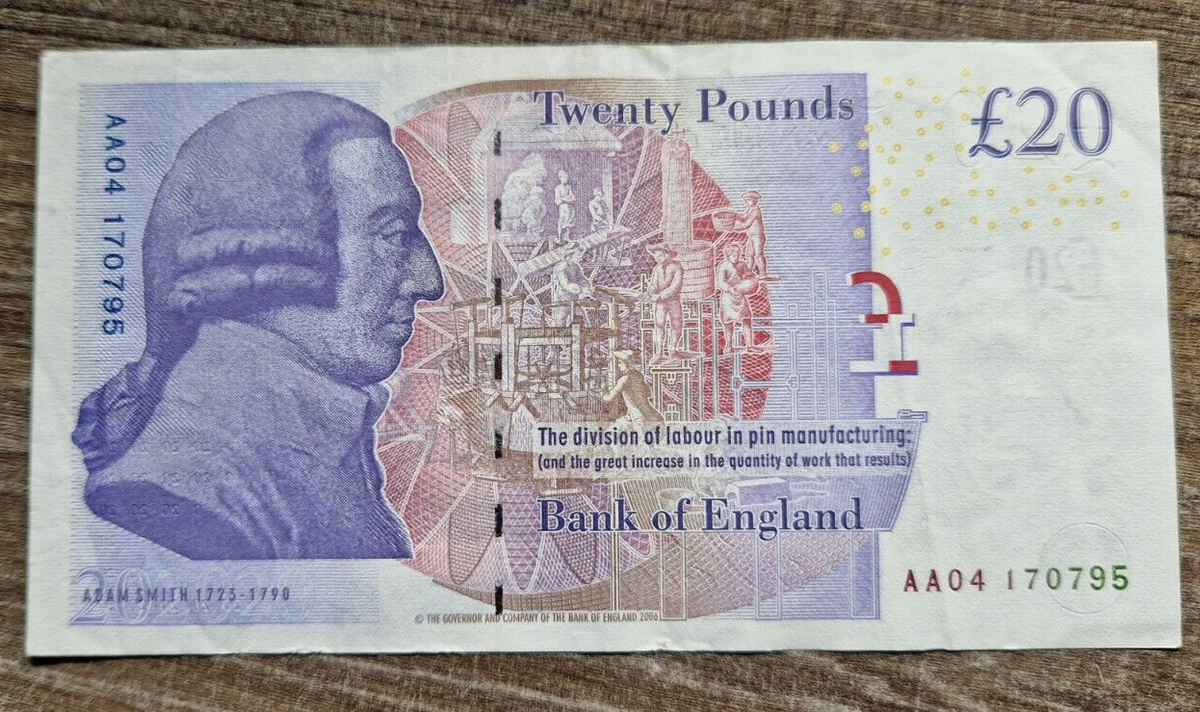
[1] As an aside, the irony of Smith’s hard-line position against small bank notes is not lost on me: from 2007 to 2020 the Bank of England issued a beautiful £20 note with Adam Smith’s portrait! (Perhaps £20 does not count as “small”?)










 prior probability
Pingback: Adam Smith on interest rate self-selection bias | prior probability