
Happy Groundhog Day! Now, let’s pick up where we left off, with Chapter 4 of Book II of The Wealth of Nations (available here). More specifically, should lenders be allowed to charge high interest rates? Or should the government impose a ceiling on interest rates? In short, should usury be legalized? Adam Smith’s answer to this key question, which appears in Book II, Chapter 4, is both subtle and surprising:
“The legal rate, it is to be observed, though it ought to be somewhat above, ought not to be much above the lowest market rate. If the legal rate of interest in Great Britain, for example, was fixed so high as eight or ten per cent, the greater part of the money which was to be lent would be lent to prodigals and projectors, who alone would be willing to give this high interest. Sober people, who will give for the use of money no more than a part of what they are likely to make by the use of it, would not venture into the competition. A great part of the capital of the country would thus be kept out of the hands which were most likely to make a profitable and advantageous use of it, and thrown into those which were most likely to waste and destroy it. Where the legal rate of interest, on the contrary, is fixed but a very little above the lowest market rate, sober people are universally preferred, as borrowers, to prodigals and projectors.” (WN, II.iv.15)
In other words, Smith identifies an “interest rate selection bias” of sorts: low interest rates attract credit-worthy borrowers who invest in solid low-risk projects, while high rates attract dicey borrowers who speculate in high-risk projects, like the ill-fated South Sea Company or Mississippi Company. As a result of this interest rate selection bias (so to speak), Smith concludes that the government should impose a floating cap or flexible ceiling on interest rates, one that is “not … much above the lowest market rate.” (WN, II.iv.15) Otherwise, if banks were allowed to charge high interest rates, risky pie-in-the-sky projects (most of which, by definition, are doomed to fail) will crowd out more solid or low-risk ones and endanger economic development.
Smith’s surprising conclusion (i.e. interest rates should be regulated) is nevertheless subtle for two reasons. One is the flexibility or pragmatic nature of his proposed regulation. Smith’s legal ceiling on interest rates is a flexible one, since it is based on whatever the lowest market rate happens to be at any given time. The other is the macro-rationale of his proposed regulation. Smith’s motivation for imposing a legal cap on interest rates is not to protect individual borrowers or consumers but to protect lenders as a class as well as economic growth and development as a whole!
And last but not least, although Smith supports a floating cap on interest rates (i.e. one that moves with the lowest market rate), he further observes that any attempt to prohibit lenders from charging any interest on loans would produce more harm than good:
“In some countries the interest of money has been prohibited by law. But …. [t]his regulation, instead of preventing, has been found from experience to increase the evil of usury; the debtor being obliged to pay, not only for the use of the money, but for the risk which his creditor runs by accepting a compensation for that use. He is obliged, if one may say so, to insure his creditor from the penalties of usury.” (WN, II.iv.13)
Yet again, we see two qualities of Adam Smith shine through, even after 250 years since the publication of The Wealth of Nations: (i) his intellectual originality — e.g. what I am calling his “interest rate selection bias” idea — and (ii) his open-minded pragmatism — his willingness to entertain some form of flexible government regulation for the greater good, i.e. to reduce suboptimal speculation, which might endanger economic growth and development. [1] Nota bene: I will conclude my survey of Book II of Smith’s magnum opus in my next post.
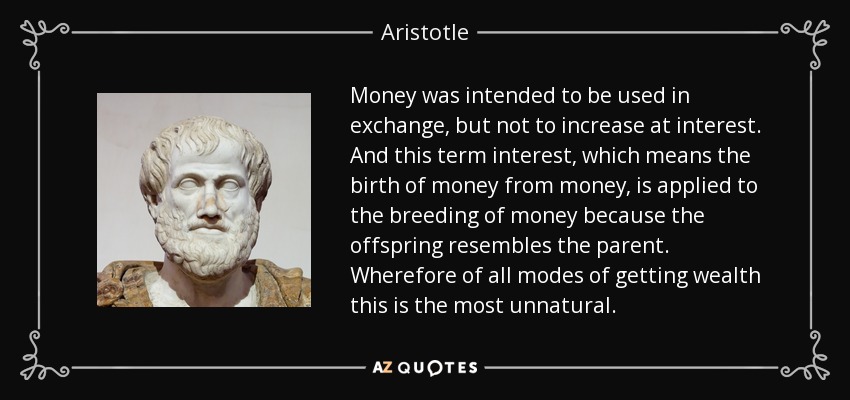
[1] Likewise, in a previous post (see here) we saw how Smith make the case for another pragmatic restriction on natural liberty: the elimination of small-denomination bank notes.







 prior probability
“the debtor being obliged to pay, not only for the use of the money, but for the risk which his creditor runs by accepting a compensation for that use”
This is confusing. First, if “the interest of money has been prohibited by law,” then the debtor is obliged to (re)pay the exact amount borrowed; anything over that amount would be considered intrest, and prohibited. But let’s assume there’s a word game going on with “intrest” (“Oh no, that’s not interest, that’s a service fee”). The second confusion is that, usury laws or not, the borrower is going to have to compensate the lender for overhead, nonperforming loans (risk) and profit. One could, I suppose, imagine a loan program that eliminates or minimizes this excess (a government loan program, say, or perhaps Islamic banks), but in the commercial sphere such lenders seem chimerical. A likely result of usury prohibition is to severely dampen the credit market.