
Alternative title: Adam Smith, an Enlightened legal realist
Among other things, Plato’s Republic contains a dialogue between Socrates and Thrasymachus about the nature of justice. Most educated people already know who Socrates was, but who was Thrasymachus? By all accounts, he was a 5th-century BC sophist and teacher of rhetoric. In his dialogue with Socrates in Book 1 of Plato’s Republic (see lines 336b to 354c, available here), Thrasymachus famously defines “justice” as nothing more than “the interest of the stronger.” In other words, justice is merely a convention imposed by the powerful to protect their own interests.
For his part, Adam Smith appears to take sides with Thrasymachus in Part 2 of Chapter 1 of Book V of The Wealth of Nations. Here, Smith surveys the second duty of government, “that of protecting, as far as possible, every member of the society from the injustice or oppression of every other member of it, or the duty of establishing an exact administration of justice ….” (WN, V.i.b.1) But as we shall see below, Smith does not paint an idyllic or idealized picture of law, for he has no illusions about the true nature of justice. Instead, the Scottish philosopher makes the following five timeless and realist points about law and government:
POINT #1 — THE ORIGINS OF LAW AND GOVERNMENT: PROPERTY RIGHTS
First off, government becomes necessary when people start to accumulate private property: “The acquisition of valuable and extensive property, therefore, necessarily requires the establishment of civil government. Where there is no property, or at least none that exceeds the value of two or three days labour, civil government is not so necessary.” (WN, V.i.b.2; my emphasis)
POINT #2 — LAW AND GOVERNMENT ARE THE INTEREST OF THE STRONGER
Secondly, Smith takes a Thrasymachean stance towards government: “Civil government supposes a certain subordination. But as the necessity of civil government gradually grows up with the acquisition of valuable property, so the principal causes which naturally introduce subordination gradually grow up with the growth of that valuable property.” (V.i.b.3; my emphasis) Smith leaves no room for doubt on this crucial point, for he further writes: “Civil government, so far as it is instituted for the security of property, is in reality instituted for the defence of the rich against the poor, or of those who have some property against those who have none at all.” (V.i.b.12; my emphasis)
POINT #3 — JUSTICE IS NOT FREE
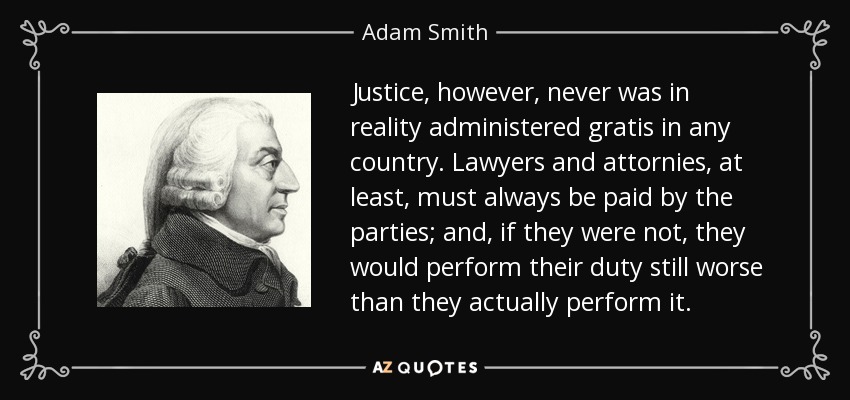
There are no free lunches in law: “Justice, however, never was in reality administered gratis in any country.” (V.i.b.18; my emphasis)
POINT #4 — THE COST OF JUSTICE SHOULD BE PAID BY FIXED USER-FEES
Unlike Socrates or even Thrasymachus, Smith explores the economics of the administration of justice, and he proposes charging litigants fixed fees when they take their disputes to court:
“The whole expence of justice, too, might easily be defrayed by the fees of court; and, without exposing the administration of justice to any real hazard of corruption, the public revenue might thus be discharged from a certain, though, perhaps, but a small incumbrance. It is difficult to regulate the fees of court effectually where a person so powerful as the sovereign is to share in them, and to derive any considerable part of his revenue from them. It is very easy where the judge is the principal person who can reap any benefit from them. The law can very easily oblige the judge to respect the regulation, though it might not always be able to make the sovereign respect it. Where the fees of court are precisely regulated and ascertained, where they are paid all at once, at a certain period of every process, into the hands of a cashier or receiver, to be by him distributed in certain known proportions among the different judges after the process is decided, and not till it is decided, there seems to be no more danger of corruption than where such fees are prohibited altogether. Those fees, without occasioning any considerable increase in the expence of a law-suit, might be rendered fully sufficient for defraying the whole expence of justice.” (V.i.b.20; my emphasis)
POINT #5 — JUDGES MUST BE INDEPENDENT
Because law and government are the interest of the stronger, the judicial branch of government must be independent from the other branches, especially the executive:
“When the judicial is united to the executive power, it is scarce possible that justice should not frequently be sacrificed to what is vulgarly called polities. The persons entrusted with the great interests of the state may, even without any corrupt views, sometimes imagine it necessary to sacrifice to those interests the rights of a private man. But upon the impartial administration of justice depends the liberty of every individual, the sense which he has of his own security. In order to make every individual feel himself perfectly secure in the possession of every right which belongs to him, it is not only necessary that the judicial should be separated from the executive power, but that it should be rendered as much as possible independent of that power. The judge should not be liable to be removed from his office according to the caprice of that power. The regular the good-will or even upon the good œconomy payment of his salary should not depend upon of that power.” (V.i.b.25; my emphasis)
Nota bene: this Monday (9 March) is the 250th anniversary of the publication of The Wealth of Nations, so my next two blog posts will mark this occasion with some fun surprises. Then, on Tuesday (10 March), we will proceed to Part 3 of Chapter 1 of Book V of Smith’s magnum opus, to the third and last of the three duties of government: the provision of public goods.







 prior probability