
We now turn to Part 1 of Chapter 2 of Book V of The Wealth of Nations. Here, Adam Smith surveys the two major “Sources of Revenue which may peculiarly belong to the Sovereign or Commonwealth” (WN, V.ii.a.1): capital and land. Moreover, in the course of his superlative survey Smith, yet again, makes a number of timeless observations:
1. ADAM SMITH’S EVERGREEN CRITIQUE OF DEMOCRACY
First off, the Scottish scholar compares and contrasts in passing “the orderly, vigilant, and parsimonious administration of such aristocracies as those of Venice and Amsterdam” with “the thoughtless extravagance” of parliamentary democracies like England:
“The orderly, vigilant, and parsimonious administration of such aristocracies as those of Venice and Amsterdam is extremely proper, it appears from experience, for the management of a mercantile project of this kind. But whether such a government as that of England—which, whatever may be its virtues, has never been famous for good œconomy; which, in time of peace, has generally conducted itself with the slothful and negligent profusion that is perhaps natural to monarchies; and in time of war has constantly acted with all the thoughtless extravagance that democracies are apt to fall into—could be safely trusted with the management of such a project, must at least be good deal more doubtful.” (WN, V.ii.a.4)
2. SMITH’S LIMITED DEFENSE OF “MERCANTILE PROJECTS” LIKE THE POST OFFICE
Although Smith is very critical of the mercantile system in general (see especially Chapters 1 to 8 of Book IV of The Wealth of Nations), he is, above all and as we have seen time and time again, a pragmatist, so he is willing to tolerate — and even praise — certain mercantile projects when the benefits of those projects are great enough and benefit the public at large:
“The post office is properly a mercantile project. The government advances the expence of establishing the different offices, and of buying or hiring the necessary horses or carriages, and is repaid with a large profit by the duties upon what is carried. It is perhaps the only mercantile project which has been successfully managed by, I believe, every sort of government. The capital to be advanced is not very considerable. There is no mystery in the business. The returns are not only certain, but immediate.” (WN, V.ii.a.5)
3. “NO TWO CHARACTERS SEEM MORE INCONSISTENT THAN THOSE OF TRADER AND SOVEREIGN” (WN, V.ii.a.7)
Why? Because the government is a monopoly, so it doesn’t have to worry about competition:
“No two characters seem more inconsistent than those of trader and sovereign. If the trading spirit of the English East India Company renders them very bad sovereigns, the spirit of sovereignty seems to have rendered them equally bad traders. While they were traders only they managed their trade successfully, and were able to pay from their profits a moderate dividend to the proprietors of their stock. Since they became sovereigns, with a revenue which, it is said, was originally more than three millions sterling, they have been obliged to beg extraordinary assistance of government in order to avoid immediate bankruptcy. In their former situation, their servants in India considered themselves as the clerks of merchants: in their present situation, those servants consider themselves as the ministers of sovereigns.” (WN, V.ii.a.7)
4. THE OPPORTUNITY COSTS OF PUBLIC OWNERSHIP OF LAND
Last but not least, Adam Smith has this to say regarding government ownership of land:
“The revenue which, in any civilized monarchy, the crown derives from the crown lands, though it appears to cost nothing to individuals, in reality costs more to the society than perhaps any other equal revenue which the crown enjoys. It would, in all cases, be for the interest of the society to replace this revenue to the crown by some other equal revenue, and to divide the lands among the people, which could not well be done better, perhaps, than by exposing them to public sale.” (WN, V.ii.a.19; my emphasis)
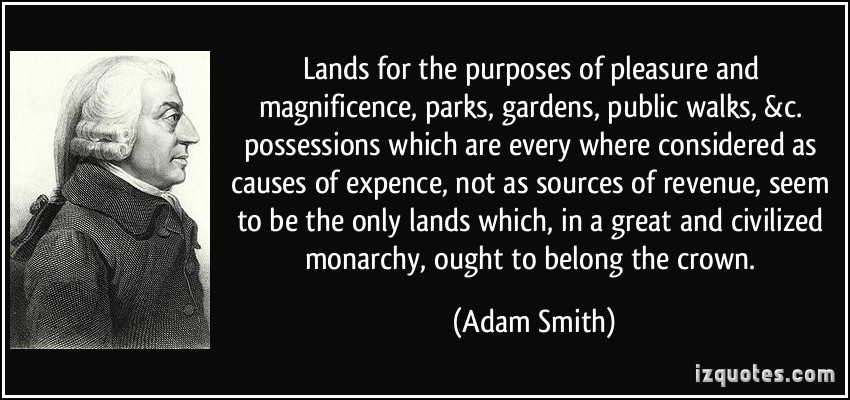
But at the same time, the Scottish scholar makes a pragmatic exception for “parks, gardens, public walks, &tc.”:
“Lands for the purposes of pleasure and magnificence—parks, gardens, public walks, &c. possessions which are every where considered as causes of expence, not as sources of revenue—seem to be the only lands which, in a great and civilized monarchy, ought to belong to the crown.” (WN, V.ii.a.20)
On this note, recall Adam Smith’s discussion of “publick diversions” in Paragraph 15 of Article 3 of Part 3 of Chapter 1 of Book V of The Wealth of Nations (WN, V.i.g.15), one of my favorite passages in Smith’s entire magnum opus. For me, Smith’s call for “publick diversions” and his public-spirited defense of communal spaces go hand-in-hand: a great society is one in which the people are able to choose from many different forms of entertainment [1] in many different communal and private spaces.
Nota bene: I will proceed to Part 2 of Chapter 2 of Book V of The Wealth of Nations in my next post.
[1] Alas, as I mentioned in a previous post, a potential blind spot bedevils Smith’s call for “publick diversions”, for Smith says that the market for entertainment should be free so long as the forms of entertainment being offered are “without scandal and indecency.” (WN, V.i.g.15) The blind spot, then, is this: Smith’s anti-scandal caveat appears to necessitate some form of censorship. After all, who decides what is scandalous or indecent?










 prior probability