The first time Ronald Coase uses the word “reciprocal” to describe the problem of harmful effects is in his 1959 FCC paper (Coase 1959), but this observation begs the question, what is the source of Coase’s reciprocal-harm model? Did Coase borrow or steal? Or did he discover it on his own? Today, I will one consider one possible source of Coase’s reciprocal-harm model: Wesley Hohfeld’s influential theory of legal relations. (Hohfeld 1913, 1917)
Among other things, Hohfeld (pictured below) observed the ubiquity of rights talk in legal reasoning as well as the polysemy of this legal concept: the legal concept of a “right” in law can be used in different ways to describe different types of legal relations. What Hohfeld did that would shape generations of legal scholars-and perhaps at least one economist, Coase–is create a theoretical framework to capture the precise meaning of different uses of the word “right” in legal reasoning.
Without getting bogged down in the tedious details of Wesley Hohfeld’s overall framework, the part of Hohfeld’s theory of legal relations that is most relevant to Coase’s reciprocal harm model is the logical relationship between legal rights and legal duties. Simply put, a Hohfeldian legal right is always linked to a correlative duty: a right held by one person, let’s call him A, necessarily entails the imposition of a corresponding legal duty on someone else, B.
Nevertheless, the available evidence indicates that Coase most likely developed his reciprocal harm model independent of the work Wesley Hohfeld. For starters, Coase never cites Hohfeld in either his FCC or social cost paper. (As an aside, the first British legal scholar to formally cite and integrate Hohfeld into English legal scholarship was G. W. Keeton (1930).)
Secondly, although Coase uses the word “right” dozens of times in both his FCC and social cost papers, for Coase a legal right is just another “factor of production” or economic input, such as land, labor, and capital. Towards the end of his social cost paper, Coase writes:
“If factors of production are thought of as rights. it becomes easier to understand that the right to do something which has a harmful effect (such as the creation of smoke, noise, smells, etc.) is also a factor of production. Just as we may use a piece of land in such a way as to prevent someone else from crossing it, or parking his car, or building his house upon it, so we may use it in such a way as to deny him a view or quiet or unpolluted air. The cost of exercising a right (of using a factor of production) is always the loss which is suffered elsewhere in consequence of the exercise of that right–the inability to cross land, to park a car, to build a house, to enjoy a view, to have peace and quiet or to breathe clean air. (Coase 1960, p. 44)
This passage, however, points us to another possible source of Coase’s reciprocal harm model: the so-called “LSE tradition in cost theory,” which was developed by Lionel Robbins and F. A. Hayek at the London School of Economics in the 1930s. (To be continued…)
Wesley Hohfeld
Works cited:
R. H. Coase. “The Federal Communications Commission.” Journal of Law and Economics, Vol. 2 (1959), pp. 1-41.
R. H. Coase. “The Problem of Social Cost.” Journal of Law & Economics, Vol. 3 (1960), pp. 1-44.
W. N. Hohfeld. “Some Fundamental Legal Conceptions as Applied in Judicial Reasoning.” Yale Law Journal, Vol. 23, No. 1 (1913), pp. 16-59.
W. N. Hohfeld. “Fundamental Legal Conceptions as Applied in Judicial Reasoning.” Yale Law Journal, Vol. 26, No. 8 (1917), pp. 710-770.
G. W. Keeton. 1930. The Elementary Principles of Jurisprudence. London: A. C. Black.
I have long been fascinated by the English economist Ronald Coase’s insight that harms are always a “reciprocal” or jointly-caused problem–so much so that I wrote a paper at the end of last year titled “Coase’s fable” in which I describe the idea of reciprocal harms as an axiom or truism, trace the intellectual origins of Coase’s counter-intuitive idea, and explore its domain or outer limits. (For reference, I blogged about my 2025 Coase paper here, here, here, and here. Also, for the record, I have not used any A.I. models to research or write any of my papers!)
Since then, I presented my paper in May of 2026 at the first-ever joint conference of the European Society for the History of Economic Thought (ESHET) and the History of Economics Society (HES) at the Université Côte d’Azur in Nice, France, and based on the excellent feedback I received at the conference, I have expanded the part of my paper that traces the intellectual origins of Coase’s reciprocal-harm model. (Among other things, I explore the relationship between Coase’s model and the opportunity-cost approach to economics that Lionel Robbins and F. A. Hayek developed at the London School of Economics in the 1930s, and I consider the possibility that Coase might have been influenced by Wesley Hohfeld’s influential theory of legal relations — stated simply, the idea that every legal right creates a corresponding duty, and vice versa, every legal duty implies a corresponding right.) I will say more about these substantive additions to my paper in my next two posts; in the meantime, here is a link my revised paper (via SSRN).
On this day (28 September) in 1821, Juan José Espinosa de los Monteros, secretary of Mexico’s newly-created “Provisional Governmental Board” (the first governing body of independent Mexico that administered the country from 28 September 1821 until 24 February 1822), drafts the Acta de Independencia del Imperio Mexicano(Declaration of Independence of the Mexican Empire; pictured below), the founding document by which Mexico declared independence from the Spanish Empire.
What is the optimal number of seats in the United States Congress? On 25 September 1789, the Congress proposed twelve amendments to the U.S. Constitution. Ten of these amendments–the so-called “Bill of Rights“–were subsequently ratified by the requisite number of States. The two “lost” amendments that were not ratified at the time are the original first amendment — theCongressional Apportionment Amendment, which would have enacted a new mathematical formula for determining the number of seats in the U.S. House of Representatives — and the Congressional Compensation Amendment, which was finally ratified in 1992 (becoming the 27th Amendment to the U.S. Constitution)! This amendment states that any law that increases or decreases the salary of members of Congress may take effect only after the next election of the House of Representatives has occurred.
Bonus link: Check out this fascinating paper by Zachary S. Elkins (University of Texas) for a history of the 200-year gestation and birth of the 27th Amendment. (Professor Elkins’s paper is also available here and here.)
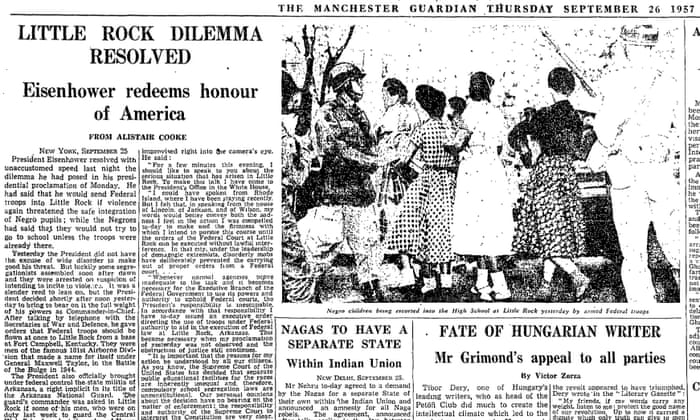
But was Ike’s historic order constitutional? Can a president deploy the armed forces of the United States to quell a purely domestic disturbance? And if so, what are the limits, if any, to his emergency powers? I explore this fundamental legal question in my 2019 law review article “Domestic Constitutional Violence,” which has been cited several times since its publication. See, for example (in alphabetical order, by author):
Did Adam Smith’s direct experiences with some of the most celebrated doctors of his age motivate his remark in The Wealth of Nations regarding the “absurd prescriptions” of doctors? How could they not have! From his Oxford and Glasgow days (see, for example, here, here, and here) to the final weeks of his travelling tutor years (see here and here), Smith saw a wide range of home remedies and medical treatments first hand during his lifetime, including tar water, leeches, ipecacuanha, opiates, rhubarb, and bloodletting. These, by our standards, “absurd prescriptions” were what state-of-the-art medical care consisted of in the 18th-century Europe.
But that said, the line between mere quackery and medical cure in Smith’s day was a fuzzy one, especially if Smith’s private letters–such as the ones he postmarked from Glasgow in March and November 1760 and from Compiègne and Paris in August and October 1766–are any guide. In all, three of Smith’s students became seriously ill, and in two of these cases (Duke Henry and Thomas Petty-Fitzmaurice), the patients recovered after receiving the standard prescriptions of the day: bloodletting and leeches. In the other case (Hew Campbell Scott), however, the patient died on Smith’s watch.
I will conclude my three-act medical morality play with Smith’s June 16, 1776, letter to David Hume. (Corr. 161) By way of background, Smith and Hume, two of the most prominent figures of the “Scottish Enlightenment,” were lifelong friends and intellectual collaborators.[1] Hume had fallen ill in 1775,[2] and to alleviate the pain caused by his illness, or perhaps in search of a cure, Hume traveled south to England to “take the waters.”[3] During this final journey before his death (Hume died on August 25, 1776), he visited two great English spa towns–Bath and Buxton[4]–and when Adam Smith got wind of Hume’s hydrotherapy treatments from a mutual acquaintance (Corr. 160), he fired off the following letter to his lifelong friend and mentor:
“I am very sorry to Learn by Mr Strahan that the Bath Waters have not agreed with you for some time, so well as they appeared to do at first. You have found one Medicine which has agreed with you; travelling and change of air. I would continue, if I was you, during the continuance of the fine Season the constant application of that medicine without troubling myself with any other, and would spend the summer in Sauntering thro all the different corners of England without halting above two or three nights in any one place. If before the month of October you do not find yourself thoroughly re’established, you may then think of changing this cold climate for a better, and of visiting the venerable remains of antient and modern arts that are to be seen about Rome and the Kingdom of Naples. A mineral water is as much a drug as any that comes out of the Apothecaries Shop. It produces the same violent effects upon the Body. It occasions a real disease, tho’ a transitory one, over and above that which nature occasions. If the new disease is not so hostile to the old one as to contribute to expell it, it necessarily weakens the Power which nature might otherwise have to expell it. Change of air and moderate exercise occasion no new disease: they only moderate the hurtful effects of any lingering disease which may be lurking in the constitution; and thereby preserve the body in as good order as it is capable of being during the continuance of that morbid state. They do not weaken, but invigorate, the power of Nature to expel the disease. I reckon it probable that the Bath Waters had never agreed with you, but that the good effects of your journey not being spent when you began to use them, you continued for some time to recover, not by means of them, but in spite of them. Is it probable that the Buxton waters will do you more good? The Prescription supposed most likely to do good is always given first. If it fails, which it does nine times in ten, the second is surely likely to fail ninety nine time in a hundred….” (Corr. 161; my emphases)
How accurate are Smith pronouncements on the efficacy of “Bath Waters” and his scathing indictment of those “prescription[s] supposed most likely to do good”? The line between quackery and cure might be a fuzzy one in any given case, but when the failure rate of a prescribed medical treatment is so high—“nine times in ten,” to quote Adam Smith; let alone 99 in a 100—then such a prescription qualifies as absurd quackery!
[1] See generally Dennis C. Rasmussen, The Infidel and the Professor: David Hume, Adam Smith, and the Friendship That Shaped Modern Thought, (Princeton University Press 2017). Hume was older, having been born in 1711, while Smith was born in 1723. Both luminaries lost their fathers when they were young and were raised by their mothers.
[2] According to Hume’s own account (he had written a brief autobiographical essay titled “My Own Life” a few months before his death), “In spring 1775, I was struck with a disorder in my bowels, which at first gave me no alarm, but has since, as I apprehend it, become mortal and incurable.” Hume 2019 [1776]. Cf. Ernest Campbell Mossner, The Life of David Hume, 2nd edition (Oxford University Press 1980), p. 596: “… so far as the evidence goes, modern medical science might agree that, although cancer of the bowel cannot be ruled out, Hume probably died of chronic ulcerative colitis, following an acute bacillary dysentery.”
[3] Curiously, what began as a medical treatment quickly evolved into a social fad for high society, combining healthcare, high fashion, and matchmaking. See, e.g., Alev Lytle Croutier, Taking the Waters: Spirit, Art, Sensuality (Abbeville Press 1992). See also Veronique Greenwood, “‘Taking the waters’ was the original summer getaway,” Time (July 9, 2026), available here.
[4] See Ernest Campbell Mossner and Ian Simpson Ross (editors). The Correspondence of Adam Smith (Liberty Fund 1987), p. 194 n.3. See also Corr. 160 & Corr. 161.
Adam Smith’s next direct experience with doctors would occur in October 1766 in Paris. Duke Henry’s younger brother, Hew Campbell Scott (pictured below), contracted some kind of illness in the City of Light. Although Hew would obtain the best medical care he could have possibly received in 18th-century Paris, the intellectual and cultural epicenter of the 18th-century Age of Enlightenment, his sickness was so severe that it would take his life in a matter of days.
For his part, Adam Smith–who, after all, was responsible for the health and safety of his teenage pupils as their travelling tutor–had once again consulted the best doctors he could find, including his friend the royal physician François Quesnay as well as Richard Gem (1717–c.1800), the doctor assigned to the British embassy in Paris (Armbruster 2019, p. 131), and Théodore Tronchin (1709–1781), the famed physician, Professor Emeritus of Medicine at the Academy of Geneva, who had opened a medical practice in Paris. (See Corr. 97.) But how good would this medical care have been by our modern medical standards?
In the first part of a lengthy letter (dated 15 October 1766) addressed to Duke Henry’s sister (Lady Frances), Smith describes Hew’s ailment in gruesome detail as well as the specific treatments prescribed by his doctors–everything from “ippcuana” to “a very gentle opiat” to “fifteen grains of Rhubarb”:
“On Monday morning Dr Gem observed some degree of fever in Mr Scott’s pulse which he had thought entirely free of it for some days before. Mr Quenay observed the same thing. His vomitings, however, and Purgings continued with great violence all day, notwithstanding a dose of ipp[eca]cuana which they had given him in the morning. His fever seemed to go off almost entirely in the evening, and they gave him, what they had given for two days before, a very gentle opiat to quiet his stomach and to give him a little rest in the night time. Yesterday morning Dr Gem imagined he felt more quickness in his pulse than he had ever done before; this, however, soon subsided and his pulse returned to a degree of frequency that was not much beyond its natural state. He was all day much freer from vomitings than he had been for some days before, and his purgings seemed to be no greater than what might be expected from fifteen grains of Rhubarb which they had given him the night before and that morning: from one to about three o’clock afternoon I thought I observed some alterations in his speech, and an extraordinary hurry and confusion in his Ideas.” (Corr. 97)
Were any the three treatments described in the passage above–the “dose of ipp[eca]cuana”; the “very gentle opiate”; and the “15 grains of rhubarb”–“absurd prescriptions”? Where do we draw the line between pseudo-scientific quackery and legitimate cures? Let’s start with the “dose of ippcuana.” (Corr. 97) Quackery or cure? Ipecac, short for ipecacuanha (Kang & Pederson, p. 22), was first brought to Europe in the 1600s and was used for centuries as an expectorant to clear chest congestion as well as an emetic to induce vomiting. Ipecac is still available today, but it straddles the line between legitimate treatment and medical quackery, for “modern toxicologists know it doesn’t reliably decrease the absorption of toxins, and half the time, it doesn’t even make you throw up.”[1] In other words, given these even odds, deciding whether ipecac is a cure or a quack remedy is no different than a coin toss.
What about the “very gentle opiate”? As it happens, opiates have a long and storied history going back to ancient times.[2] Today, opium tincture (a liquid solution) is used to treat severe cases of diarrhea.[3] But whether opiates are an “absurd prescription” or a legitimate one depend on whether the known benefits of the drug (euphoria and drowsiness) outweigh the known side-effects, including addiction and death![4] Given these risks, Smith is at pains to reassure Lady Frances–i.e. Duke Henry’s sister to whom Smith’s letter is addressed–that a “gentle opiat” was prescribed.
That leaves the “fifteen grains of Rhubarb.” Quackery or cure? According to Clifford Foust (1992), who literally wrote the book on rhubarb, at the time rhubarb was “a popular and expensive drug” (Foust 1992, p. 156) that was widely prescribed as a laxative and cathartic.[5] Rhubarb is also one of the most ancient and important herbs in traditional Chinese medicine (Xiang et al. 2020), and the dried rhubarb root is still used as a short-term stimulant laxative.[6] According to Foust (1992, p. 142), however, 15 grains was a “light dosage,” so again, determining which side of the quackery-cure line rhubarb falls on is an open question.
Hew temporarily recovered, for Smith reports that his pupil “was entirely free from sickness and vomiting” and that “[t]he Physicians [Quesnay and Gem] were both much pleased with his situation and imagined that all the violence of his disorder was over”:
“This disagreeable symptom, however, soon went off, so as to have me uncertain whether I had not fancy’d it from my own apprehensions; His pulse continuing all the while, tho’ a little feverish, extremely gentle and moderate. In the evening he appeared easier than he had been for some days before: They gave him no opiat that night and he Passed it very easily notwithstanding. This morning he ordered himself to be taken out of bed at eight o’clock and sit up to Eleven. He was entirely free from sickness and vomiting; his pulse had very little quickness; and his purging was no greater than what was to be expected from the fifteen grains of Rhubarb he had taken this morning and the night before. The Physicians were both much pleased with his situation and imagined that all the violence of his disorder was over. Quenay said that he had been at a loss before but he now knew what to do. I thought I might venture to go to my Bankers to get some money which, tho I had much occasion for it, I had put off doing for eight days before in order not to leave him. Dr Gem undertook to sit by him till I should return. I stayed out about an hour happy to imagine that all my anxiety was likely to be at an end.” (Corr. 97)
Whether Hew recovered because of or in spite of his treatments is hard to say. But his recovery was short-lived, and when his health deteriorated further, it was time to let the blood flow. Smith writes: “Upon my return I found him quite delirious, and that too with no very violent fever. I immediately sent for Quenai who ordered him instantly to be blooded.” (Corr. 97)
Towards the end of his letter to Lady Frances, Smith reports that he decided to get a third opinion due to the mistaken predictions or flawed diagnoses of Hew’s doctors: “Tho’ I have entire confidence in the skill of the Physicians [Quesnay and Gem] that have hitherto attended him, notwithstanding they have been mistaken in their predictions, I have thought proper to call in Tronchin, who will attend him for the future along with them.” (Corr. 97; my emphasis) By the end of the week, however, Hew would be dead,[7]
Alas, whether the “absurd prescriptions” of Hew’s doctors contributed to his death is impossible to say. (To be continued…)
[4] Cf. Kang & Pederson, p. 63: “Within half an hour of consuming [raw opium], you feel euphoric and drowsy, while even your most excruciating pain is numbed away. Sounds wonderful, right? Just wait for the side effects: itchy skin, constipation, nausea, and dangerously slow breathing. Oh, also crippling addiction. And death.”
[6] Cf. Kindermann 2025: “Unsurprisingly, given its history as a laxative, one of the biggest properties of rhubarb is its high fiber content. What’s more, it also has a high tannin content, which means it also has anti-diarrheal properties. While rhubarb could still be considered an herbal remedy for constipation (it is sometimes sold in powdered form at natural food stores), these two properties together mean it should only be used as a temporary solution, with the guidance of a qualified doctor.”
[7] In his next letter to Lady Frances (dated 19 October 1766; see Corr. 98), Smith writes: “It is my misfortune to be under the necessity of acquainting you of the most terrible calamity that has befallen us. Mr Scott dyed this Evening at seven o’clock.”
Act III: Compiègne and Paris (1766) [Parts I and II are available here, here, and here]
Adam Smith’s next first-hand experience with medical quackery occurs during the last part of his travels in France. By way of background, Smith had accompanied Henry Scott, the 3d Duke of Buccleuch (pictured below), who was born in 1746, along with Hew Campbell Scott, the duke’s younger brother (by one year), on their “grand tour” of Europe in the mid-1760s. Smith was travelling in his capacity as their tutor and overseas guardian, and at some point, Smith and his private pupils must have secured an invitation to visit the royal hunting park at Compiègne, France, for that is where Smith and his two pupils found themselves in August of 1766.
It was here, in Compiègne, that the young duke became violently ill. Although Smith describes this ailment as a “slight fever” in a lengthy letter (dated 26 August 1766) addressed to the duke’s stepfather, Charles Townshend:
“It is, you may believe, with the greatest concern that I find myself obliged to give you an account of a slight fever from which the Duke of Buccleugh is not yet entirely recovered, tho’ it is this day very much abated.” (Corr. 94; punctuation and spelling in the original)
Next, Adam Smith describes how the young duke had contracted what the travelling tutor describes as a “slight fever”:
“He came here to see the camp and to hunt with the King and the Court. On Thursday last he returned from hunting about seven at night very hungry, and eat heartily of a cold supper, with a vast quantity of sallad, and drank some cold punch after it. This supper, it seems, disagreed with him. He had no appetite next day, but appeared well and hearty as usual. He found himself uneasy in the field, and returned home before the rest of the company. He dined with my Lord George Lennox, and, as he tells me eat heartily. He found himself very much fatigued after dinner, and threw himself upon his servant’s bed. He slept there about an hour, awaked about eight at night in a good deal of disorder. He vomited, but not enough to relieve him. I found his pulse extremely quick; he went to bed immediately and drank some vinegar whey, quite confident that a night’s rest and a sweat, his usual remedy, would relieve him. He slept little that night but sweat profusely. The moment I saw him next day (Sunday) I was sure he had a fever, and begged of him to send for a physician. He refused a long time, but at last, upon seeing me uneasy, consented. (Corr. 94; punctuation and spelling in the original)
What Smith is describing in this passage sounds like a stomach illness, perhaps some form of food poisoning. Moreover, the duke’s ailment was severe enough that Smith ended up chasing down three different doctors to attend to and treat the duke’s malady: “Quenay” or François Quesnay (1694-1774), physician to the French royal court; “Senac” or Jean–Baptiste Senac (1693-1770), premier physician to Louis XV from 1752; and “De la Saone” or Joseph-Marie-François de Lassone (1717-1778), appointed the First Physician to the Queen of France, Marie Leszczyńska (wife of Louis XV), in 1751. In Smith’s words:
I sent for Quenay, first ordinary physician to the King. He sent me word he was ill. I then sent for Senac; he was ill likewise. I went to Quenay myself to beg that, notwithstanding his illness, which was not dangerous, he would come to see the Duke. He told me he was an old infirm man, whose attendance could not be depended on, and advised me, as his friend, to depend upon De la Saone, first physician to the Queen. I went to De la Saone, who was gone out and was not expected home till late that night. I returned to Quenay, who followed me immediately to the Duke. It was by this time seven at night. The Duke was in the same profuse sweat which he had been in all day and all the preceding night.” (Corr. 94; punctuation and spelling in the original)
Today, doctors would treat such a severe case of stomach flu with “oral rehydration solutions,” such as Pedialyte, Naturalyte, Infalyte, or CeraLyte. But in Smith’s day, bloodletting was the most likely course of action:
“In this situation Quenay declared that it was improper to do anything till the sweat should be over. He only ordered him some cooling ptisane drink. Quenay’s illness made it impossible for him to return next day (Monday) and De la Saone has waited on the Duke ever since, to my entire satisfaction. On Monday he found the Duke’s fever so moderate that he judged it unnecessary to bleed him. . . . To–day, Wednesday, upon finding some little extraordinary heat upon the Duke’s skin in the morning, he proposed ordering a small quantity of blood to be taken from him at two o’clock. But upon returning at that hour he found him so very cool and easy, that he judged it unnecessary.” (Corr. 94; punctuation, including the ellipsis, and spelling in the original)
Next, Smith acknowledges just how routine the practice of bloodletting was in his day, for in the very next sentence he makes the following offhand but revealing remark: “When a French physician judges bleeding unnecessary, you may be sure that the fever is not very violent.” (Corr. 94) Alas, the young duke was not to be spared this gruesome treatment, after all. By all accounts, bloodletting was a “cure-all,” so when Smith wrote a second letter to Duke Henry’s stepfather the very next day (27 August 1766), he describes how the duke’s doctors ended up taking “three moderate tea cupfuls of blood”:
“I resume the history of the Dukes illness from the moment in which I left it of yesterday. I had scarce sealed up my Letter when de la Saone came into the Room. He found that the fever was somewhat increased since the time that he had seen him before which was at two o’clock afternoon. Its paroxysme is always from about seven in the evening till about twelve or one in the morning. He thought that a gentle bleeding would diminish this paroxysme which had entirely broke his rest the night before. He ordered accordingly three moderate tea cupfuls of blood to be taken from him, which was accordingly done at eight at night.” (Corr. 95; punctuation and spelling in the original)
In fact, the duke’s doctors shed “a little more blood” from Duke Henry’s veins, for Smith concludes his letter by describing how “[t]he extreme good success of last night[’]s bleeding” inclined them to repeat their bloodletting procedure a second time:
“The extreme good success of last nights bleeding inclines them to take a little more blood from the Duke, provided the fever increases as usual towards seven or eight at night. Senac is more formal than la Saone who is one of the most engaging men I ever saw; In his reasonings and Judgements, however, Senac is one of the clearest, distinctest and most rational Physicians I ever saw. La Saone is not less so.
“Since I wrote the above la Saone has been to see the Duke. He finds him so easy that he imagines it will be unnecessary to bleed him to night. He is to return, however, at eight o’clock in order to decide that point along with Senac.” (Corr. 95; punctuation, spelling, and paragraph indent in the original)
Fortunately for Duke Henry–and for Adam Smith, who, after all, was responsible for the young duke’s health safety as his travelling tutor–no more of the young duke’s blood was let. But the fact that this gruesome treatment was entertained at all shows us how primitive, by modern medical standards, the practice of medicine was in Smith’s day: quackery was the rule rather than the exception in 18th-century Europe. Alas, Smith’s next direct experience with quackery, which would occur just a few weeks later in Paris, would take a deadly turn. (To be continued…)