Overall, according to this 2023 report by Al Jazeera, of the 486 attempted or successful military coups around the world since 1950, almost half of this total or 214 have occurred in our “Mother Continent”, and of those 214 African coup attempts, 106 have been successful. The map below, by contrast, shows the sundry coup d’etats that have taken place in Africa since the outbreak of the Wuhan pandemic in 2020.
I shall always remember and forever miss my dear friend and “intellectual co-conspirator” Andre Richard Carlyle Joseph (18 May 1972 — 2 September 2023). You were just three years younger than me. May we meet again in another life; I still have many unfinished drafts and works-in-progress for your review …
I forgot to mention that I had the great honor of meeting New York Times columnist Ross Douthat in person earlier this year. (Mr Douthat is also the author of many books; see here, for example.) My formal paper The Leibniz Conspiracy was in large part inspired by one of his op-ed pieces!
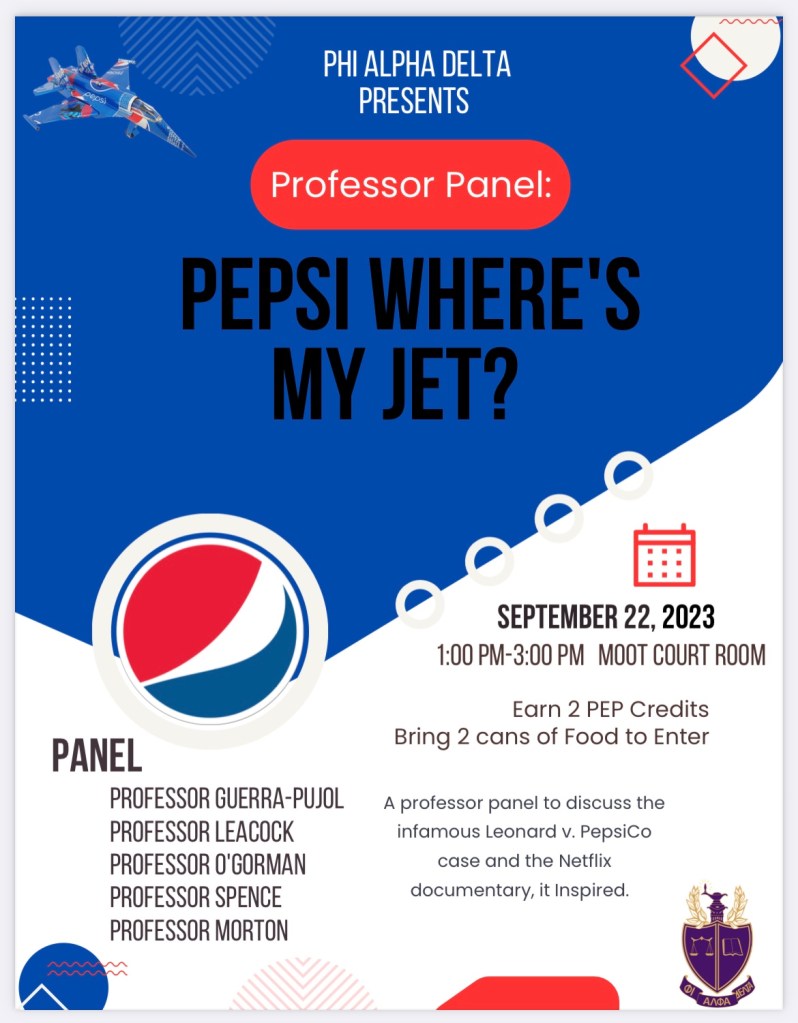
My previous post mentioned that I would be speaking on the Pepsi Points case on the afternoon of 22 September. (Thanks to Professor Dan O’Gorman and 3L Joshua J. Floth for the invite.) Among other things, my presentation (see also my slide deck below) highlighted three procedural aspects of the case:
To begin with, the court found itself in a procedural paradox or choice-of-law Catch-22: “The choice of law question [i.e. whether to apply New York state law or Washington state law] cannot … be resolved until after the Court determines whether the [Pepsi] commercial was an offer or not.” See Leonard v. Pepsico, 88 F.Supp.2d 116 (S.D.N.Y. 1999), at p. 122. But to determine whether the Pepsi ad is a legally-enforceable reward offer or just mere puffing, don’t we need to know which State’s law to apply? (P.S.: Remember Erie v. Tompkins R.R.? There is supposed to be no federal common law! See slide #2 below.)
It took the court over three years to figure out that the Pepsi ad was just a bad joke: “The present motion thus follows three years of jurisdictional and procedural wrangling.” See 88 F.Supp.2d, at p. 121. (For my part, I have proposed a simplified Turing-like legal procedure to speed up civil litigation. See F. E. Guerra-Pujol, The Turing Test and the Legal Process, Information & Communications Technology Law, Vol. 21, No. 2 (2012), pp. 113-126, available here. See slide #3 below.)
But by far the worst aspect of the Pepsi Points case is that the court cavalierly invaded the province of the jury: “A reasonable viewer would understand such advertisements as mere puffery, not as statements of fact, see, e.g., Hubbard v. General Motors Corp. … (advertisement describing automobile as ‘Like a Rock,’ was mere puffery, not a warranty of quality).” See 88 F.Supp.2d, at p. 128. Alas, putting aside the fact that the case cited by the court (Hubbard v. General Motors) is totally irrelevant to the Pepsi case (in Hubbard the dispute was over product quality), the bottom line is that a jury should have decided what a “reasonable viewer” would have thought because “reasonableness” presents a question of fact for the trier of fact (i.e. the jury) to weigh the evidence and judge the credibility of the witnesses. (See slide #4 below.)
I then concluded my talk with three additional observations:
It’s perfectly legal to buy and sell military jets. (See this FAA circular from 1996, for example, as well as slide #5 below.)
When this case was decided in August of 1996, Pepsico’s market capitalization was over $21 Billion (see here); a Harrier jet, by comparison, cost a mere $23 Million, or 0.00106% of Pepsi’s market cap. (See slides #6 & #7 below.)
Lastly, shouldn’t food and beverage companies owe a fiduciary duty to their consumers and to the public, especially when their ad campaigns are directed to young people? (There is no slide to illustrate this last point because this fiduciary-duty idea popped into my head just a few minutes before the panel was set to begin.)
Have you seen the four-part Netflix documentaryPepsi, Where’s My Jet? If you love this modern-day David versus Goliath story as much as I do and are in the Orlando area this weekend, I will be speaking on the Pepsi Points case at the Dwayne O. Andreas Law School on Friday afternoon. Details below:
A few days ago, Sidney “Release the Kraken” Powell filed a “general demurrer and motion to dismiss” in the epic Georgia election racketeering case. (Along with former president Trump and others, Ms Powell is charged with conspiracy to commit election fraud, conspiracy to commit computer theft, trespass, and invasion of privacy.) Among other things, a footnote in her motion mentions that she lost her TSA PreCheck status because of the criminal allegations against her, so she now has to wait in Soviet-style screening lines at the airport like the rest of us.
Alas, as tempting as it is to roast Ms Powell for losing her PreCheck status (see here), let’s not lose sight of the larger issue: How unamerican it is to lose a public benefit without being convicted of anythingyet! Or in the words of travel blogger Gary Leff: “There is no judicial review. If you antagonize someone at the Department of Justice or Department of Homeland Security, they can punish you completely outside of the rule of law.”
Hello again friends! I am reblogging the post below (via Remember Singapore), which surveys the history of one of Singapore’s oldest bridges and includes some old maps of the “orh kio tau” area of the Southeast Asian city-state.
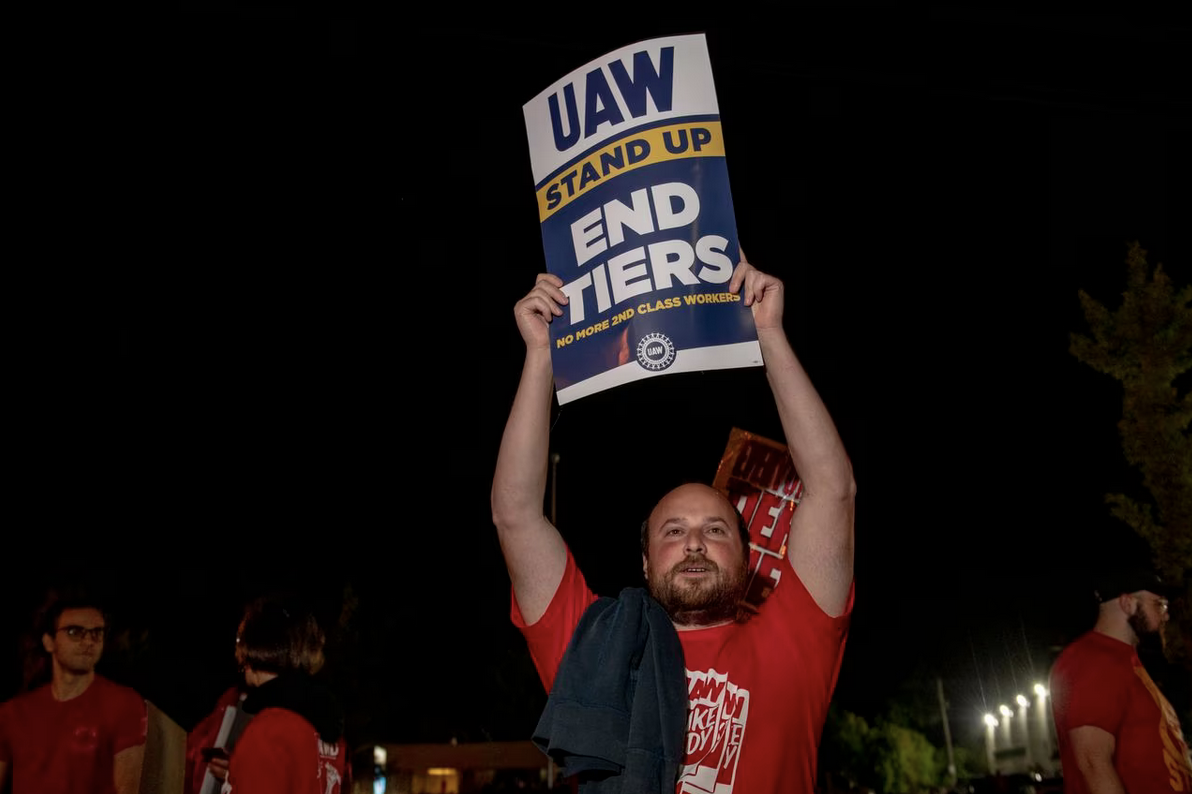
You may have heard that the United Auto Workers (UAW), one of the largest labor unions in North America, is now on strike (see here or here, for example). What, however, you may not know is that among the union’s demands is a call for no more “tiered labor contracts” in their industry. To this end the UAW has even approved the following strongly-worded resolution:
“The union shall reject management proposals for contract language which seek to divide the membership through tiered wages, benefits, or post-employment income and benefits. Where current contracts provide for such divisive compensation, it shall be the obligation of the International Executive Board to seek the elimination of all such tiers by raising lower tiers to the higher level, holding to the long-standing union principle of ‘equal pay for equal work.”
Is this demand a reasonable one? By way of analogy, why don’t the tenured faculty members at our esteemed institutions of higher educations — which are supposedly bastions of progressive and “Marxian” academics, especially in the humanities — demand the end of “tiered contracts” in Academia, e.g. adjuncts, lecturers, instructors, etc.? In the meantime (but don’t hold your breath), check out the following links regarding some other sundry academic “scams”:















 prior probability