*The Other 9/11*

Today (11 Sept.) is the 50-year anniversary of the 1973 Chilean coup d’état. What led up to the coup, and what lessons can we learn from it today? In the English language, here is a short report from the Office of the Historian of the U.S. Department of State, and here, by contrast, is a much longer report from Allan Woods, a British political theorist.

Posted in Uncategorized | Leave a comment

Questions for Baude and Paulsen

In their massive 126-page law review article (see here), William Baude and Michael Stokes Paulsen claim that former president Donald J. Trump is automatically disqualified from holding federal office under 14th Amendment’s Disqualification Clause (Amend. XIV, § 3). I already wrote up a formal reply to their article explaining why disqualification cannot be automatic or self-executing. Here, however, I will compare and contrast the various provisions in the Constitution that refer to insurrections or rebellions and then pose some questions directly to Baude and Paulsen.

For starters, aside from Sections 3 and 4 of the 14th Amendment of 1868, where else does the U.S. Constitution refer to rebellions or other serious domestic strife? As it happens, the Constitution makes only two references–one direct; the other indirect–to insurrections, invasions, and the like. A direct mention appears in the Habeas Corpus Clause of the Constitution (Art. I, § 9, cl. 2), which uses the actual words “Rebellion or Invasion”. (For the record, the Habeas Corpus clause states: “The Privilege of the Writ of Habeas Corpus shall not be suspended, unless when in Cases of Rebellion or Invasion the public Safety may require it.”) The indirect reference, by contrast, appears in the Guarantee Clause of the Constitution (Art IV, § 4), which refers more broadly to “domestic Violence” as well as invasions. (For its part, the Guarantee Clause states: “The United States shall guarantee to every State in this Union a Republican Form of Government, and shall protect each of them against Invasion; and on Application of the Legislature, or of the Executive (when the Legislature cannot be convened) against domestic Violence.”)

Broadly speaking, both of these constitutional provisions anticipate the possibility of a state of emergency, such as a full-scale rebellion by a domestic group or an invasion/sneak attack by a foreign force. One provision (Article I, § 9) contemplates the curtailment of procedural rights during the emergency situation, while the other (Article IV, § 4) appears to allow for the use of military force and martial law. Alas, both of these provisions raise many more questions than they answer. Who decides what constitutes an emergency? The Congress, the president, or the courts? What other common law or judicial rights, in addition to habeas corpus, can be suspended during the emergency? (If habeas corpus can be suspended, for example, what about due process?) And last but not least, can governmental actions under either constitutional provision be challenged in a court of law, or are such actions “non justiciable” political questions beyond the scope of judicial review? (See, for example, the leading Guarantee Clause case of Luther v. Borden.)

For my part, I will not attempt to address these thorny questions here. Instead, I just want to point out that many of these same questions apply to the 14th Amendment’s Disqualification Clause. In brief, the Disqualification Clause can be used to disqualify a candidate from federal office when two conditions are met: 1st, the candidate must be someone who has “previously taken an oath, as a member of Congress, or as an officer of the United States, or as a member of any State legislature, or as an executive or judicial officer of any State, to support the Constitution of the United States,” and 2nd, the candidate must “have engaged in insurrection or rebellion against the [United States], or given aid or comfort to the enemies thereof.” But who decides, for example, who is an “officer of the United States” under Section 3 of the 14th Amendment, and who decides what forms of violence rise to the level of an “insurrection or rebellion”?

For now, I will conclude this post with the following observation: the Disqualification Clause refers only to internal insurrections and rebellions–not to foreign-led invasions or mere cases of “domestic Violence” more generally. This observation, in turn, generates several more key questions. First off, why does the Disqualification Clause omit the words “domestic Violence” from its scope? Was this omission a deliberate one? Either way, where should we draw the line between a full-scale insurrection/rebellion and an isolated case of “domestic Violence”? I await Baude and Paulsen’s reply …

Posted in Uncategorized | 3 Comments

Sunday song: a melancholic remix of *Loving You*

To Sydjia …

Posted in Uncategorized | 2 Comments

Star Trek Saturday

I am late to the party, but yesterday (8 Sept.) was “Star Trek Day“!

Posted in Uncategorized | 2 Comments

Domestic Constitutional Violence and the Disqualification Clause: A Preview

Yesterday, I posted to SSRN a formal reply (see here) to a forthcoming paper by William Baude and Michael Stokes Paulsen, a pair of legal scholars who claim that the Disqualification Clause set forth in Section 3 of the 14th Amendment automatically disqualifies former president Trump from holding federal office for giving aid and comfort to the enemies of the USA.

As it happens, five years ago this month (28 September 2018, to be more precise) I presented a paper of mine on “Domestic Constitutional Violence” (DCV) at the University of Arkansas in Little Rock. In summary, my DCV paper, which is available here or here, explores what I call “the laws of constitutional necessity”, i.e. the constitutional and statutory powers of the president to use military force to quell insurrections and rebellions within the United States. (It is also a federal crime to engage in a rebellion or insurrection; see the video below or Section 2383 of Volume 18 of the U.S. Code, 18 U.S.C. § 2383.)

In other words, a possible connection exists between the laws of constitutional necessity and the Disqualification Clause, which prohibits certain people who have engaged in an insurrection or rebellion from holding any federal office. Stay tuned, for I will further explore this connection next week …

Posted in Uncategorized | Leave a comment

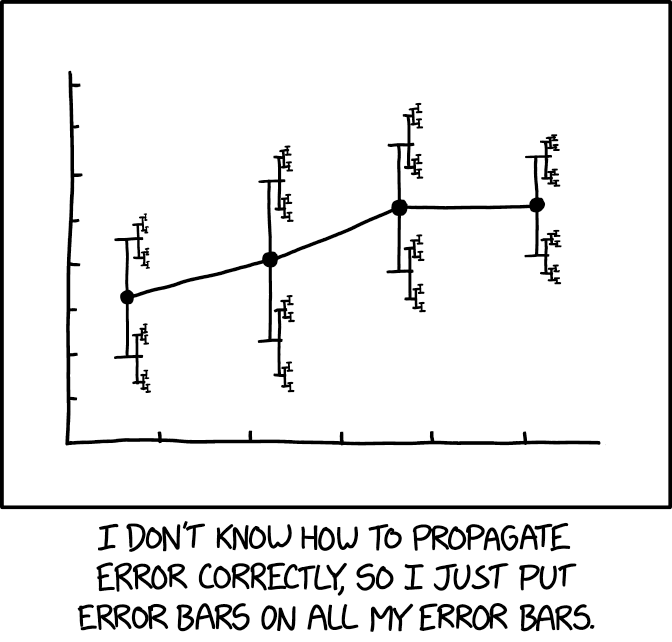
Friday funnies: fractal error bars

Cartoon credit: xkcd/2110

Posted in Uncategorized | 2 Comments

Reply to Baude & Paulsen’s disqualification article

Is former president Donald J. Trump automatically disqualified from holding any federal office under Section 3 of the 14th Amendment? I wrote up a short but formal academic reply to Professors Michael Stokes Paulsen and William Baude (pictured below) and posted it here (via SSRN).

Posted in Uncategorized | Leave a comment

New disqualification clause lawsuit

Update (7 September): Although a federal judge in South Florida ruled last week that private parties lack “standing” to enforce the 14th Amendment’s disqualification clause (a case I blogged about the other day; see below), another cohort of progressive plaintiffs — this one in Colorado — has now filed a 105-page complaint in a local court (not federal) in Denver demanding that Trump be kept off the ballot in their home State. Here is a copy of their complaint. Will this new case be dismissed for lack of standing like the Florida case was? Either way, I will be following the Colorado case closely and will report back as soon as any new developments occur.

Posted in Uncategorized | Leave a comment

Data journalist Jon Keegan scraped the DMV websites of all 50 States and discovered over 8,200 different license plates you might see on the road

See here; hat tip: Kottke.

Posted in Uncategorized | Leave a comment

Taking the *con* out of constitutional law: yes, even Donald Trump is entitled to due process

Alternate Title: Critique of Baude & Paulsen (2023), Part 3

As you may have heard by now (see here, for example), multiple efforts are afoot in various States to disqualify Donald Trump from the ballot box under the disqualification clause of the 14th Amendment. This dangerous and misguided movement has been bolstered by a 126-page law review article (see here), which mistakenly claims, among other things, that the disqualification clause is “self-executing” and that due process rights are somehow inapplicable to disqualification cases. For my part, I have already debunked the completely bogus “self-execution” argument here and here. Today, by contrast, I will explain why due process of law is never optional and why the disqualification clause cannot be self-executing without violating the right to due process. Simply put, before someone can be disqualified from running for federal office, that someone (even Mr Trump) is entitled to a fair hearing before a regular court of law.

Recall what the disqualification clause does: it disqualifies from federal office anyone “who, having previously taken an oath, as a member of Congress, or as an officer of the United States, or as a member of any State legislature, or as an executive or judicial officer of any State, to support the Constitution of the United States, shall have engaged in insurrection or rebellion against the same, or given aid or comfort to the enemies thereof.” In other words, this provision poses several novel questions of law and fact, and these questions must at some point be adjudicated by a regular court of law. Among these novel legal questions are:

  1. Is the president an “officer of the United States”?
  2. What state of affairs constitutes an “insurrection or rebellion”?
  3. Who decides who the “enemies” of the United States are?
  4. And what constitutes the giving of “aid or comfort” to those enemies?

In addition to these questions of law, a court would also have to apply the law to the facts. But what are the facts? In the case of Trump, a court would have to decide whether the riot at the U.S. Capitol on January 6, 2021 constituted an insurrection or rebellion and whether any of the former president’s actions or omissions on that fateful day could be construed as giving aid or comfort to the enemies of democracy under the 14th Amendment.

Frankly, a strong case can be that Trump deserves to be disqualified for his provocative tweets on J-6 or for his extended “radio-silence” on that fateful day, when he refused to address the nation until after the riot was over. But the point I am trying to make here is that it does not matter what I think — or what pundits like William Baude or Larry Tribe think — about J-6. What matters here is what the courts decide, and a court cannot decide these questions of law and fact without complying with the rudiments of due process, i.e. without at a minimum giving Trump a fair hearing.

Suffice it to say, due process is not some minor detail that we can dispense with whenever we don’t like a person or his alleged actions, no matter how heinous or evil. Why not? Because due process is the bedrock of our Anglo-American legal system. Period, full stop. Even the Nazi war criminals were entitled to due process during the Nuremberg trials.

Posted in Uncategorized | 4 Comments