At the end of my previous post, I mentioned that I had just finished reading Travels with Tocqueville by Jeremy Jennings. Before I had read Professor Jennings’s intellectual biography of Alexis de Tocqueville (1805–1859), I did not know much about the life or work of this 19th-century French aristocrat beyond his great treatise Democracy in America, which is available here via Project Gutenberg. I knew about this book in particular because I had attended many political philosophy and constitutional law lectures in college and law school, and many of my professors would show off their erudition by quoting often from Democracy in America. (In fact, de Tocqueville’s classic work is to this day still considered to be one of the best-ever books written on democracy, if not the best-ever written on North America.)
But what I did not know is that the United States was not the only place de Tocqueville visited or wrote about. He also visited many other places for prolonged periods of time, including Algeria (twice), England (twice), Germany, Ireland, Italy, and Switzerland, and during each of these extended visits de Tocqueville kept extensive notes of the people he met and the things he learned. I also did not know that de Tocqueville did not travel alone when he visited the United States. He was accompanied by his best friend and trusted companion Gustave de Beaumont, who is deserving of his own biography. (Among other things, Beaumont wrote a fascinating romance novel about a forbidden love affair between an idealistic young Frenchman and an apparently white American woman with African ancestry: Marie, or Slavery in the United States, which is available here (in French).)
So, how can I describe in just a few words all the things I learned from Jennings’s beautiful biography about de Tocqueville’s short life and his various voyages? One of the things I loved the most about de Tocqueville was the meticulous research he would undertake before embarking on a journey, especially his willingness to learn the language of the countries he was about to visit, but I will sum up my admiration of this remarkable French nomad by sharing my favorite de Tocqueville quote, which appears on page 234 of Travels with Tocqueville: “It is a mistake to suppose that events stay in the memory simply because of their importance or greatness: it is more often the little things that make a deep impression on the mind and stay in memory.”
Last Friday (1 Sept. 2023), a federal judge in South Florida decided that she lacks “subject matter jurisdiction” (i.e. judicial power) to decide whether Donald J. Trump is disqualified from running for president under the disqualification clause of the 14th Amendment because the plaintiffs supposedly lack “standing” to sue. (FYI: here is the court’s ruling.) But isn’t it the duty of the courts to say what the law is? Alas, the standing doctrine has become a veritable shitshow: courts have historically applied this controversial doctrine in a selective and inconsistent fashion. Be that as it may, the nationwide effort by some shadowy progressive groups to keep the former president off the ballot (see here, for example) continues to receive a lot of media attention; below are just a few of the most recent prominent examples I could find:
This report from today (5 September) by Maegan Vazquez (via the Washington Post).
Another report from yesterday (4 Sept.) by Houston Keene (via Fox News).
And this report from Thursday (31 August) by Nicholas Riccardi (via the Associated Press).
So, will the metaphorical “Trump Train” even be able to leave the station? As it happens, I have been blogging about this fascinating topic since the end of last month (see here, here, and here), but I still have much more to say. Among other things, I want to explain why it must be a regular court of law or a duly-elected legislature that gets to decide whether Trump is disqualified from running for federal office. Stay tuned! I will resume my analysis of the disqualification clause in the next day or two.
PS: I also just finished reading Travels with Tocqueville this weekend and will have a few things to say about this beautiful book soon.
Via Thomas Kole, check out this reconstruction of Tenochtitlan, the awe-inspiring island-metropolis of the Aztecs: “The year is 1518. Mexico-Tenochtitlan, once an unassuming settlement in the middle of Lake Texcoco, now a bustling metropolis. It is the capital of an empire ruling over, and receiving tribute from, more than 5 million people. Tenochtitlan is home to 200.000 farmers, artisans, merchants, soldiers, priests and aristocrats. At this time, it is one of the largest cities in the world.” If I could borrow a time machine, this is the first place I would visit! Hat tip: Marginal Revolution.
I floated this idea once before: instead of celebrating just one measly day in honor of the working man, why can’t the most properous country in the world give all her workers two full weeks of paid time-off, say between Juneteenth and the Fourth of July? If necessary, we could move Columbus Day, Memorial Day, Veterans Day, and/or MLK Day into that two-week window from 19 June to 4 July to ameliorate the financial consequences of my modest proposal. Is that too much to ask?
I am sharing this particular video of Jimmy Buffet performing one of his lesser-known ballads because the first part of this film clip shows the legendary artist explaining the colorful origins of his tropical-rock composition “Cuban Crime of Passion”.
Alternate Title: Critique of Baude & Paulsen (2023), Part 2
My previous two posts have featured a forthcoming law review article titled “The Sweep and Force of Section Three” by my conlaw colleagues William Baude and Michael Stokes Paulsen (pictured below). Among other things, Professors Baude and Paulsen not only claim that the disqualification clause in Section 3 of the 14th Amendment is “self-executing”, or in plain English: former president Donald J. Trump can be automatically prohibited from holding any federal office for his role in instigating the riot at the United States Capitol on January 6, 2021. They also further claim that the disqualification clause somehow “supersedes” or trumps (pun intended!) the fundmental right to due process.
Their “self-execution” argument, however, looks more like a red herring than a serious scholarly point: an intellectually dishonest rhetorical ploy designed to fool the public and the media. Why? Because Baude and Paulsen themselves readily concede that the actual application of the disqualification clause would not — and in fact could not — really be self-executing. (See especially Part II.B of their paper, or pp. 22-34.) To the point: before Trump can be disqualified from running for president, someone somewhere must first determine whether he “engaged in insurrection or rebellion” against the United States or gave “aid or comfort” to her enemies, i.e. whether Trump’s efforts to overturn the 2020 presidential election or his connection to the J-6 riot meets either of the two alternative conditions that trigger disqualification under the 14th Amendment.
For their part, Baude and Paulsen claim that the disqualification clause empowers “state or local election boards” (p. 23) to unilaterally or sua sponte to exclude Trump off their ballots. It is true that state or local election officials have to initially decide whether a declared candidate is eligible to run for federal office, but my point in reply is this. In making this threshold ruling, the potential disqualification of a disputed candidate — even the terrible Trump — would never be a foregone conclusion, since local election officials would first have to determine whether the disputed candidate is or was a rebel or gave comfort to the enemy. In Trump’s case, for example, reasonable men can disagree whether J-6 was a riot or a rebellion.
Either way, this initial determination by local election officials would not be final, for as Baude and Paulsen also concede, however grudgingly or reluctantly, an adverse or negative decision by local officials regarding a candidate’s eligibility for office would most likely be subject to judicial review by a regular court of law, or in their own words: “such determinations about ballot eligibility may also be subject to further judicial review” (p. 24, emphasis added). Alas, Baude and Paulsen are like two poker-players with a non-verbal but information-revealing cue or “tell”. The very fact that they so grudgingly and reluctantly concede the possibility of judicial review of the disqualification clause itself shows us just how disingenuous and politically-motivated their “self-execution” argument really is.
Worse yet, Baude and Paulsen’s “self-execution” argument is not only patently wrong on its face; it also poses an unprecedented level of peril in these trying times, for in their zeal to weaponize the Constitution to keep former president Trump off the ballot, these two law professors, as well as other legal academics, are playing a very volatile and dangerous game — one that is antithetical to the most bedrock principle of our Anglo-American common law and constitutional traditions: due process of law, a concept that can be traced back to the Magna Carta of 1215 A.D. By way of example, buried deep in the inner bowels of their massive 126-page paper (see especially pp. 56-57), Professors Baude and Paulsen dismiss due process altogether, devoting just a few pithy paragraphs to this fundamental rule-of-law principle, where they simply assert that the domain of due process does not extend to election law or disputes over the disqualification clause. This dangerous claim is not only flat-out wrong; it begs the critical question, Why does due process apply only to civil and criminal cases and not to contested elections?
For now, I will conclude my critique with the eloquent slogan of the Carter Center, a progressive organization that was founded by Jimmy and Rosalynn Carter: “Every citizen has the right to be elected“. Of course, no constitutional or legal right is absolute, but at the very least candidates who are excluded from the electoral process are at some point entitled to due process of law — i.e. adequate notice and a fair hearing before a neutral arbiter — and the disqualification clause does not and cannot override these bedrock common law/constitutional principles. Elite intellectuals might be willing to sacrifice due process today in order to deny the detested Trump the ability to run for office tomorrow. I, for one, am not.
Note: I am going to take a couple of days off to watch some college football, catch up on my other readings, and enjoy the holiday weekend, but when I return to Baude and Paulsen’s Trumpian paper on Tuesday, I will further explain why due process is non-negotiable, even in the domain of the disqualification clause.
Alternate Title: Critique of Baude & Paulsen (2023), Part 1
By way of background, my colleagues William Baude and Michael Stokes Paulsen recently posted to SSRN a 126-page law review article titled “The Sweep and Force of Section Three”. Among other things, Professors Baude and Paulsen claim that the disqualification clause in Section 3 of the 14th Amendment is “self-executing”, so that former president Donald J. Trump and others involved in the infamous January 6 fiasco are automatically prohibited from holding any federal office.
Alas, the meat and potatoes of their self-execution argument boils down to two false analogies. One is to the bright-line “age, citizenship, and residency” requirements set forth in the qualification clause in Article II, Section 1 of the Constitution. (This particular parallel is off the mark because it is presumably way easier to produce a certified birth certificate than to adjudicate whether the events of J-6 rose to the level of an insurrection or rebellion.) The other faulty comparison they make is to the 13th Amendment, which categorically declares the demise of slavery in the United States. (Again, this is a false analogy because the existence of the antebellum institution of slavery and the existence of a rebellion or insurrection are two different matters.)
In short, Professors Baude and Paulsen want you to believe that the Disqualification Clause in Section 3 of the 14th Amendment operates in the same way that the age, citizenship, and residency requirements in Article II do and in the same way that the 13th Amendment’s anti-slavery declaration does (i.e. automatically or ex proprio vigore), but both of these constitutional analogies are fundamentally flawed. Why? Because Baude and Paulsen commit the “level of generality” fallacy: i.e. comparing apples to oranges. Yes, at a high enough level of generality, it is true that both apples and oranges are pieces of fruit that taste sweet, but when you actually inspect or bite into them you soon see that apples are, in fact, quite different from oranges! (As an aside, this is a problem that bedevils most forms of Originalist scholarship; see here, for example.)
Likewise, although the set of constitutional provisions cited by Baude and Paulsen — i.e. the 14th Amendment’s disqualification clause; the age, citizenship, and residency requirements in Article II; and the 13th Amendment — all share a similar linguistic structure to some degree (e.g. “no person shall …” or “slavery … shall not exist”), all three of these provisions are substantively different; they attempt to solve different problems in different ways. Simply put, it is one thing to declare the end of slavery in the United States, which is literally what the 13th Amendment does, and quite another to impose qualifications for holding federal office, which is what the age, citizenship, and residency requirements in Article II do.
The Disqualification Clause, by contrast, operates “on top of” the bright-line age, citizenship, and residency requirements of Article II. That is, even if you are a natural-born U.S. citizen and are over 35 years of age and have resided in the U.S. for 14 years, you can still be disqualified from running for president if you participated in an insurrection against the United States or supported her enemies, but (and this is the most important point of this post) who gets to decide your age and citizenship status or whether you are a rebel or someone who has aided and abetted insurrectionists, and what procedures must this fact finder follow when making these determinations?
In other words, even if these analogies were not faulty, none of the substantive constitutional provisions invoked by Baude and Paulsen (Article II, Section 1; the 13th Amendment; and Section 3 of the 14th Amendment) could ever be automatic or self-executing in actual practice. As I shall readily explain in my next post, even the ban on slavery and the bright-line age, citizenship, and residency requirements must all be enforced by the government in one way or another, and those enforcement actions are always subject to judicial review and to the requirements of due process.
I took advantage of yesterday’s tropical cyclone (see my previous post) to finish reading some of the items on my end-of-summer reading list, including a 126-page law review article on “The Sweep and Force of Section Three” co-authored by my conlaw colleagues William Baude and Michael Stokes Paulsen.
The tweet version of their paper is that the disqualification clause in Section 3 of the 14th Amendment is a “self-executing” provision, so that former president Trump — and presumably his past and present allies as well — is/are automatically prohibited from holding any federal office. Alas, now that I have read their forthcoming article in full for myself, I can safely say that most of their legal, historical, and textual claims are not only wrong — full of gaping logical holes and self-refuting internal contradictions — I can also confirm how dangerous and ill-advised their “self-execution” argument is. It would mean, for example, that Trump’s slate of presidential electors (assuming he wins his party’s nomination next year) should refuse to cast their ballots for him even in those States where Trump is the victor. Crazy, right?
Given the massive amount of national media attention that Baude and Paulsen’s work is receiving (see here, for example), as a public service I have decided to write up a point-by-point critique/rebuttal of their paper, starting tomorrow. In the meantime, feel free to check out my takedown of another pair of anti-Trump legal agitators, which I am reblogging below.
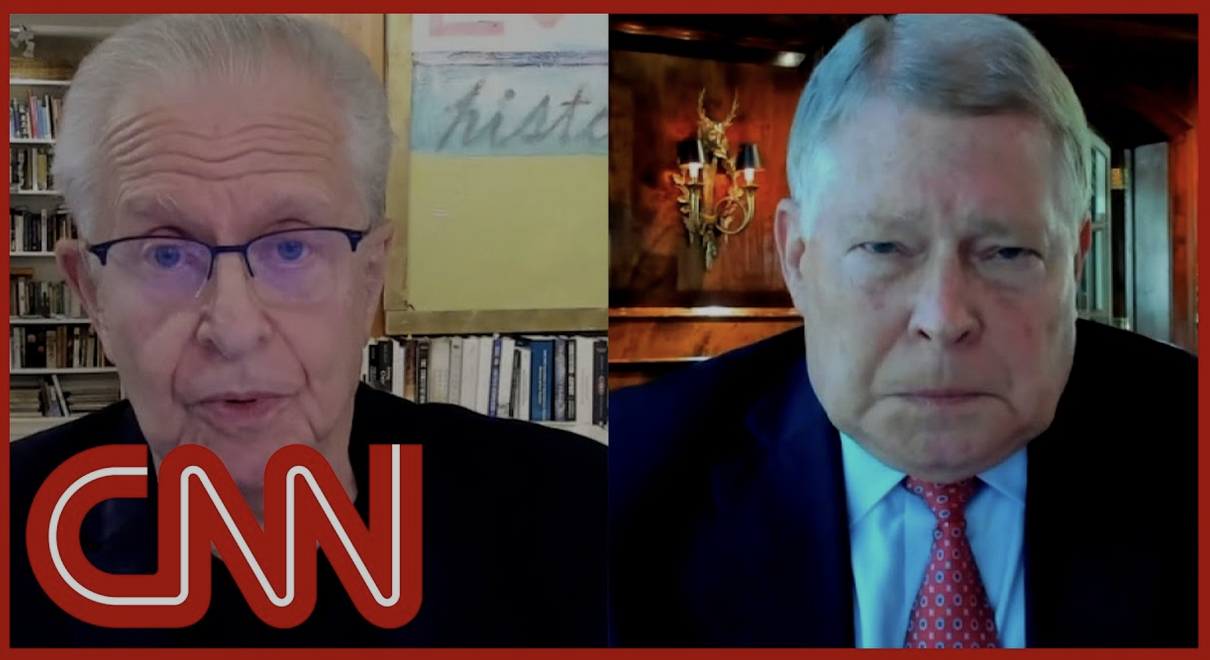
As I mentioned in my previous post, Judge Michael Luttig and Professor Larry Tribe (who are pictured below) recently published a polemical essay in The Atlantic concluding that the Constitution prohibits Donald J. Trump from being re-elected president. (By way of background, Section 3 of the 14th Amendment states in no uncertain terms that any person who has “engaged in insurrection or rebellion against the [United States]” or who has “given aid or comfort to the enemies thereof” is disqualified from federal office.) Here, as a public service, I will present a simple and straightforward critique of Judge Luttig and Professor Tribe’s attempted hit job against former president Trump.
In summary, there are two fatal flaws with Luttig and Tribe’s feeble screed. The first one is their bald-face and unsubstantiated claim that the disqualification clause in Section 3 of the 14th Amendment is somehow self-executing, or in the breathtaking words of Mssrs Luttig and Tribe themselves: “the disqualification clause operates independently of any … criminal proceedings and, indeed, also independently of impeachment proceedings and of congressional legislation.” But this conclusion is flat-out wrong. Before Trump or anyone else can be disqualified from any federal office, they must first be found guilty of being “engaged in insurrection or rebellion” against the U.S. (or of giving “aid or comfort” to her enemies) by a regular court of law or by a duly-elected legislature. Like it or not, ladies and gentlemen, we must give Trump due process before we can disqualify him from office.
More importantly, my point above about the non-self-executing nature of the Constitution leads me to the other inescapable problem with Luttig and Tribe’s polemic. Simply put, they beg the $64 question, Who decides what actions (or in the case of Trump, inaction) constitute an “insurrection or rebellion” against the U.S. or the giving of “aid or comfort” to her enemies? (And by the same token, I might add, who decides who the enemies of the U.S. are?) Moreover, just posing the “Who Decides?” question, in turn, tells us precisely why the disqualification clause cannot be self-executing: in the case of Trump, for example, someone has to first determine whether his tweets on January 6th or his phone call to Georgia election officials a few days earlier, etc., rose to the level of an “insurrection or rebellion”–and that “someone” cannot simply consist of hyper-progressive media pundits or biased outlets like The Atlantic, CNN, or The Times. File under (again): Due Process, the most basic constitutional right of all.
So, who decides? For their part, instead of citing a legal precedent or a prior act of Congress, Luttig and Tribe (one a former federal judge; the other a retired Harvard professor) can only muster between them a single source in support of their overly-broad and utterly unprecedented interpretation of the Constitution’s disqualification clause. They cite … wait for it … an obscure non-peer-reviewed article that is over 100 pages long. (No, you cannot make this stuff up!) For the record, the massive law review article cited by Luttig and Tribe was written by my constitutional law colleagues William Baude and Michael Stokes Paulsen and is titled “The Sweep and Force of Section Three.” Alas, in law, especially constitutional law, the quality of an argument and its quantity are independent variables. (If you prefer, here is a synopsis of Baude and Paulson’s erudite 126-page article.) I will therefore turn to Baude and Paulsen’s work in a future post.


















 prior probability