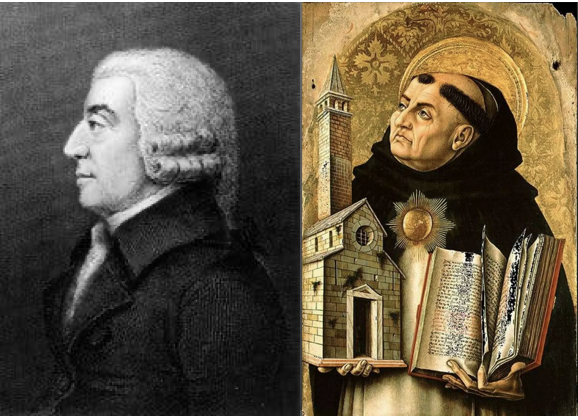
This past week, I have been attending a symposium at the Thomistic Institute in Washington, D.C. The institute is named in honor of St Thomas Aquinas, the great 13th-century philosopher, theologian, and Doctor of the Church, so I could not help but ask myself, What did Adam Smith the moral philosopher learn from Aquinas? My tentative answer is to say not much, since Smith does not even mention Aquinas once in The Theory of Moral Sentiments. Alas, the closest Smith comes to referring to the scholastic tradition of the great Christian thinkers of the medieval period is in Book 7 of The Theory of Moral Sentiments, when Smith derisively describes the ancient Greek Stoic philosopher Chrysippus as the thinker who reduced the doctrines of the Stoics “into a scholastic or technical system of artificial definitions, divisions, and subdivisions; one of the most effectual expedients, perhaps, for extinguishing whatever degree of good sense there may be in any moral or metaphysical doctrine.”
In other words, it looks like Smith has a low opinion of scholasticism as a methodology of reasoning. But at the same time, that can’t be the whole story, for both Aquinas and Smith wrote in the virtue ethics tradition of Aristotle. Smith, for example, extols the virtues of prudence, benevolence, and self-command in Book 6 of his treatise on moral sentiments, while Aquinas identifies four cardinal virtues in his magnum opus, the Summa theologiae: prudence, justice, temperance, and courage. (See Question 61, Article 2 of the Summa, available here via the Thomistic Institute!) So, I suspect we should be able to trace an indirect intellectual path between Aquinas and Adam Smith, something which I shall try to do in the future.
Although I have been indoors for most of this past week attending a symposium, during my free time I have walked through a few of the nearby neighborhoods in our nation’s capital; below are some of the sights I have seen during my strolls:
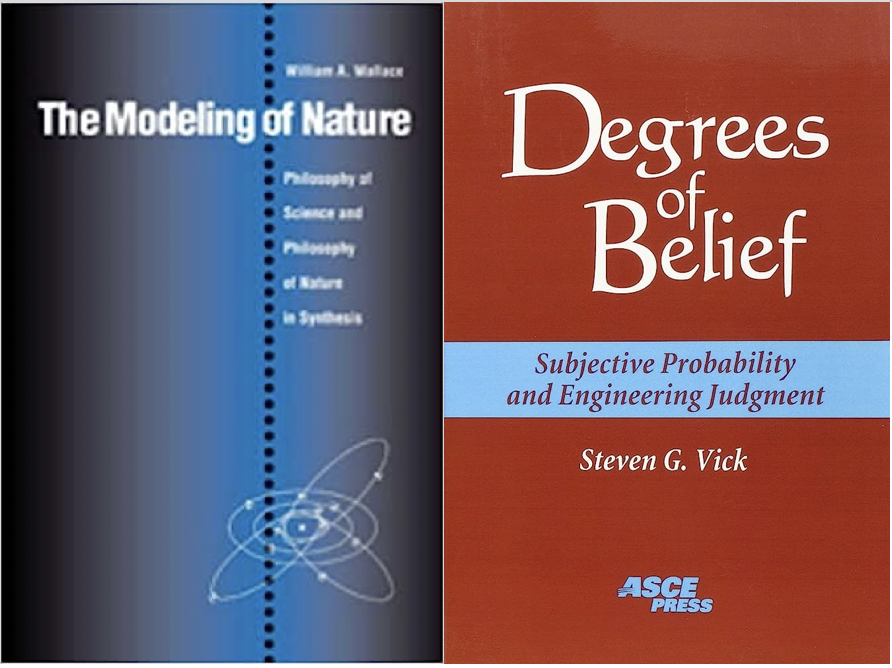
For the 5th Annual Thomistic Philosophy and Natural Science Symposium, which I am now attending in Washington, D.C., I have been reading large chunks of“The Modelling of Nature” by William A. Wallace and “Degrees of Belief” by Steven G. Vick. (The covers of both books are pictured below.)
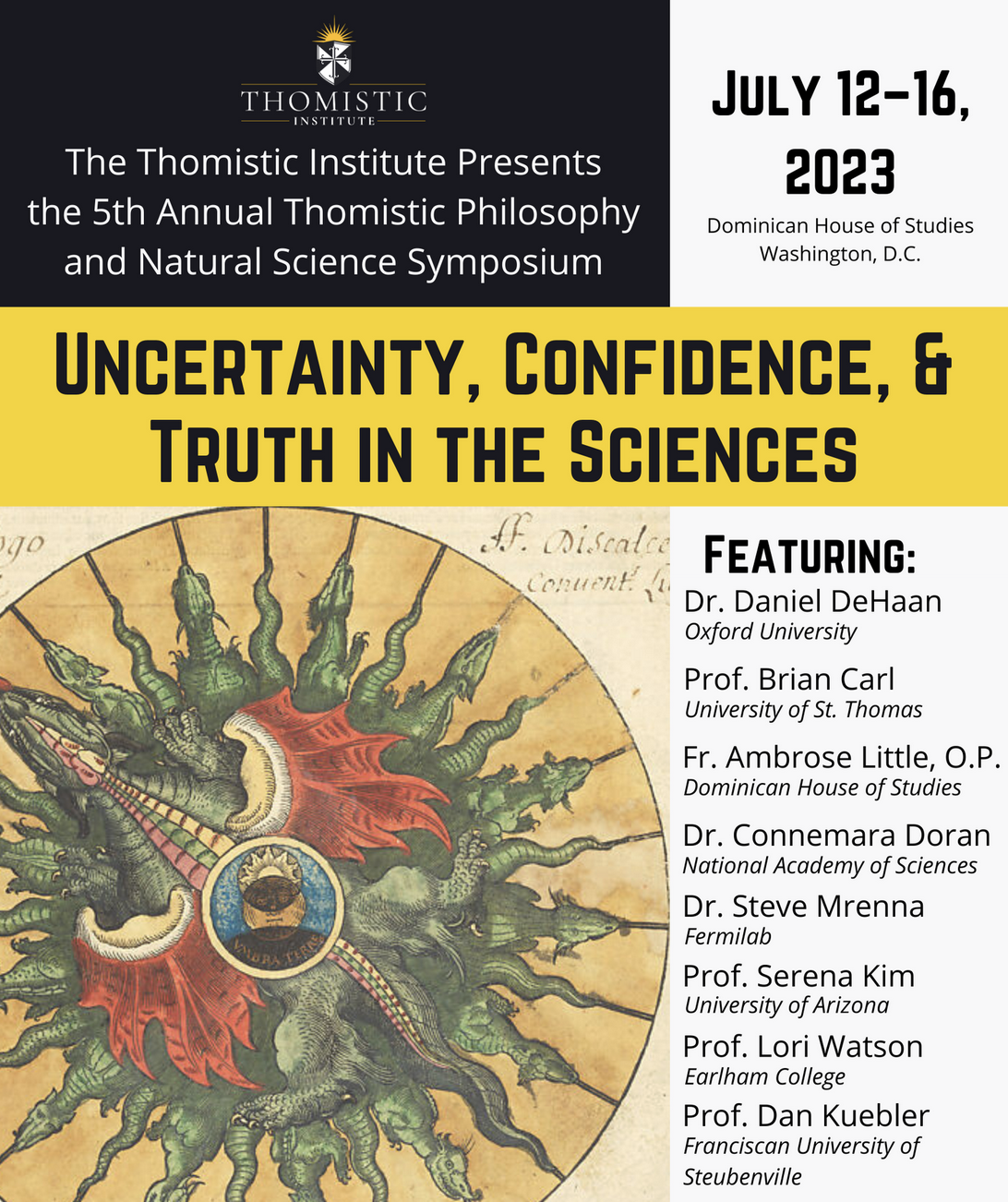
I will be blogging haphazardly, if at all, because I will be taking part in several academic conferences during the remainder of this month, including the 5th Annual Thomistic Philosophy and Natural Science Symposium at the Thomistic Institute in Washington, D.C. The theme of this year’s symposium is “Uncertainty, Confidence, and Truth in the Sciences” (see the Thomistic Institute’s flyer pictured below). For me, “truth” is a probabilistic concept (see, for example, here, here, or here), not an absolute or all-or-nothing one, so I cannot wait to exchange ideas at this symposium.
Update: In anticipation of the upcoming annual meeting of the International Adam Smith Society later this month, I have made further revisions to my work-in-progress “Die Adam Smith Probleme“.
I revised my draft of “Die Adam Smith Probleme” during my train ride from Edinburgh to London, and I have just posted my revised work on SSRN (see here). Among other things, I added two new and related open problems to my growing list of unsolved Adam Smith mysteries. One has to do with Smith’s politics: is Smith really a hardcore libertarian or is he a closet progressive? (Into which quadrant in the diagram below, for example, does Smith best fit?) The other refers to Smith’s concern for the plight of the poor and his views on economic inequality: would Smith be in favor of or opposed to income redistribution?
I forgot to mention that I was finally able to visit Horace Walpole’s summer villa in Twickenham while I was in London last month; below are some snapshots of my visit:
What is the “optimal level” of social science research fraud? Zero, right? Alas, Dr Francesca Gino, a professor at the prestigious Harvard Business School and an “award-winning researcher” whose work focuses on dishonesty and unethical behavior (she is, get this, the author of Rebel Talent: Why It Pays to Break the Rules in Work and Life), has herself been accused of publishing at least four research papers with fake or doctored data. (See here, here, here, and here.) Because she is a professor at Harvard, these data-fabrication allegations have received national and even international media attention.
Shame on Dr Gino, but what about Harvard and her co-authors? Are they victims of Gino’s alleged fraud, or just as guilty as Gino for enabling her deceit, or somewhere in-between? And what about the journals that published her papers? Among these are the Journal of Personality and Social Psychology (see here), Proceedings of the National Academy of Sciences (here), and Psychological Science (here). For my part, I have proposed extending the law of fraud to academic journals. Until courts begin imposing legal liability, both civil and criminal, on authors and journals for publishing fake studies, we can expect many more cases of data fraud in the future.
My previous post featured many of the “favorite Adam Smith quotes” that were just published in the “Smith at 300” symposium issue of the Journal of the History of Economic Thought: Vol. 45, No. 2, June 2023, pp. 179-228. (Alas, this special issue is gated.) Amazingly, however, none of the contributors to the symposium chose Adam Smith’s most famous quote of all, the one that refers to an “invisible hand”. This omission is all the more surprising given how original and important Smith’s invisible hand metaphor is to the world of ideas. (See here and here, for example.)
In fact, this metaphor appears thrice in the works of Adam Smith. The first reference pops up in his early essay on The History of Astronomy, where Smith uses the invisible hand metaphor to compare and contrast the ad hoc explanations of cosmic events of early times: “Fire burns, and water refreshes; heavy bodies descend, and lighter substances fly upwards, by the necessity of their own nature; nor was the invisible hand of Jupiter ever apprehended to be employed in those matters.” (See Adam Smith’s Essays on Philosophical Subjects, Glasgow Edition, p. 49.) Moving on, the next reference appears in Paragraph 10 of Chapter 1 of Part 4 of Smith’s 1759 treatise on ethics The Theory of Moral Sentiments (1759), where Smith uses this metaphor to describe what today is often disparagingly referred to as “trickle-down economics”:
They [wealthy people] consume little more than the poor, and in spite of their natural selfishness and rapacity, though they mean only their own convenience, though the sole end which they propose from the labours of all the thousands whom they employ, be the gratification of their own vain and insatiable desires, they divide with the poor the produce of all their improvements. They are led by an invisible hand to make nearly the same distribution of the necessaries of life, which would have been made, had the earth been divided into equal portions among all its inhabitants, and thus without intending it, without knowing it, advance the interest of the society, and afford means to the multiplication of the species.
The Theory of Moral Sentiments, Glasgow edition, p. 184
But Adam Smith’s most famous reference to “an invisible hand” (and my favorite Smith quote) appears in Paragraph 9 of Chapter 2 of Part 4 of The Wealth of Nations, which is titled “Of restraints upon the importation from foreign countries of such goods as can be produced at home”, and reads as follows:
As every individual … endeavours as much as he can both to employ his capital in the support of domestic industry, and so to direct that industry that its produce may be of the greatest value; every individual necessarily labours to render the annual revenue of the society as great as he can. He generally, indeed, neither intends to promote the public interest, nor knows how much he is promoting it. By preferring the support of domestic to that of foreign industry, he intends only his own security; and by directing that industry in such a manner as its produce may be of the greatest value, he intends only his own gain, and he is in this, as in many other cases, led by an invisible hand to promote an end which was no part of his intention. Nor is it always the worse for the society that it was no part of it. By pursuing his own interest he frequently promotes that of the society more effectually than when he really intends to promote it. I have never known much good done by those who affected to trade for the public good. It is an affectation, indeed, not very common among merchants, and very few words need be employed in dissuading them from it.
The Wealth of Nations, Glasgow edition, pp. 455-456


























 prior probability