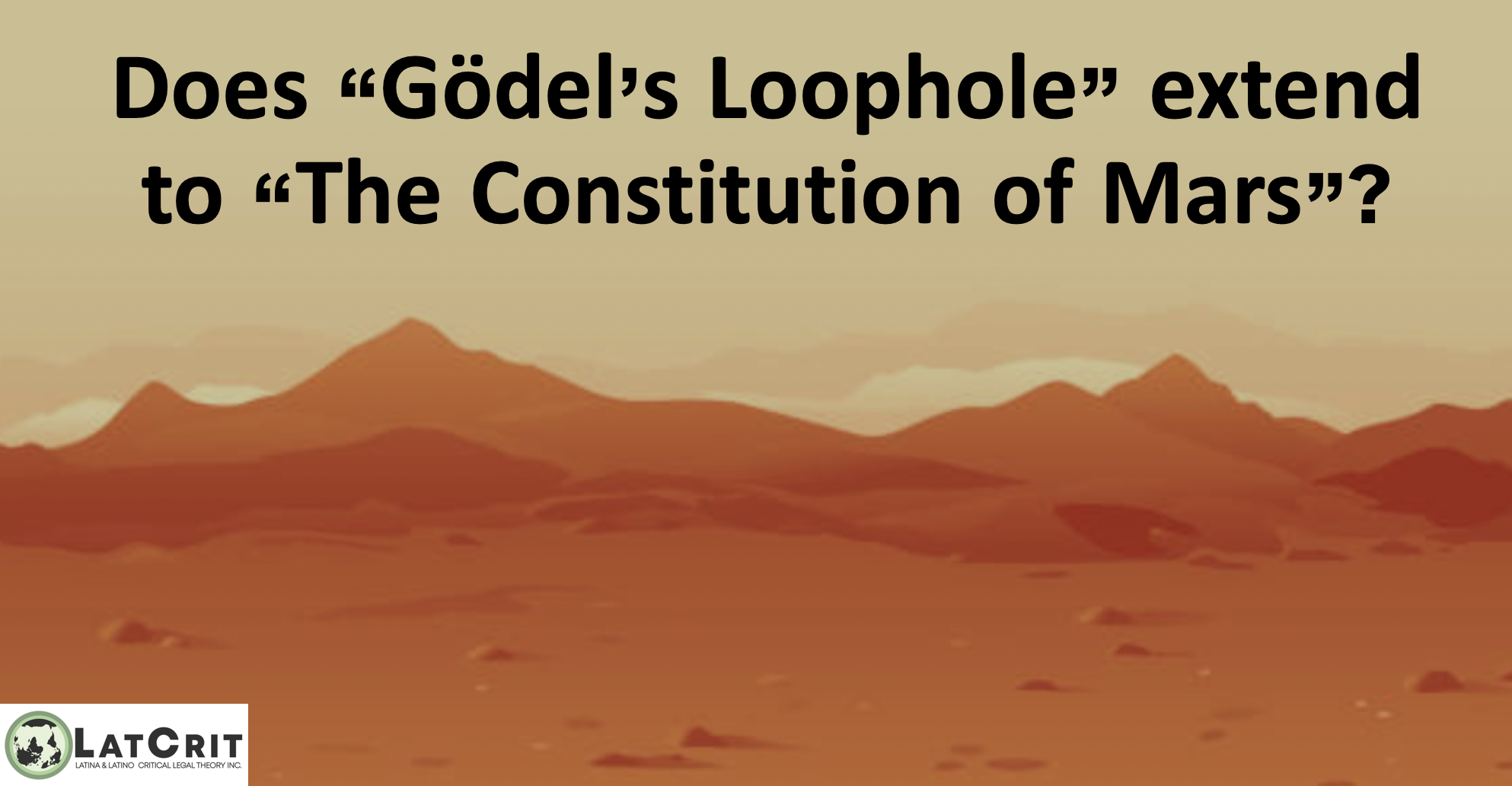
As I mentioned in my previous post, I was invited to present my work on “Outer Space Justice” at the LatCrit 2023 Biennial Conference, which is taking place this weekend. By coincidence, my colleague and new friend Dean Spade gave the Jerome M. Culp Memorial Lecture yesterday (Friday, 6 October), and at the end of his lecture he lamented in passing how some billionaires on Earth are considering creating colonies in outer space in response to ecological threats on Earth. This observation provides the perfect backdrop for my talk on “Outer Space Justice” later today. Although the focus of my talk is narrow and technical (see here, for example), my short slide deck is posted below:
That is the title of the talk I will be giving this weekend at the “LatCrit 2023 Biennial Conference“. (Click here or on the image below for more information about this year’s “LatCrit” conference, which is being hosted by Cornell Law School.) In brief, my talk will be based in large part on my work-in-progress “Gödel’s Loophole 2.0“, where I survey several proposed constitutions for the planet Mars. I will have much more to say about “Outer Space Justice” in my next post, but for now I want to take this opportunity to shout out my fellow LatCrit colleagues for fighting the good fight in so many different ways. Looking back, I attended my first of many LatCrit events in October 2004 (almost 20 years ago!) at my old stomping grounds, the Caribe Hilton, just a few blocks from my residence in the Miramar neighborhood of San Juan, Puerto Rico! At that time, however, I had no inkling of the irresistible gravitational force this diverse and inclusive community of legal and literary lights would exert on my future intellectual development. Among other things, LatCrit is where I first met such inspiring scholars as Cecil Hunt, Tayyab Mahmud, Saru Matambanadzo, Margaret Montoya, and Frank Valdes, all of whom not only ended up being mentors and role models; they also became lifelong friends.
As a follow-up to my previous post, I did some further digging and discovered that the toy cars and dolls used way back in 1914 in a Paris courtroom to re-enact a transit accident–i.e. the miniature model that influenced Wittgenstein’s work, especially his philosophy of language–has itself generated a substantial scholarly literature! In addition to Susan Sterrett’s beautiful paper “Pictures, Models, and Measures” (see my previous post), if you admire the enigmatic Ludwig Wittgenstein (pictured below) as much as I do, below are a few other relevant works in chronological order worth reading:
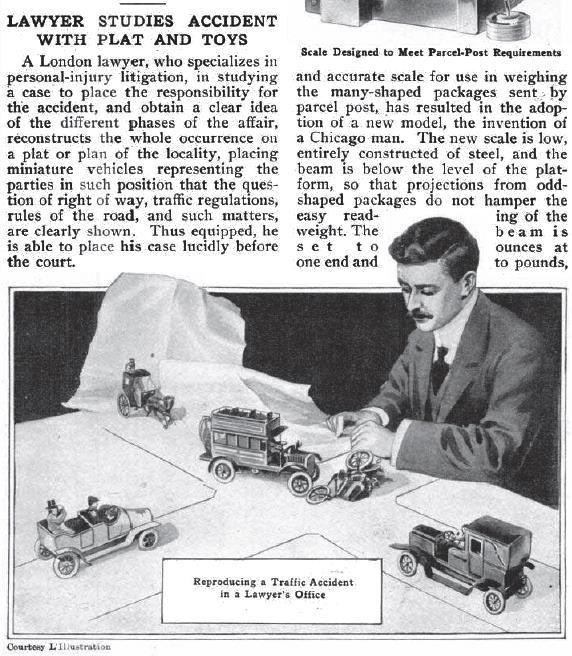
That is the title of this beautiful paper by Susan G. Sterrett, who teaches philosophy of science at Wichita State University. (Although Professor Sterrett presented this paper as early as 2015 at a symposium on “Wittgenstein’s ’Picture Theory’’, it was posted on the Wittgenstein Initiative website a month ago on 5 September 2023.) Along with an extended excerpt from Professor Sterrett’s paper, pictured below is a reproduction of a sketch from her paper showing a lawyer using a model bus and dolls to depict a traffic accident, a sketch that was first published in a 1914 Paris magazine and that may have inspired Wittgenstein’s picture theory of language:
A great many people have written about Wittgenstein’s reading of the use of miniatures in the courtroom. According to von Wright’s memoirs, Wittgenstein mentioned it to many friends on many different occasions (von Wright, n.d. 20 fn 9); no one, so far as I am aware, has ever located the newspaper account or the court case about the traffic accident that occasioned his insight. My concern, however, has been, not that the newspaper account has so far not been located, but that these discussions have not put the use of miniatures in the courtroom in their historical context. The context of the history of science and technology is especially relevant here, for it reveals that there was a time when miniatures were not just toys, but scientific objects. As for the depiction of the use of models of a traffic accident in a magazine, I have, in spite of the expenditure of an inordinate amount of time on fruitless efforts to locate it, finally happened upon something close to it: a magazine account of the use of a miniature car and bus to depict a traffic accident, which was published in 1914. This is consistent with a report that Wittgenstein, much later, spoke of seeing ‘a newspaper notice which said that in Paris at a legal proceeding about a traffic accident, the accident was presented with dolls and a little bus.’ (Klagge 2016) The sketch of the lawyer using the miniatures is credited to a French publication published in Paris (L’Illustration). It is striking that the mention of dolls and a little bus match this illustration, too. I cannot be certain, in the sense historians demand, that it is the same depiction of what happened in the lawcourt or even that it depicts the same accident, but I think it is at least fair to say that the illustration and accompanying text depict the sort of use of miniatures in a courtroom that was a newsworthy practice in 1914.
We already know that Francesca Gino, an award-winning professor at the Harvard Business School, was accused of publishing at least four studies with fake or doctored data; see here. We also know that a few weeks after her alleged research fraud was exposed to the public on a statistics blog called “Data Colada“, Professor Gino sued the authors of the blog for defamation on 2 August 2023. (She also sued Harvard for gender discrimination; see here.) I now have eight significant developments to report in the Francesca Gino case:
For starters, on 18 August 2023, about two weeks after the Gino defamation complaint was filed in court, Larry Lessig, a liberal Harvard law professor who was one of the most vocal champions of “net neutrality” (perhaps the most inane and inconsequential idea of the early 21st century!), published a brief but vigorous defense of his fellow Harvard colleague. (See here.) Among other things, Professor Lessig’s 765-word blog post portrays the Data Colada bloggers as the proverbial “bad guys” and Professor Gino as the hapless but innocent victim of a social media-driven moral panic.
Twelve days later (29 August 2023), Adam Mastroianni posted this scathing critique of experimental psychology’s “cognitive bias craze” on his “Experimental History” blog. What makes Mastroianni’s essay especially worth reading and relevant to the Gino case is that he not only mentions by name Francesca Gino as well as her co-author Dan Ariely, another prominent professor accused of data fraud; he also explains why their entire field (experimental psychology) is most likely worthless bullshit. (In what other field, Mastroianni asks, do six out of 10 studies fail to replicate, while the field’s core research paradigms remain blissfully intact?!)
A few days later (1 September), the Data Colada bloggers posted the first of two updates about the Gino case on their blog (here), thanking the donors to their legal defense fund. (Remember, Professor Gino had sued them for defamation on 2 August.)
Next (16 September), the Data Colada bloggers posted a second more substantive update, where they subject three of the exhibits in Professor Gino’s case to critical scrutiny.
Then, after a brief lull, things start to move fast. For starters, this past Friday (29 September), Professor Gino herself, the embattled professor at the center of this scientific misconduct storm, launched her own website to proclaim her innocence: “I did not commit academic fraud. I did not manipulate data to produce a particular result. I did not falsify data to bolster any result. I did not commit the offense I am accused of. Period“.
The very next day (Saturday, 30 September), The New Yorker published on its website this in-depth essay by Gideon Lewis-Kraus, who surveys the allegations of research fraud against Dan Ariely and Francesca Gino, both of whom are pictured below. (Update: The New Yorker piece also appears in print in its 9 October 2023 edition.)
Also on 30 September, the “Gray Lady,” i.e. the serious and sober-minded New York Times, published a pro-Gino puff piece titled “The Harvard professor and the bloggers” on its website. (The Gino story was also published on the front page of the Business section of this week’s Sunday edition (1 October), under the headline “A dishonesty expert is labeled a liar.”)
Last (for now), Matthew Lilley, a Harvard PhD in economics (i.e. not a mere journalist), dropped this atomic bomb of a blog post today (Wednesday, October 4) tearing apart the arguments put forth by Professor Gino in her defense.
Buckle up your metaphorical seat belts, y’all: it looks like this topsy-turvy ride through the world of pseudo-scientific research (see item #2 above) is going to be wild one!